QUESTION IMAGE
Question
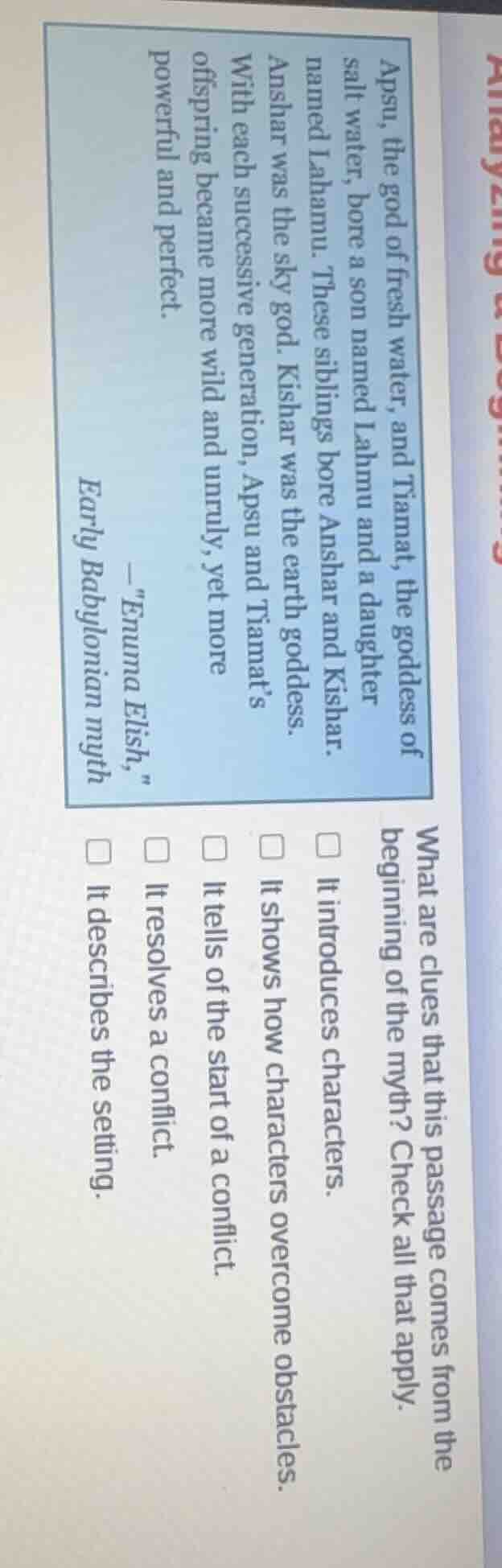
apsu, the god of fresh water, and tiamat, the goddess of salt water, bore a son named lahmu and a daughter named lahamu. these siblings bore anshar and kishar. anshar was the sky god. kishar was the earth goddess. with each successive generation, apsu and tiamats offspring became more wild and unruly, yet more powerful and perfect.
—\enuma elish,\
early babylonian myth
what are clues that this passage comes from the beginning of the myth? check all that apply.
□ it introduces characters.
□ it shows how characters overcome obstacles.
□ it tells of the start of a conflict.
□ it resolves a conflict.
□ it describes the setting.
- The passage introduces deities like Apsu, Tiamat, Lahmu, Lahamu, Anshar, and Kishar, so it introduces characters.
- It establishes the foundational beings (fresh water, salt water, their offspring) that set up the world of the myth, so it describes the setting.
- It states that later generations of offspring became "more wild and unruly," which sets up the core conflict of the Enuma Elish, so it tells of the start of a conflict.
The passage does not show characters overcoming obstacles or resolve a conflict.

Snap & solve any problem in the app
Get step-by-step solutions on Sovi AI
Photo-based solutions with guided steps
Explore more problems and detailed explanations
- It introduces characters.
- It describes the setting.
- It tells of the start of a conflict.