QUESTION IMAGE
Question
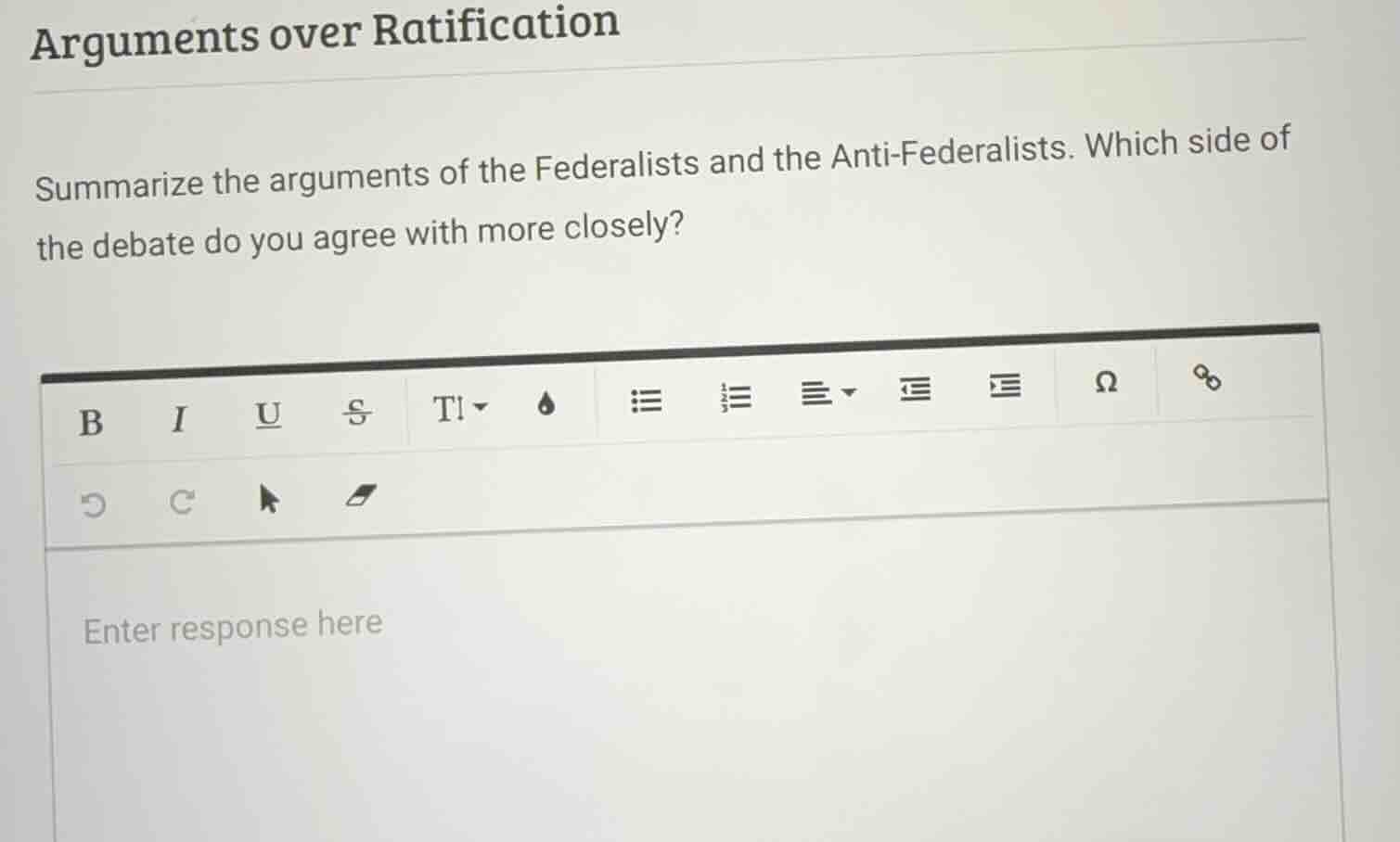
arguments over ratification
summarize the arguments of the federalists and the anti - federalists. which side of
the debate do you agree with more closely?
Federalists' Arguments:
- Support for the Constitution: They believed the Articles of Confederation were too weak, as the central government lacked sufficient power to regulate trade, collect taxes, or maintain order.
- Strong Central Government: Argued for a strong federal government with separated powers (legislative, executive, judicial) to prevent tyranny and ensure national stability.
- Checks and Balances: Emphasized that the system of checks and balances in the Constitution would prevent any one branch from becoming too powerful.
- Broad Interpretation of Powers: Supported the elastic clause (necessary and proper clause) to allow the government to address unforeseen issues.
Anti - Federalists' Arguments:
- Fear of Tyranny: Worried that a strong central government would become tyrannical, similar to British rule, and that the Constitution lacked a Bill of Rights to protect individual liberties.
- Power of the States: Believed in strong state governments, as they were closer to the people and better able to represent local interests.
- Concerns about Representation: Felt that the large republic proposed would not adequately represent the diverse interests of the people, and that a smaller, more localized government was better.
- Opposition to the Elastic Clause: Thought it gave too much power to the federal government and could be misused.
Personal Agreement (Example):
I agree more with the Federalists. The Articles of Confederation had proven ineffective in addressing national issues like trade disputes between states and the inability to raise funds for defense. A strong central government with checks and balances was necessary to create a stable nation, and the later addition of the Bill of Rights (as a compromise) addressed the Anti - Federalists' concerns about individual liberties, while still providing the benefits of a unified national government.

Snap & solve any problem in the app
Get step-by-step solutions on Sovi AI
Photo-based solutions with guided steps
Explore more problems and detailed explanations
Federalists' Arguments:
- Believed the Articles of Confederation were too weak, supported a strong central government with separated powers, emphasized checks and balances, and supported the elastic clause.
Anti - Federalists' Arguments:
- Feared a tyrannical central government, supported strong state governments, had concerns about representation in a large republic, and opposed the elastic clause.
Personal Agreement (Example):
I agree more with the Federalists. The Articles of Confederation were ineffective, a strong central government with checks and balances was needed, and the Bill of Rights (later added) addressed liberty concerns while maintaining a unified nation.