QUESTION IMAGE
Question
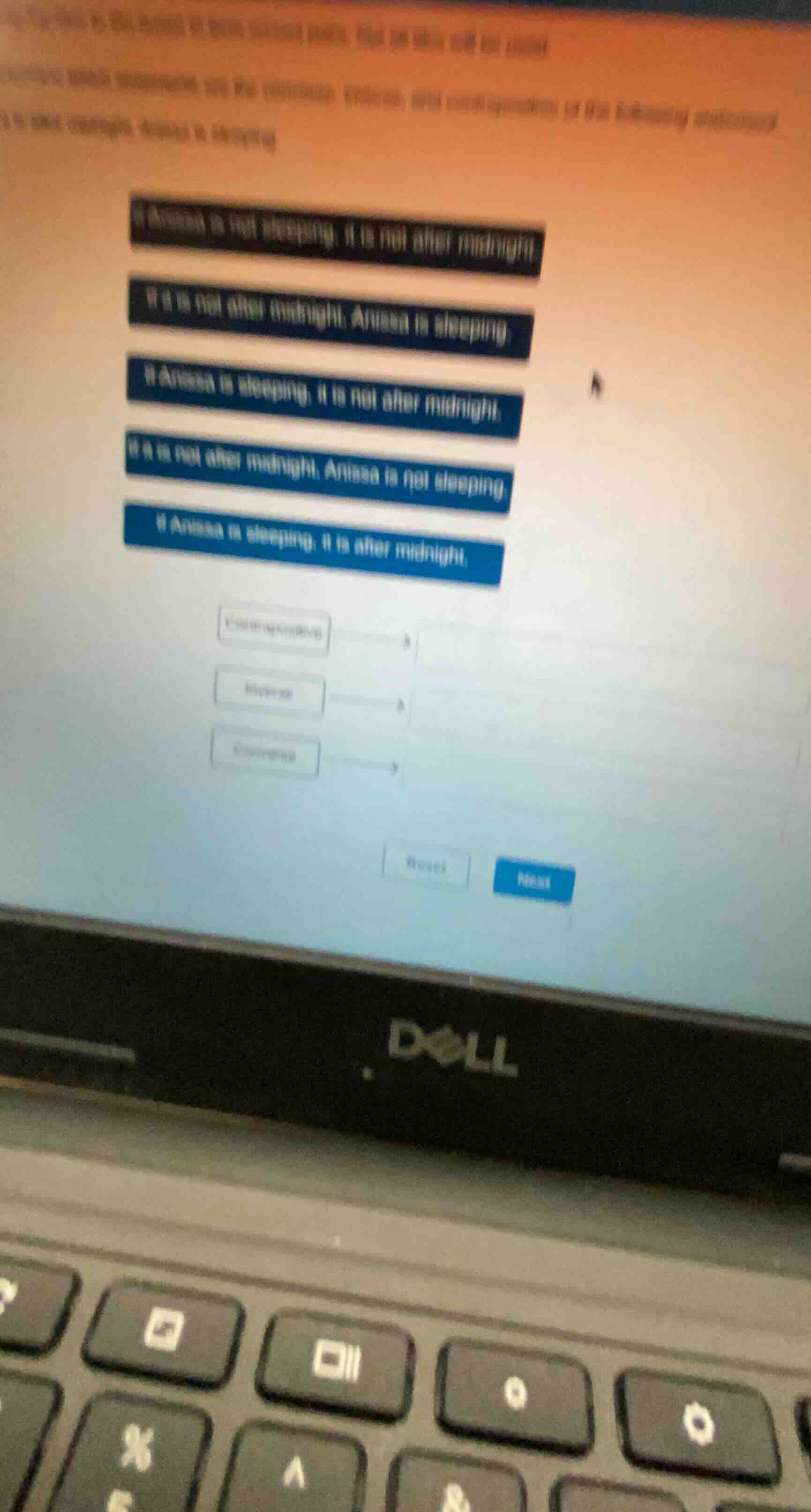
if arissa is not sleeping, it is not after midnight.
if it is not after midnight, arissa is sleeping.
if arissa is sleeping, it is not after midnight.
if it is not after midnight, arissa is not sleeping.
if arissa is sleeping, it is after midnight.
To solve this, we analyze the logical relationships (contrapositive, inverse, converse) of the statement "If Arissa is sleeping, it is after midnight" (let \( p \): Arissa is sleeping, \( q \): it is after midnight, so the original is \( p \to q \)).
Step 1: Recall Logical Equivalences
- Contrapositive: \(
eg q \to
eg p \) (logically equivalent to \( p \to q \)).
- Inverse: \(
eg p \to
eg q \) (not equivalent to \( p \to q \)).
- Converse: \( q \to p \) (not equivalent to \( p \to q \)).
Step 2: Analyze Each Option
- Option 1: "If Arissa is not sleeping, it is not after midnight" → \(
eg p \to
eg q \) (Inverse).
- Option 2: "If it is not after midnight, Arissa is sleeping" → \(
eg q \to p \) (Not a standard form).
- Option 3: "If Arissa is sleeping, it is not after midnight" → \( p \to
eg q \) (Contradicts original).
- Option 4: "If it is not after midnight, Arissa is not sleeping" → \(
eg q \to
eg p \) (Contrapositive, equivalent to original).
- Option 5: "If Arissa is sleeping, it is after midnight" → \( p \to q \) (Original statement).
Matching to Logical Forms
- Contrapositive: Matches Option 4 (\(
eg q \to
eg p \)).
- Inverse: Matches Option 1 (\(
eg p \to
eg q \)).
- Converse: Would be "If it is after midnight, Arissa is sleeping" (\( q \to p \)), not listed here, but if we assume the task is to pair "Contrapositive" with its statement, "Inverse" with its, and "Converse" (or original) with its:
- Contrapositive → "If it is not after midnight, Arissa is not sleeping" (Option 4).
- Inverse → "If Arissa is not sleeping, it is not after midnight" (Option 1).
- Original (or Converse? Wait, original is \( p \to q \), converse is \( q \to p \); but Option 5 is original). If the left boxes are "Contrapositive", "Inverse", "Converse" (or similar), then:
- Contrapositive: \(
eg q \to
eg p \) → "If it is not after midnight, Arissa is not sleeping" (Option 4).
- Inverse: \(
eg p \to
eg q \) → "If Arissa is not sleeping, it is not after midnight" (Option 1).
- Original/Converse: If "Converse" is \( q \to p \), but no option is \( q \to p \). Option 5 is original (\( p \to q \)), so "Original" → Option 5.
Assuming the left labels are "Contrapositive", "Inverse", "Converse" (or similar), the pairings are:
- Contrapositive → "If it is not after midnight, Arissa is not sleeping" (Option 4).
- Inverse → "If Arissa is not sleeping, it is not after midnight" (Option 1).
- Original (or Converse) → "If Arissa is sleeping, it is after midnight" (Option 5).

Snap & solve any problem in the app
Get step-by-step solutions on Sovi AI
Photo-based solutions with guided steps
Explore more problems and detailed explanations
(Example Pairing):
- Contrapositive: If it is not after midnight, Arissa is not sleeping (Option 4).
- Inverse: If Arissa is not sleeping, it is not after midnight (Option 1).
- Original: If Arissa is sleeping, it is after midnight (Option 5).
(Adjust based on exact left-box labels, but the key is matching the logical forms to the statements.)