QUESTION IMAGE
Question
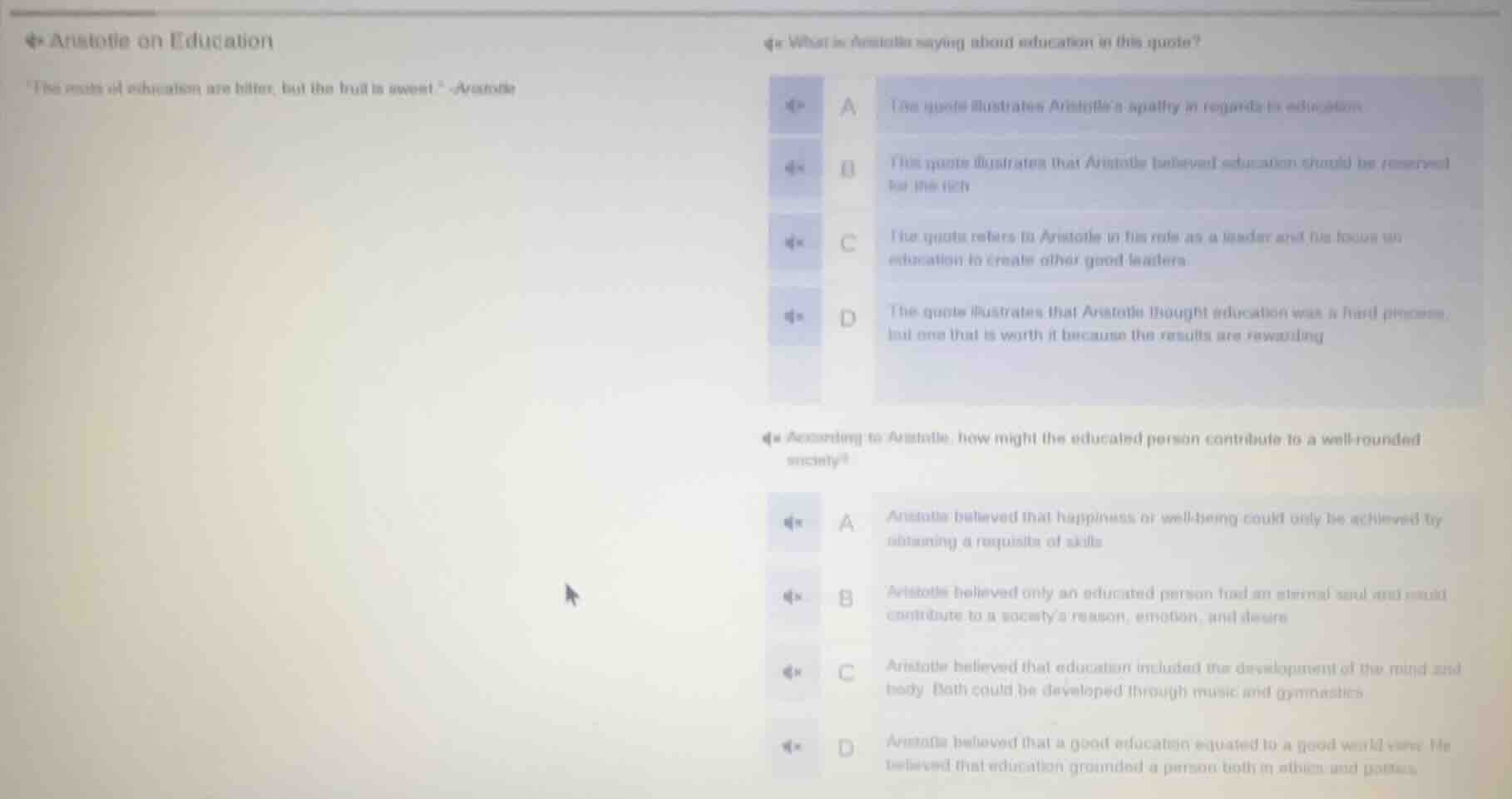
aristotle on education
\the roots of education are bitter, but the fruit is sweet.\ -aristotle
what is aristotle saying about education in this quote?
a. the quote illustrates aristotle’s apathy in regards to education
b. the quote illustrates that aristotle believed education should be reserved for the rich
c. the quote refers to aristotle in his role as a leader and his focus on education to create other good leaders
d. the quote illustrates that aristotle thought education was a hard process but one that is worth it because the results are rewarding
according to aristotle, how might the educated person contribute to a well - rounded society?
a. aristotle believed that happiness or well - being could only be achieved by obtaining a requisite of skills
b. aristotle believed only an educated person had an eternal soul and could contribute to a society’s reason, emotion, and desire
c. aristotle believed that education included the development of the mind and body. both could be developed through music and gymnastics
d. aristotle believed that a good education equated to a good world view. he believed that education grounded a person both in ethics and politics
First Question (What is Aristotle saying about education in this quote?):
The quote is "The roots of education are bitter, but the fruit is sweet". Let's analyze each option:
- Option A: The quote doesn't show apathy (lack of interest) towards education. The mention of "bitter roots" and "sweet fruit" shows engagement with education's process and outcome, so A is wrong.
- Option B: The quote has no mention of education being for the rich. It's about the nature of the education process, not its accessibility based on wealth, so B is wrong.
- Option C: The quote doesn't relate to Aristotle's role as a leader or educating leaders. It's a general statement about education's process (bitter roots) and outcome (sweet fruit), so C is wrong.
- Option D: "Bitter roots" implies the education process is hard, and "sweet fruit" implies the results are rewarding. This matches the quote's meaning.
Let's analyze each option based on Aristotle's views on education and society:
- Option A: Aristotle's view on happiness (eudaimonia) was more about living a virtuous life and using reason, not just acquiring a "requisite of skills". This option misrepresents his view, so A is wrong.
- Option B: Aristotle's views on the soul (rational, appetitive, etc.) and education don't focus on only educated people having an "eternal soul" or contributing in this specific way. This is not a core part of his view on educated people's contribution to society, so B is wrong.
- Option C: While Aristotle did emphasize the development of mind and body (through music, gymnastics, etc.), this option focuses more on the individual's development rather than their contribution to a well - rounded society. It's about how education shapes the individual, not how the educated individual shapes society, so C is wrong.
- Option D: Aristotle believed that a good education (grounded in ethics and politics) leads to a good world - view. An educated person, with this good world - view, can contribute to a well - rounded society by being virtuous and engaged in political and ethical life. This aligns with his views on the role of education in producing virtuous citizens who contribute to society.

Snap & solve any problem in the app
Get step-by-step solutions on Sovi AI
Photo-based solutions with guided steps
Explore more problems and detailed explanations
D. The quote illustrates that Aristotle thought education was a hard process, but one that is worth it because the results are rewarding