QUESTION IMAGE
Question
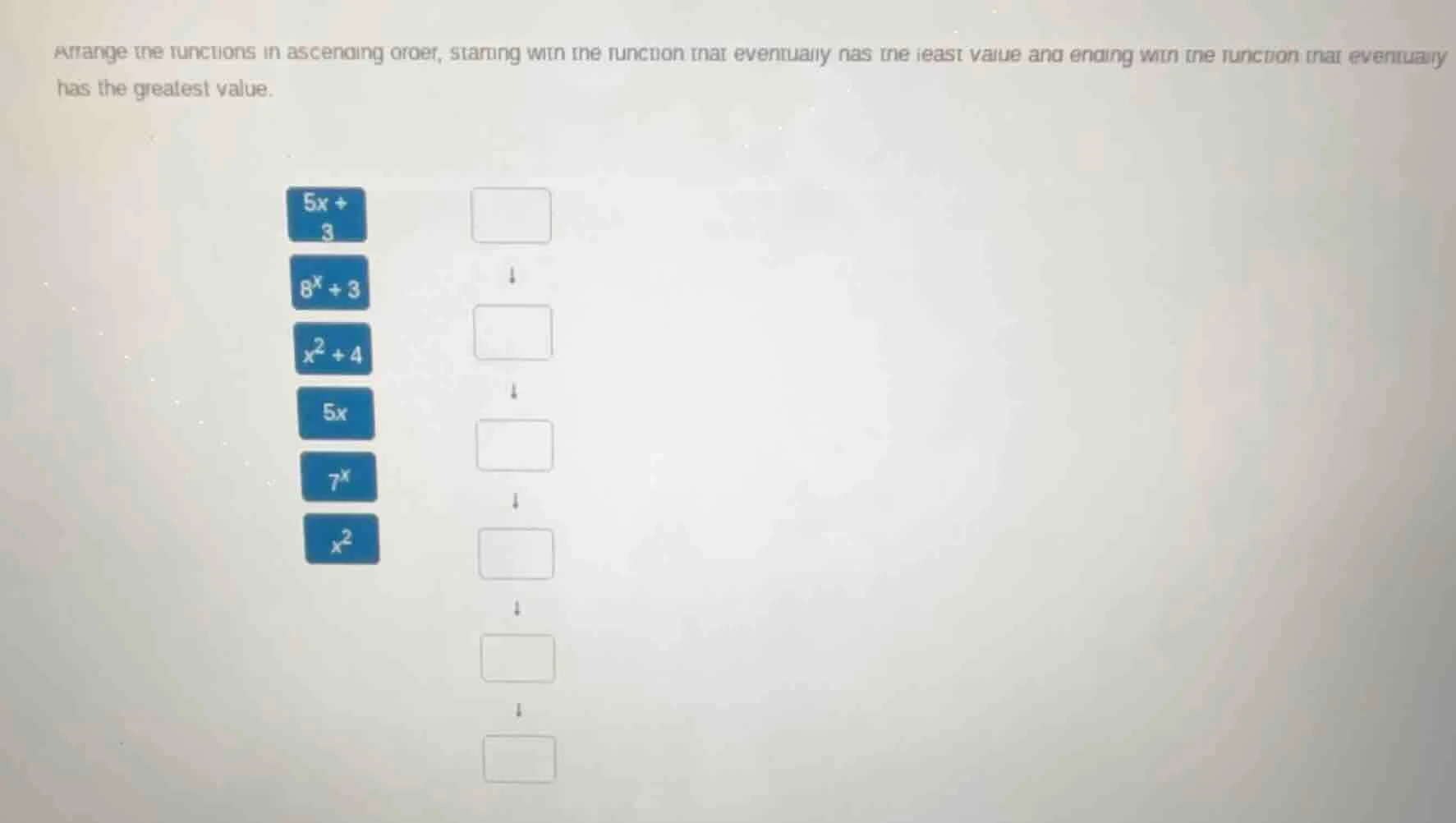
arrange the functions in ascending order, starting with the function that eventually has the least value and ending with the function that eventually has the greatest value.
5x + 3
8^x + 3
x^2 + 4
5x
7^x
x^2
To arrange the functions in ascending order based on their eventual (as \( x \) becomes very large) values, we analyze the growth rates of different types of functions:
Step 1: Identify Function Types and Growth Rates
- Linear Functions: \( 5x \), \( 5x + 3 \) (linear, degree 1)
- Quadratic Functions: \( x^2 \), \( x^2 + 4 \) (quadratic, degree 2)
- Exponential Functions: \( 7^x \), \( 8^x + 3 \) (exponential, base > 1)
Step 2: Compare Growth Rates
- Linear vs Quadratic vs Exponential:
- Linear functions grow slower than quadratic functions.
- Quadratic functions grow slower than exponential functions.
Step 3: Compare Within Each Type
- Linear Functions:
- \( 5x \) and \( 5x + 3 \): For large \( x \), the \( +3 \) is negligible. So \( 5x < 5x + 3 \).
- Quadratic Functions:
- \( x^2 \) and \( x^2 + 4 \): For large \( x \), the \( +4 \) is negligible. So \( x^2 < x^2 + 4 \).
- Exponential Functions:
- \( 7^x \) and \( 8^x + 3 \): Since \( 8 > 7 \), \( 7^x < 8^x + 3 \) for large \( x \).
Step 4: Order All Functions
- Linear (slowest) → Quadratic → Exponential (fastest)
- Within linear: \( 5x < 5x + 3 \)
- Within quadratic: \( x^2 < x^2 + 4 \)
- Within exponential: \( 7^x < 8^x + 3 \)
Putting it all together (from least to greatest):
\( 5x \), \( 5x + 3 \), \( x^2 \), \( x^2 + 4 \), \( 7^x \), \( 8^x + 3 \)

Snap & solve any problem in the app
Get step-by-step solutions on Sovi AI
Photo-based solutions with guided steps
Explore more problems and detailed explanations
The functions in ascending order (from least to greatest eventual value) are:
\( 5x \), \( 5x + 3 \), \( x^2 \), \( x^2 + 4 \), \( 7^x \), \( 8^x + 3 \)