QUESTION IMAGE
Question
article: make sure variable expenses dont derail your budget with these 4 tips
as you observed in the infographic, variable expenses make up a large portion of our spending. but it can\be tricky to budget for variable expenses since they change from month to month. read this article to learnsome strategies. then, answer the questions.
- briefly summarize the four approaches to budgeting for variable expenses.
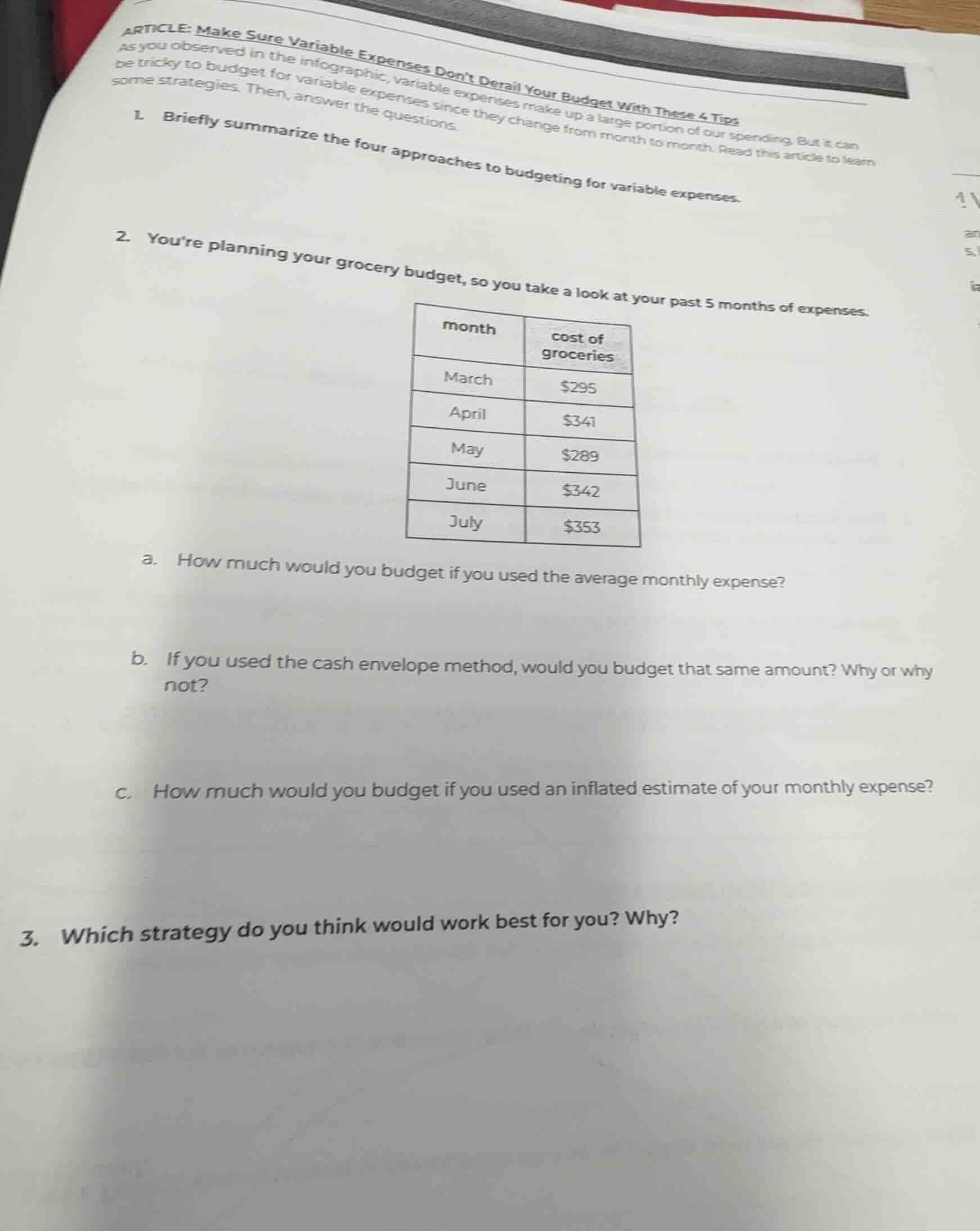
- youre planning your grocery budget, so you take a look at your past 5 months of expenses.
| month | cost of groceries |
|---|---|
| april | $341 |
| may | $289 |
| june | $342 |
| july | $353 |
a. how much would you budget if you used the average monthly expense?
b. if you used the cash envelope method, would you budget that same amount? why or why not?
c. how much would you budget if you used an inflated estimate of your monthly expense?
- which strategy do you think would work best for you? why?
Step1: Sum all grocery expenses
$\$295 + \$341 + \$289 + \$342 + \$353 = \$1620$
Step2: Calculate average monthly expense
$\frac{\$1620}{5} = \$324$
Step3: Explain cash envelope method difference
The cash envelope method uses fixed, set amounts (often based on the highest expense or a safe upper limit) to avoid overspending, not the average.
Step4: Calculate inflated estimate (use highest expense)
The highest monthly expense is $\$353$, a standard inflated estimate uses the maximum past cost to cover peak spending.
Step5: Summarize 4 common variable expense budgeting strategies
- Average past expenses: Use historical monthly averages to set a consistent budget.
- Cash envelope system: Allocate a fixed cash amount (often based on peak costs) and stop spending once the envelope is empty.
- Inflated estimate budgeting: Budget at or above the highest past monthly expense to cover unexpected high-cost months.
- Percentage-based budgeting: Allocate a fixed percentage of total income to variable expenses like groceries.
Step6: Select and justify best strategy
The average expense method balances consistency and realism, avoiding underbudgeting in high months and overbudgeting in low months for regular, predictable variable costs like groceries.

Snap & solve any problem in the app
Get step-by-step solutions on Sovi AI
Photo-based solutions with guided steps
Explore more problems and detailed explanations
- The four common approaches are:
- Use average monthly past expenses to set a consistent budget.
- Cash envelope method: Allocate a fixed cash amount (typically based on peak spending) and cease spending once the funds are exhausted.
- Inflated estimate: Budget at or above the highest historical monthly expense to cover peak costs.
- Percentage-based budgeting: Assign a fixed percentage of total income to variable expenses.
- a. $\$324$
b. No. The cash envelope method typically uses a fixed amount (often the highest monthly expense or a safe upper limit) instead of the average, to ensure you don't overspend in months where costs are above average.
c. A standard inflated estimate would use the highest monthly expense, so $\$353$.
- The average monthly expense strategy works best. It balances consistency and realism, ensuring the budget is sufficient for most months without allocating unnecessary extra funds, making it easy to track and maintain for regular variable costs like groceries.