QUESTION IMAGE
Question
articles of confederation text
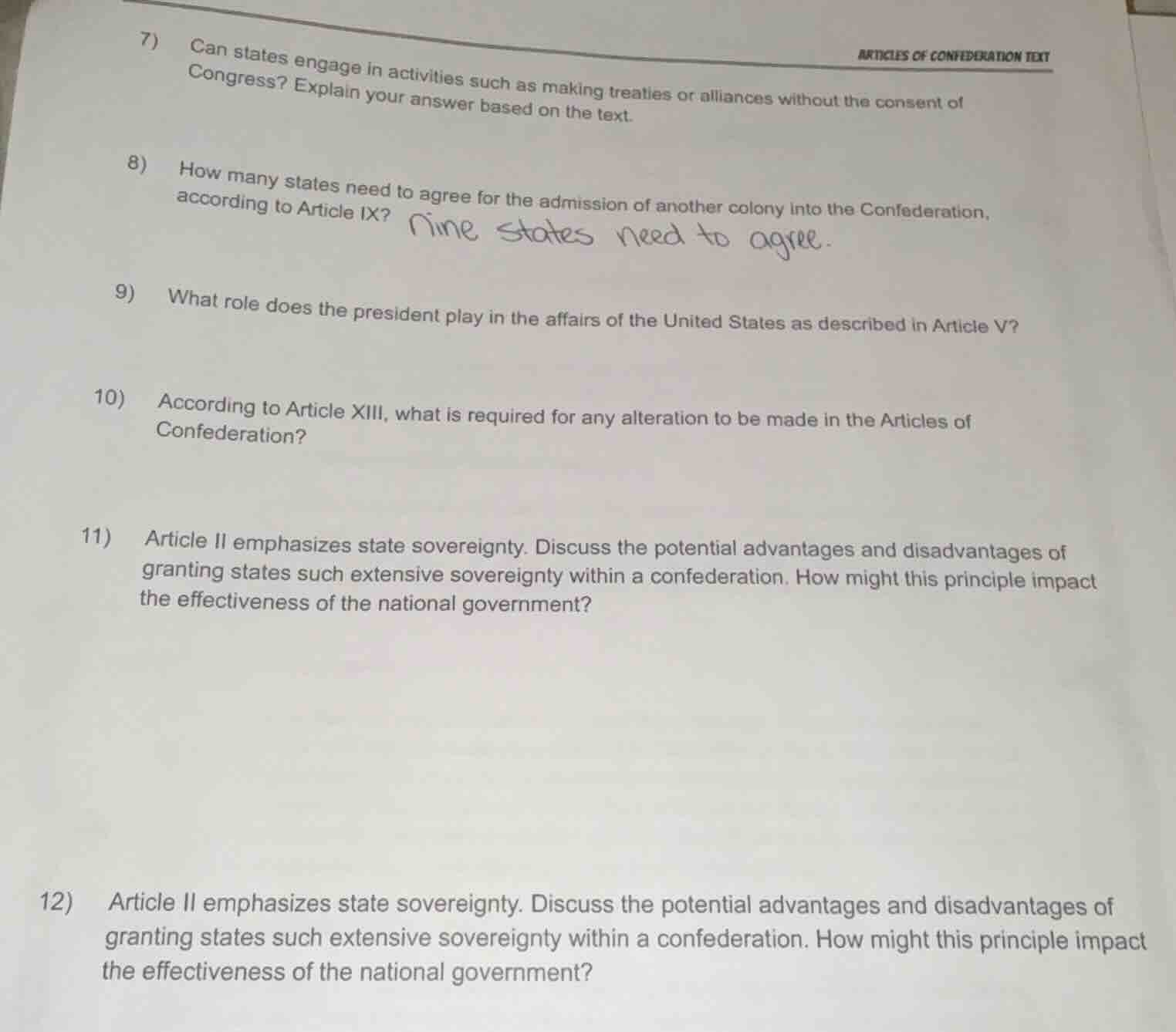
- can states engage in activities such as making treaties or alliances without the consent of congress? explain your answer based on the text.
- how many states need to agree for the admission of another colony into the confederation, according to article ix?
- what role does the president play in the affairs of the united states as described in article v?
- according to article xiii, what is required for any alteration to be made in the articles of confederation?
- article ii emphasizes state sovereignty. discuss the potential advantages and disadvantages of granting states such extensive sovereignty within a confederation. how might this principle impact the effectiveness of the national government?
- article ii emphasizes state sovereignty. discuss the potential advantages and disadvantages of granting states such extensive sovereignty within a confederation. how might this principle impact the effectiveness of the national government?
Question 7
Under the Articles of Confederation, states could not engage in activities like making treaties or alliances without Congress's consent. Article VI of the Articles of Confederation explicitly stated that no state could enter into any treaty, alliance, or confederation without the consent of the United States in Congress assembled. This was to ensure a unified foreign policy and prevent states from acting independently in ways that could undermine the confederation or create conflicts with other nations.
Article IX of the Articles of Confederation stated that the admission of a new colony into the Confederation required the agreement of nine states. This was part of the voting requirements for certain important matters within the confederation, ensuring a significant level of consensus among the member states for such a significant change.
Under the Articles of Confederation (Article V), there was no president in the way we understand the role today. Instead, the United States in Congress assembled (the Confederation Congress) was the main governing body, and it elected a president of the Congress. This president was more of a presiding officer of the Congress, with limited powers, serving a one - year term, and not having executive powers like the modern - day president. The president's role was largely ceremonial and to preside over the Congress, with no independent executive authority to enforce laws or direct the national government's operations in the way a modern president does.

Snap & solve any problem in the app
Get step-by-step solutions on Sovi AI
Photo-based solutions with guided steps
Explore more problems and detailed explanations
No, states cannot engage in activities such as making treaties or alliances without the consent of Congress. According to Article VI of the Articles of Confederation, no state is permitted to enter into any treaty, alliance, or confederation without the consent of the United States in Congress assembled.