QUESTION IMAGE
Question
asian history
the japanese people were granted universal suffrage (voting rights), and everyone over the age of 20 was allowed to vote for members of the diet. the new constitution designed by macarthur contained a bill of rights guaranteeing basic social freedoms, as well as a clause (legal requirement) which prevents japan from declaring war; japan is only allowed to fight if it is attacked first. japan signed all peace treaties (legal agreements between countries) ending the war and pledged to pay r______ (damages) to all the countries it harmed during world war ii. american troops were allowed to remain in japan, and the japanese were not permitted to rebuild their military in any major way.
rising sun battle flag of japan
mao zedong
nationalism had a powerful influence in china at the end of world war i. chinese nationalists overthrew (took power from) the qing dynasty in 1912 and established the republic of china. this new government was unable to bring order to the country, however, and its rule was challenged by the chinese communist party of m____ z____ in 1921. civil war broke out, after which mao and the communists took control of china in 1949.
in 1958, mao launched a plan to reorganize china’s farms and factories into large - scale c____. all agriculture and industry (particularly steel manufacturing) was placed under government control and given strict production quotas to meet. most chinese workers disliked these changes. the environmental impact of rapid industrialization in china was terrible, and a series of crop failures in the late 1950s led to mass f__ (starvation). mao’s collectivization plan, known as the g__ l__ f____, was abandoned in 1960.
following this failure, many chinese citizens began to reject communism and seek out private ownership of their farms and factories. mao’s response was to initiate (begin) what he called a c____ r__ in china to protect his communist dream. he urged chinese students to leave school and target anything or anyone that encouraged class differences (which is to say, anything that appeared westernized or pro - capitalist). many of these students organized into an army of sorts known as the r__ g____.
the group began attacking leaders in the chinese community who seemed to hold higher social positions than their fellow communists: business managers, college professors, even some chinese government officials. anyone who threatened – or even questioned – mao’s dream of a classless, communist society was targeted, attacked, jailed, and in some cases killed. it was chaos! the cultural revolution raged on for ten years before mao himself declared it a failure.
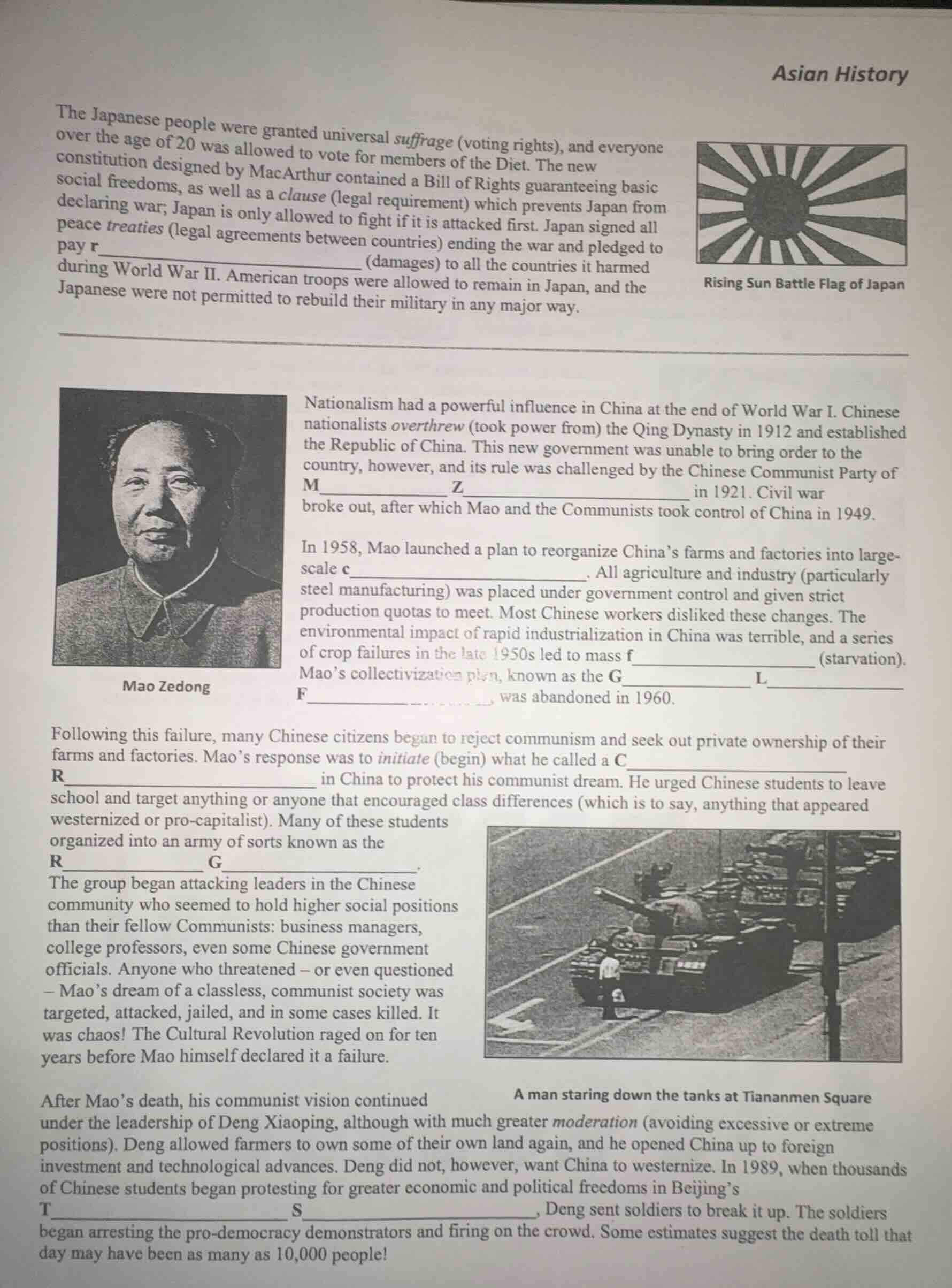
a man staring down the tanks at tiananmen square
after mao’s death, his communist vision continued under the leadership of deng xiaoping, although with much greater moderation (avoiding excessive or extreme positions). deng allowed farmers to own some of their own land again, and he opened china up to foreign investment and technological advances. deng did not, however, want china to westernize. in 1989, when thousands of chinese students began protesting for greater economic and political freedoms in beijing’s t____ s____, deng sent soldiers to break it up. the soldiers began arresting the pro - democracy demonstrators and firing on the crowd. some estimates suggest the death toll that day may have been as many as 10,000 people!
Each blank is filled based on key events and terms from 20th-century Asian history, matching the context clues provided in the text.

Snap & solve any problem in the app
Get step-by-step solutions on Sovi AI
Photo-based solutions with guided steps
Explore more problems and detailed explanations
- r: reparations
- M Z: Mao Zedong
- c: collectives
- f: famine
- G L F: Great Leap Forward
- C R: Cultural Revolution
- R G: Red Guards
- T S: Tiananmen Square