QUESTION IMAGE
Question
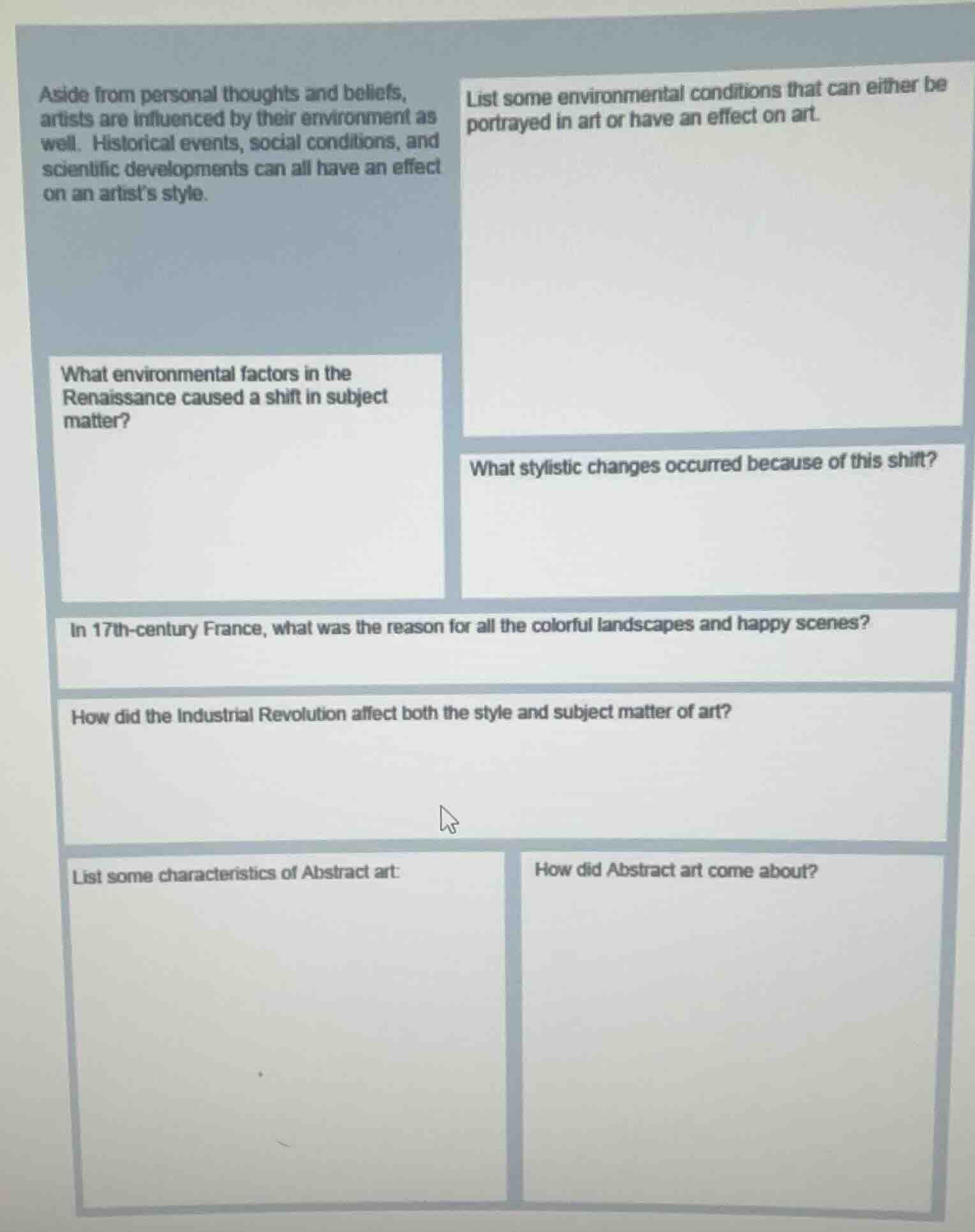
aside from personal thoughts and beliefs, artists are influenced by their environment as well. historical events, social conditions, and scientific developments can all have an effect on an artists style.
list some environmental conditions that can either be portrayed in art or have an effect on art.
what environmental factors in the renaissance caused a shift in subject matter?
what stylistic changes occurred because of this shift?
in 17th-century france, what was the reason for all the colorful landscapes and happy scenes?
how did the industrial revolution affect both the style and subject matter of art?
list some characteristics of abstract art:
how did abstract art come about?
- For environmental conditions affecting/portrayed in art: These are physical, social, or historical environmental elements that artists engage with.
- Renaissance subject matter shift: Tied to renewed classical access and humanist ideas.
- Renaissance stylistic changes: Linked to new technical and ideological shifts.
- 17th-century French art: Tied to court patronage preferences.
- Industrial Revolution's art impact: Driven by new urban landscapes and social upheaval.
- Abstract art characteristics: Defined by rejection of representational forms.
- Abstract art origins: Rooted in modernist rejection of traditional art norms.

Snap & solve any problem in the app
Get step-by-step solutions on Sovi AI
Photo-based solutions with guided steps
Explore more problems and detailed explanations
- List some environmental conditions that can either be portrayed in art or have an effect on art:
- Natural landscapes (mountains, forests, coastlines)
- Urban industrial environments (factories, crowded city streets)
- Political upheaval/war zones
- Cultural traditions and rituals of a community
- Climate and weather patterns (snow, drought, sunshine)
- What environmental factors in the Renaissance caused a shift in subject matter?
- Rediscovery of classical Greek/Roman texts and art, which shifted focus to human figures, mythology, and secular themes
- Rise of humanism, emphasizing individual human experience over solely religious subjects
- Increased wealth of merchant and noble patrons who commissioned non-religious works
- What stylistic changes occurred because of this shift?
- Development of linear perspective to create realistic spatial depth
- Use of chiaroscuro (contrast of light and shadow) for lifelike volume in figures
- Focus on anatomical accuracy in human and animal forms
- More vibrant, naturalistic color palettes
- In 17th-century France, what was the reason for all the colorful landscapes and happy scenes?
- The patronage of King Louis XIV and the French court, which favored optimistic, decorative art that glorified the monarchy and idealized French life, aligning with the formal, celebratory style of French Baroque (specifically Rococo's early influences)
- How did the Industrial Revolution affect both the style and subject matter of art?
- Subject matter: Shift to portray urban factory workers, polluted cityscapes, rural displacement, and new industrial machinery; some artists also focused on pastoral scenes as a reaction to industrialization
- Style: Rise of Realism, which depicted working-class life unflinchingly; later, Impressionism emerged, capturing the fleeting light and movement of modern urban and suburban life, influenced by new access to portable paint tubes and changing leisure patterns
- List some characteristics of Abstract art:
- Rejects representational or realistic depictions of the physical world
- Focuses on formal elements: color, line, shape, texture, and composition
- Often conveys emotional or conceptual ideas rather than literal subjects
- Includes sub-styles like Cubism, Abstract Expressionism, and Minimalism
- How did Abstract art come about?
- It emerged in the early 20th century as a rejection of traditional art's focus on realistic representation, driven by modernist ideas
- Influences included the rise of photography (which made realistic depiction less unique), non-Western art (like African masks and Japanese prints), and shifts in philosophy emphasizing subjective experience
- Pioneering artists like Wassily Kandinsky (who focused on emotional expression through color/line) and Pablo Picasso (with Cubism's fragmented forms) laid the groundwork for the movement