QUESTION IMAGE
Question
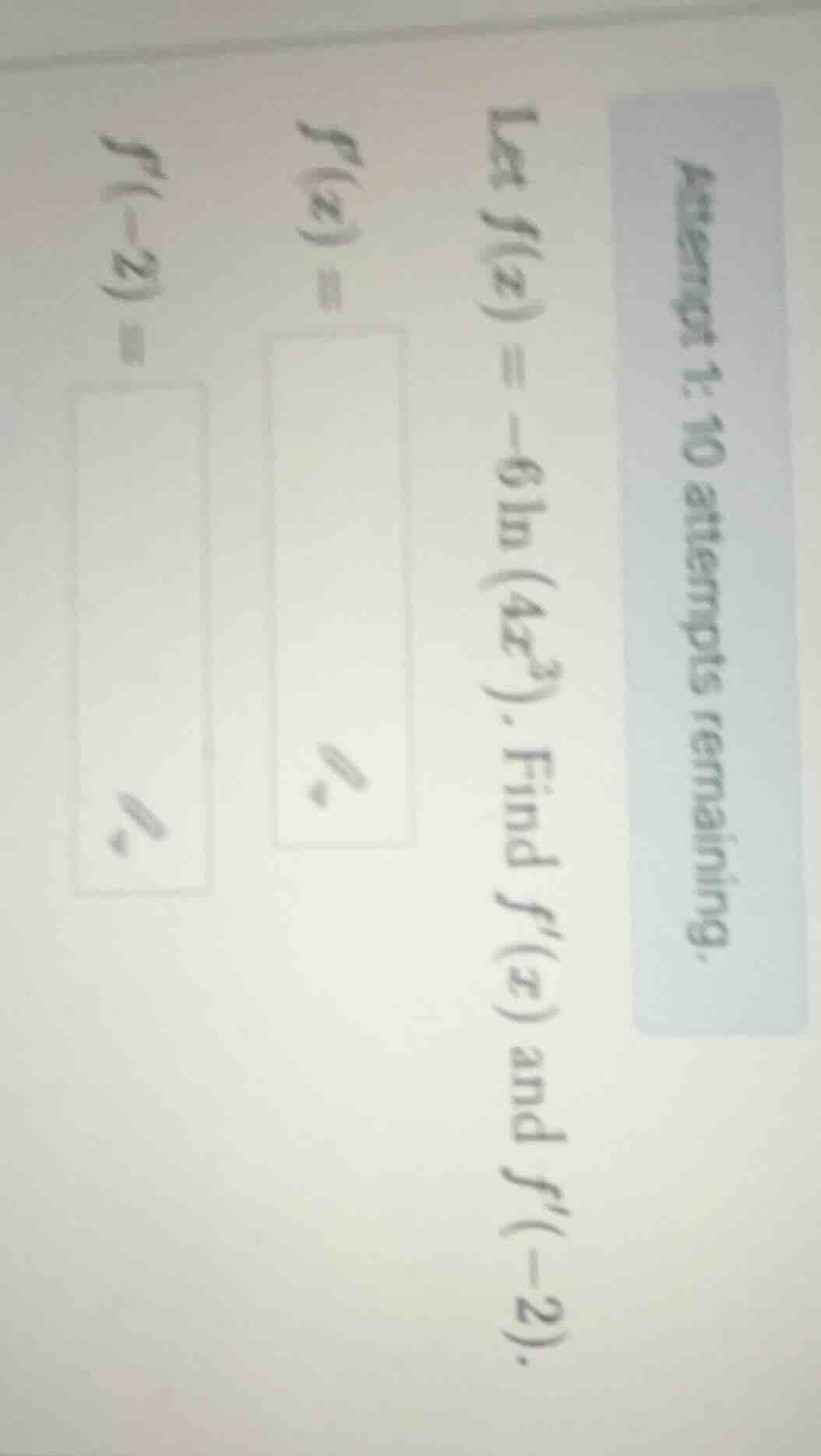
attempt 1: 10 attempts remaining. let ( f(x) = -6ln(4x^3) ). find ( f(x) ) and ( f(-2) ). ( f(x) = ) ( f(-2) = )
Step1: Simplify the function using logarithm properties
First, use the property of logarithms $\ln(ab)=\ln(a)+\ln(b)$ and $\ln(a^n)=n\ln(a)$ to simplify $f(x)= -6\ln(4x^3)$. We know that $\ln(4x^3)=\ln(4)+\ln(x^3)=\ln(4) + 3\ln(x)$, so $f(x)=-6(\ln(4)+3\ln(x))=-6\ln(4)-18\ln(x)$. But it's easier to use the chain rule directly. The derivative of $\ln(u)$ with respect to $x$ is $\frac{u'}{u}$, where $u = 4x^3$.
Step2: Apply the chain rule to find $f'(x)$
Let $u = 4x^3$, then $f(x)=-6\ln(u)$. The derivative of $f$ with respect to $u$ is $f'_u=-6\times\frac{1}{u}$, and the derivative of $u$ with respect to $x$ is $u' = 12x^2$. By the chain rule $f'(x)=f'_u\times u'$, so $f'(x)=-6\times\frac{1}{4x^3}\times12x^2$. Simplify this: $\frac{-6\times12x^2}{4x^3}=\frac{-72x^2}{4x^3}=\frac{-18}{x}$.
Step3: Evaluate $f'(-2)$
Now substitute $x = -2$ into $f'(x)$. So $f'(-2)=\frac{-18}{-2}=9$.

Snap & solve any problem in the app
Get step-by-step solutions on Sovi AI
Photo-based solutions with guided steps
Explore more problems and detailed explanations
$f'(x)=\boldsymbol{-\frac{18}{x}}$, $f'(-2)=\boldsymbol{9}$