QUESTION IMAGE
Question
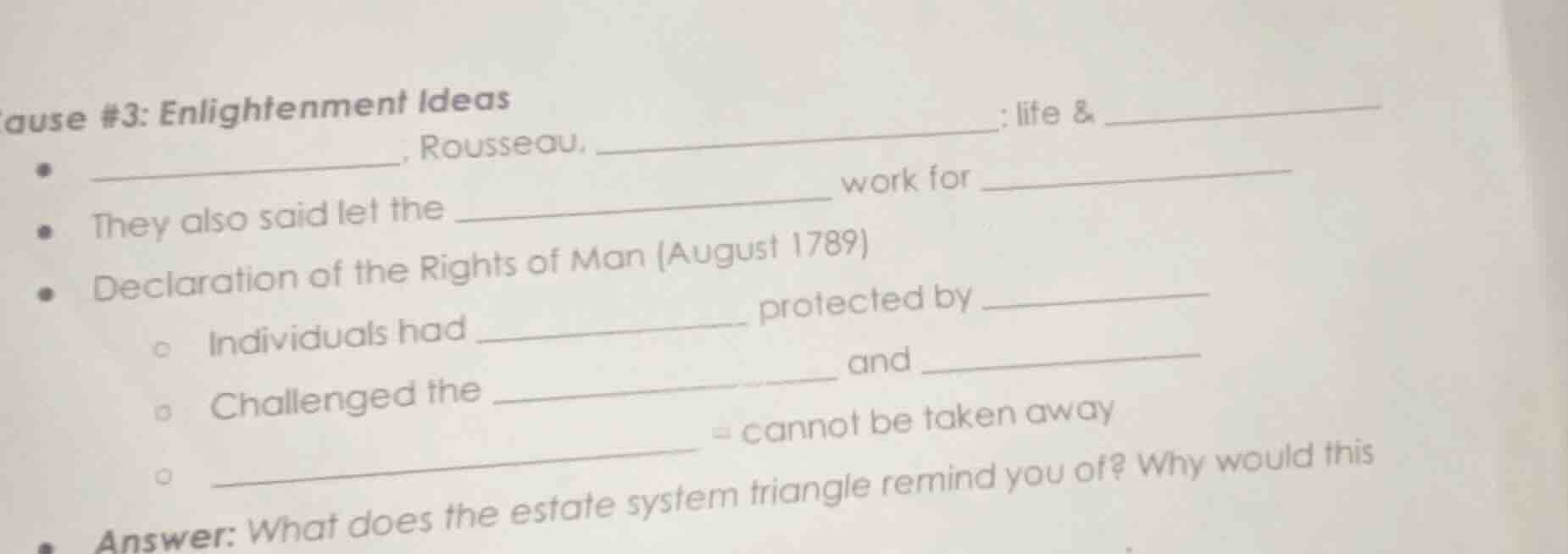
ause #3: enlightenment ideas
- ___________, rousseau, _________: life & ___________
- they also said let the ___________ work for ___________
- declaration of the rights of man (august 1789)
◦ individuals had ___________ protected by ___________
◦ challenged the ___________ and ___________
◦ _____________ = cannot be taken away
- answer: what does the estate system triangle remind you of? why would this
Brief Explanations
These blanks relate to key Enlightenment thinkers, core ideas, and the Declaration of the Rights of Man, a foundational document of the French Revolution tied to Enlightenment principles.
- The first line lists major Enlightenment philosophers focused on natural rights: Locke, Rousseau, Voltaire, with the core natural rights being life & liberty.
- Enlightenment thinkers advocated for the general will (the collective good of the people) to work for the common good, rather than a monarch's interests.
- The Declaration of the Rights of Man established that individuals had natural rights protected by the law.
- This document challenged the absolute monarchy and the traditional estate system (feudal class structure) of pre-revolution France.
- Inalienable rights are defined as rights that cannot be taken away.
- The estate system triangle resembles a feudal social hierarchy (or a pyramid of power): it reflects a rigid, unequal class structure where the small elite (First and Second Estates) held most power and wealth, while the vast majority (Third Estate) bore the burden of taxation and had little influence. This parallel shows the unequal power dynamic that Enlightenment ideas and the French Revolution sought to dismantle.

Snap & solve any problem in the app
Get step-by-step solutions on Sovi AI
Photo-based solutions with guided steps
Explore more problems and detailed explanations
- First bullet: Locke, Voltaire; liberty
- Second bullet: general will; the common good
- Third bullet (Declaration details):
- natural rights; the law
- absolute monarchy; estate system
- Inalienable rights
- Final question: The estate system triangle reminds you of a rigid, unequal feudal social hierarchy (power pyramid). It represents the unfair class structure where a small wealthy/powerful elite (First and Second Estates) controlled society, while the large, oppressed Third Estate had no political power and carried the economic burden. This inequality is exactly what Enlightenment ideas criticized, as they argued for individual rights and a government that serves the people rather than a privileged few.