QUESTION IMAGE
Question
author is a forester in western germany.
from the hidden life of trees
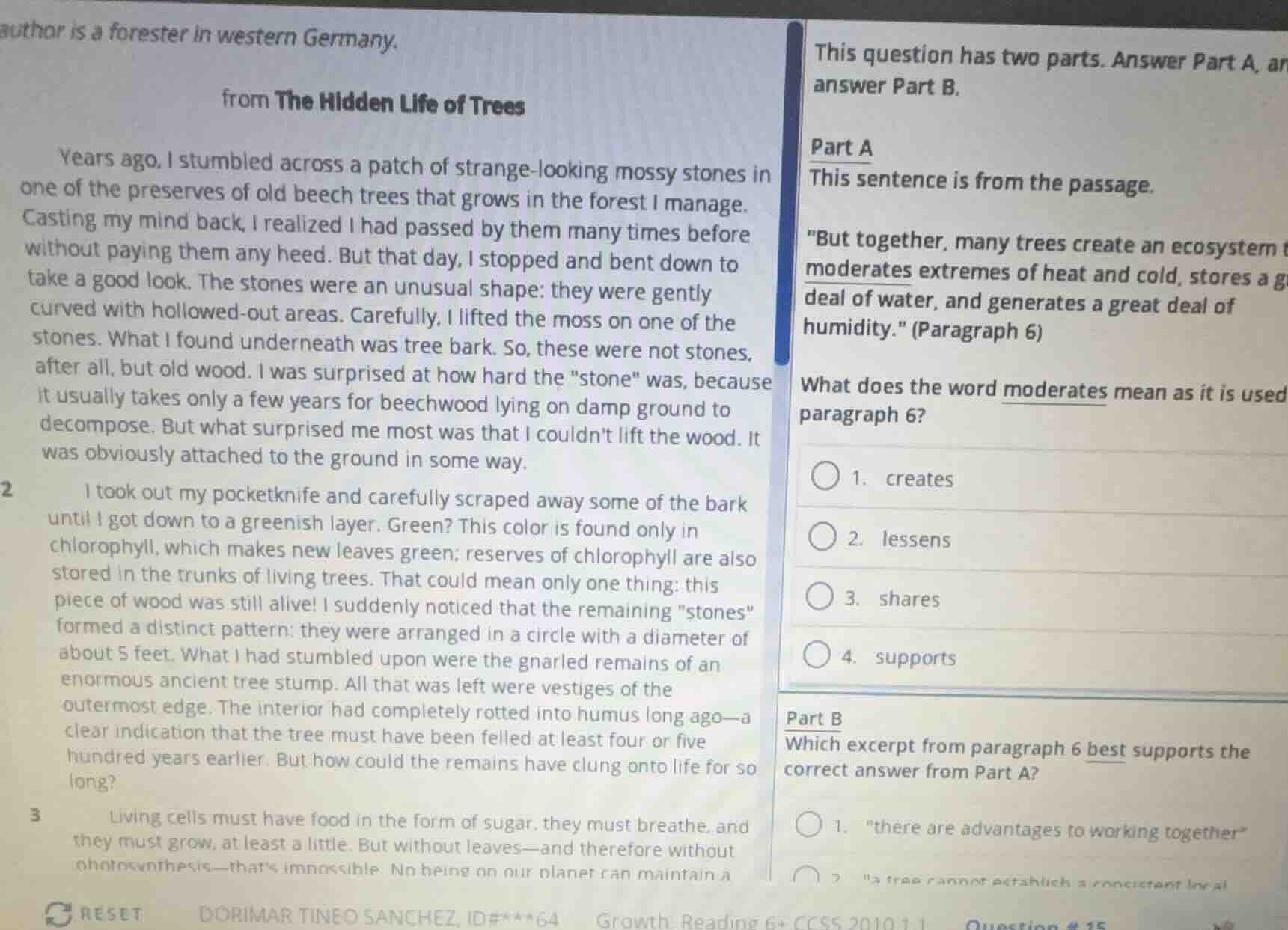
years ago, i stumbled across a patch of strange - looking mossy stones in one of the preserves of old beech trees that grows in the forest i manage. casting my mind back, i realized i had passed by them many times before without paying them any heed. but that day, i stopped and bent down to take a good look. the stones were an unusual shape: they were gently curved with hollowed - out areas. carefully, i lifted the moss on one of the stones. what i found underneath was tree bark. so, these were not stones, after all, but old wood. i was surprised at how hard the \stone\ was, because it usually takes only a few years for beechwood lying on damp ground to decompose. but what surprised me most was that i couldnt lift the wood. it was obviously attached to the ground in some way.
2
i took out my pocketknife and carefully scraped away some of the bark until i got down to a greenish layer. green? this color is found only in chlorophyll, which makes new leaves green; reserves of chlorophyll are also stored in the trunks of living trees. that could mean only one thing: this piece of wood was still alive! i suddenly noticed that the remaining \stones\ formed a distinct pattern: they were arranged in a circle with a diameter of about 5 feet. what i had stumbled upon were the gnarled remains of an enormous ancient tree stump. all that was left were vestiges of the outermost edge. the interior had completely rotted into humus long ago — a clear indication that the tree must have been felled at least four or five hundred years earlier. but how could the remains have clung onto life for so long?
3
living cells must have food in the form of sugar, they must breathe, and they must grow, at least a little. but without leaves — and therefore without photosynthesis — thats impossible. no being on our planet can maintain a
this question has two parts. answer part a, an answer part b.
part a
this sentence is from the passage.
\but together, many trees create an ecosystem t moderates extremes of heat and cold, stores a g deal of water, and generates a great deal of humidity.\ (paragraph 6)
what does the word moderates mean as it is used paragraph 6?
- creates
- lessens
- shares
- supports
part b
which excerpt from paragraph 6 best supports the correct answer from part a?
- \there are advantages to working together\
- \a tree cannot establish a consistent level
Part A
To determine the meaning of "moderates" in the sentence "many trees create an ecosystem that moderates extremes of heat and cold", we analyze the context. An ecosystem with many trees would reduce the intensity of extreme heat and cold. "Creates" (1) doesn't fit as it's about changing the extremes, not making them. "Shares" (3) is irrelevant. "Supports" (4) doesn't match the idea of reducing extremes. "Lessens" (2) means to reduce, which fits the context of moderating (making less extreme) heat and cold.

Snap & solve any problem in the app
Get step-by-step solutions on Sovi AI
Photo-based solutions with guided steps
Explore more problems and detailed explanations
- lessens
Part B
(Note: Since the options for Part B are partially cut off, we assume the relevant option would relate to how trees working together reduce or moderate environmental extremes, like an excerpt showing trees' collective effect on reducing extreme conditions. If we assume the correct supporting excerpt is related to the collective action of trees reducing extremes, for example, if an option mentions trees working together to reduce harsh conditions, that would support "lessens". But with the given cut - off, we can't provide the exact option, but the reasoning is that the correct excerpt should show trees' role in reducing extreme heat/cold, matching the meaning of "lessens" from Part A.)