QUESTION IMAGE
Question
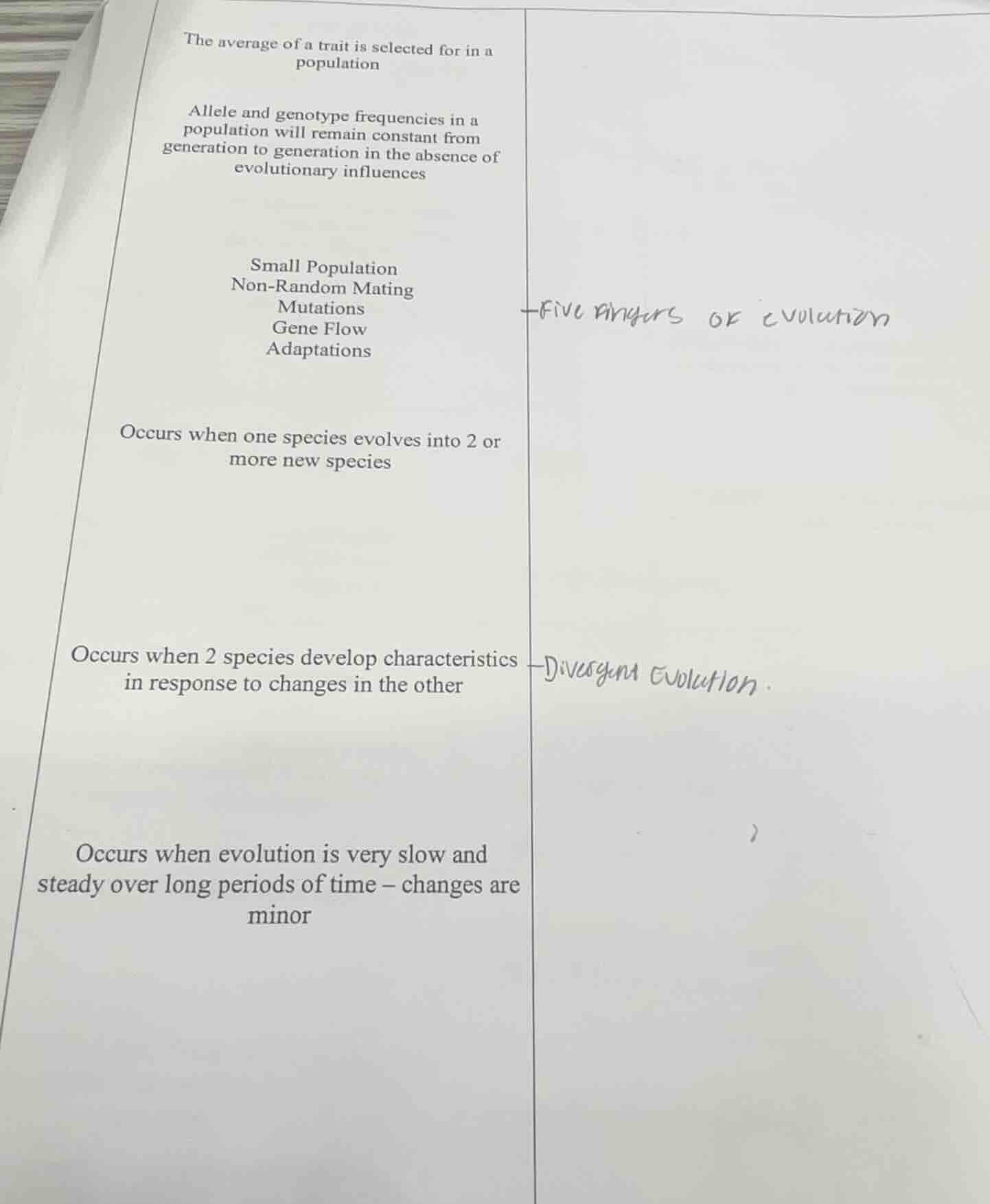
the average of a trait is selected for in a population
allele and genotype frequencies in a population will remain constant from generation to generation in the absence of evolutionary influences
small population
non - random mating
mutations
gene flow
adaptations
occurs when one species evolves into 2 or more new species
occurs when 2 species develop characteristics in response to changes in the other
occurs when evolution is very slow and steady over long periods of time – changes are minor
To solve this, we analyze each evolutionary concept:
1. "The average of a trait is selected for in a population"
This describes stabilizing selection (favors average traits, reduces variation).
2. "Allele and genotype frequencies in a population will remain constant from generation to generation in the absence of evolutionary influences"
This is the definition of the Hardy-Weinberg principle (null model for evolution).
3. "Small Population, Non - Random Mating, Mutations, Gene Flow, Adaptations"
These are (with correction: "Natural Selection" instead of "Adaptations") the five agents of evolutionary change (factors that disrupt Hardy - Weinberg equilibrium: genetic drift, non - random mating, mutation, gene flow, natural selection).
4. "Occurs when one species evolves into 2 or more new species"
This is speciation (process of new species formation).
5. "Occurs when 2 species develop characteristics in response to changes in the other"
This is coevolution (reciprocal evolutionary change between interacting species).
6. "Occurs when evolution is very slow and steady over long periods of time – changes are minor"
This is gradualism (slow, continuous evolutionary change).

Snap & solve any problem in the app
Get step-by-step solutions on Sovi AI
Photo-based solutions with guided steps
Explore more problems and detailed explanations
s:
- Stabilizing Selection
- Hardy - Weinberg Principle
- Five Agents of Evolution (Genetic Drift, Non - Random Mating, Mutation, Gene Flow, Natural Selection)
- Speciation
- Coevolution
- Gradualism