QUESTION IMAGE
Question
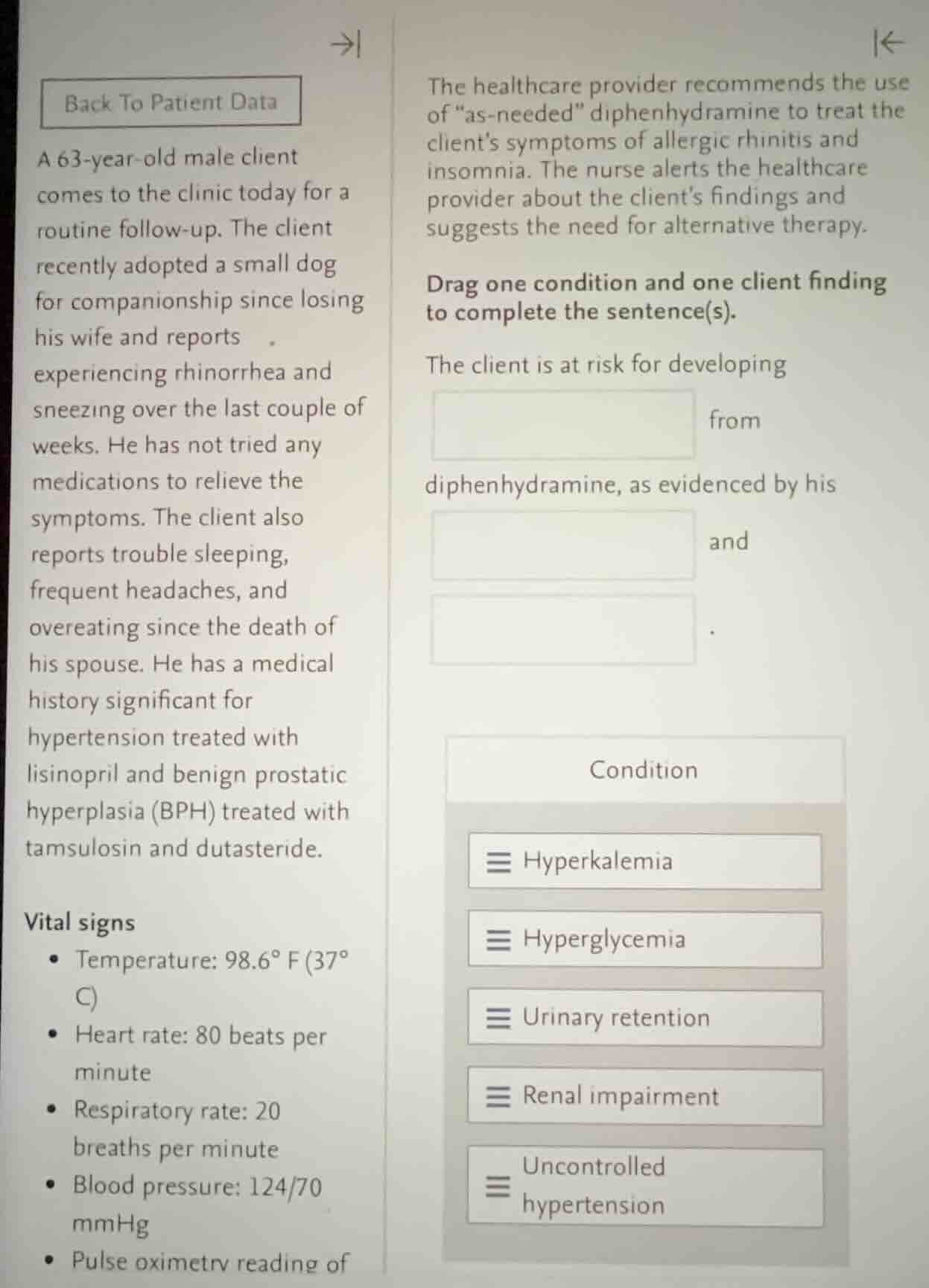
back to patient data a 63-year-old male client comes to the clinic today for a routine follow-up. the client recently adopted a small dog for companionship since losing his wife and reports experiencing rhinorrhea and sneezing over the last couple of weeks. he has not tried any medications to relieve the symptoms. the client also reports trouble sleeping, frequent headaches, and overeating since the death of his spouse. he has a medical history significant for hypertension treated with lisinopril and benign prostatic hyperplasia (bph) treated with tamsulosin and dutasteride. vital signs - temperature: 98.6°f (37°c) - heart rate: 80 beats per minute - respiratory rate: 20 breaths per minute - blood pressure: 124/70 mmhg - pulse oximetry reading of the healthcare provider recommends the use of \as-needed\ diphenhydramine to treat the client’s symptoms of allergic rhinitis and insomnia. the nurse alerts the healthcare provider about the client’s findings and suggests the need for alternative therapy. drag one condition and one client finding to complete the sentence(s). the client is at risk for developing blank from diphenhydramine, as evidenced by his blank and blank. condition - hyperkalemia - hyperglycemia - urinary retention - renal impairment - uncontrolled hypertension
- First, analyze the client's medical history and current medications. The client has BPH treated with tamsulosin and dutasteride. Diphenhydramine can cause urinary retention, especially in patients with BPH.
- Then, look at the client's findings related to potential risks from diphenhydramine. The client's BPH and the medication tamsulosin (for BPH) along with diphenhydramine's anticholinergic effects can lead to urinary retention. Also, the client has hypertension, but diphenhydramine's effect on blood pressure is less direct compared to urinary retention in this case. The other conditions (hyperkalemia, hyperglycemia, renal impairment) are not directly related to diphenhydramine use in this context. The client's BPH (a condition related to urinary system) and the potential for urinary retention from diphenhydramine, along with his current BPH treatment, make urinary retention the condition. The client findings related would be his BPH (but since we need client findings from the data, wait, the client's medical history has BPH, and the symptoms or findings? Wait, the client's medical history is BPH, and the medications for BPH. So the condition is Urinary retention, and the client findings are his BPH (but in the options, the client findings part? Wait, maybe I misread. Wait, the problem says "drag one condition and one client finding". Wait, maybe the client findings are from his symptoms or history. Wait, the client has BPH (a client finding? Or is BPH a condition? Wait, the "Condition" box has the options, and the client findings would be from his history or symptoms. Wait, the client's medical history includes BPH, and he is on tamsulosin for BPH. Diphenhydramine can cause urinary retention, which is a risk for someone with BPH. So the condition is Urinary retention, and the client findings are his BPH (but in the data, the client has BPH as a medical history, and also, maybe the other part? Wait, maybe the client findings are "benign prostatic hyperplasia (BPH)" and his current treatment with tamsulosin? But the options for condition are the ones in the Condition box. Wait, let's re-express:
The client is at risk for developing Urinary retention from diphenhydramine, as evidenced by his benign prostatic hyperplasia (BPH) and treatment with tamsulosin (for BPH). But looking at the options, the Condition is Urinary retention, and the client findings would be related to his BPH. Wait, the Condition options are Hyperkalemia, Hyperglycemia, Urinary retention, Renal impairment, Uncontrolled hypertension. The client's medical history has BPH, which is a risk factor for urinary retention when taking diphenhydramine (anticholinergic). So the condition is Urinary retention. The client findings: his BPH (a client finding from his medical history) and his treatment with tamsulosin (for BPH). But in the given data, the client's medical history includes BPH treated with tamsulosin and dutasteride. So putting it together:
The client is at risk for developing Urinary retention from diphenhydramine, as evidenced by his benign prostatic hyperplasia (BPH) and treatment with tamsulosin (for BPH). But since the options for condition are the ones in the Condition box, and client findings would be from the client's data. So the condition is Urinary retention, and the client findings are his BPH (a client finding) and his current BPH treatment (but maybe the problem expects the client's medical history of BPH and his use of tamsulosin? Wait, maybe I made a mistake. Let's check again.
Wait, the client's medical history: "H…

Snap & solve any problem in the app
Get step-by-step solutions on Sovi AI
Photo-based solutions with guided steps
Explore more problems and detailed explanations
The client is at risk for developing $\boldsymbol{\text{Urinary retention}}$ from diphenhydramine, as evidenced by his $\boldsymbol{\text{benign prostatic hyperplasia (BPH)}}$ and $\boldsymbol{\text{treatment with tamsulosin (for BPH)}}$.
(Note: If we strictly use the options in the "Condition" box and the client's data from the left panel, the Condition is "Urinary retention" (from the Condition box options), and the client findings are "benign prostatic hyperplasia (BPH)" (from his medical history) and "treatment with tamsulosin" (also from his medical history).)