QUESTION IMAGE
Question
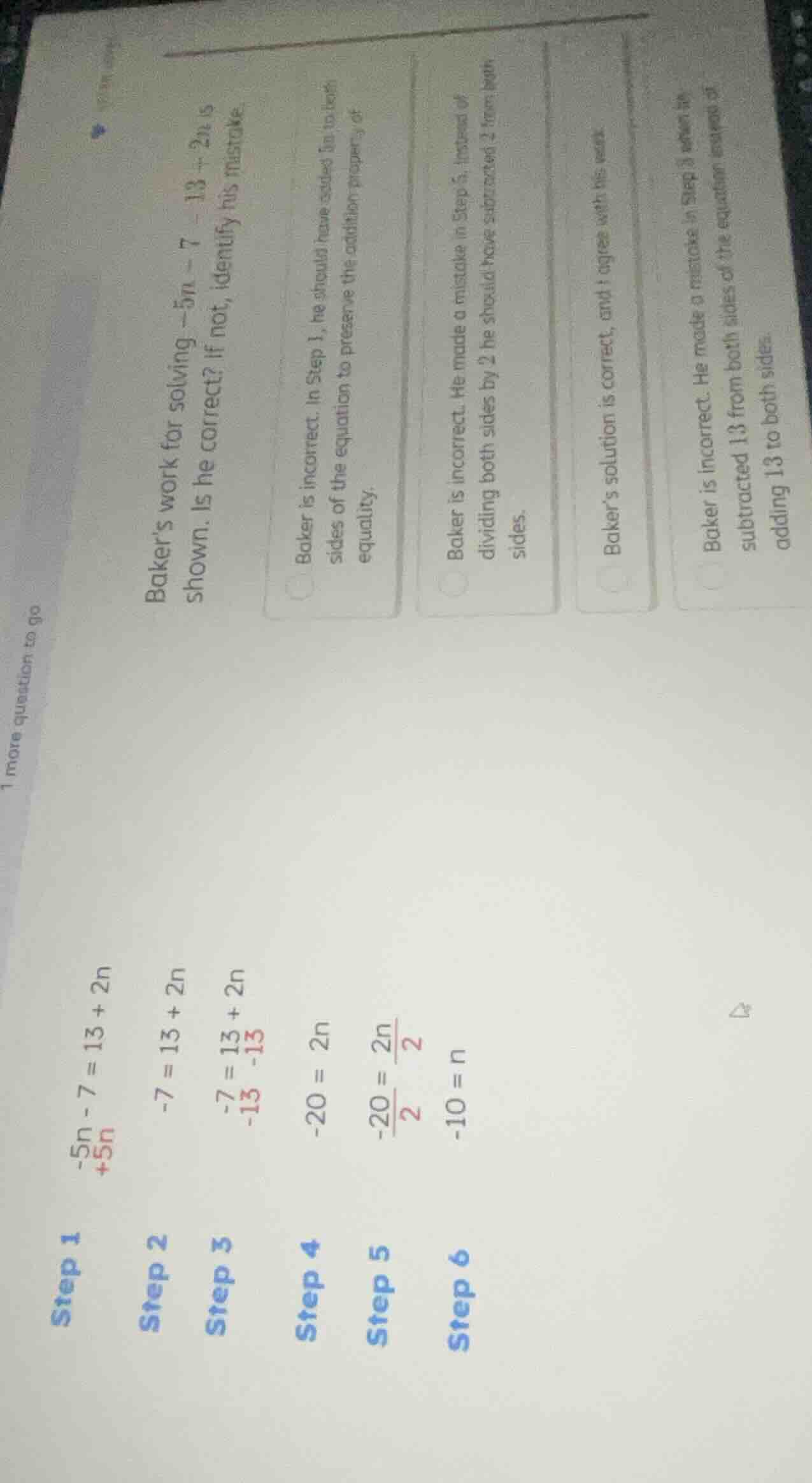
bakers work for solving (-5n - 7 = 13 + 2n) is shown. is he correct? if not, identify his mistake.
step 1: (-5n - 7 stackrel{+5n}{=} 13 + 2n)
step 2: (-7 = 13 + 2n)
step 3: (-7 stackrel{-13}{=} 13 + 2n stackrel{-13}{}
step 4: (-20 = 2n)
step 5: (\frac{-20}{2} = \frac{2n}{2})
step 6: (-10 = n)
options:
- baker is incorrect. in step 1, he should have added (5n) to both sides of the equation to preserve the addition property of equality.
- baker is incorrect. he made a mistake in step 5; instead of dividing both sides by 2 he should have subtracted 2 from both sides.
- bakers solution is correct, and i agree with his work.
- baker is incorrect. he made a mistake in step 3 when he subtracted 13 from both sides of the equation instead of adding 13 to both sides.
Step1: Verify Step 1 operation
Original equation: $-5n - 7 = 13 + 2n$
Add $5n$ to both sides:
$-5n - 7 + 5n = 13 + 2n + 5n$
Simplifies to: $-7 = 13 + 7n$
Baker got $-7 = 13 + 2n$, which is wrong.
Step2: Identify error source
Baker failed to add $5n$ to the right side, violating the addition property of equality (must perform the same operation on both sides to preserve equality).
Step3: Eliminate other options
- Step 3: Subtracting 13 from both sides of $-7=13+2n$ gives $-20=2n$, which is algebraically valid for that incorrect intermediate equation, so this is not the original mistake.
- Step 5: Dividing both sides of $-20=2n$ by 2 gives $n=-10$, which is valid for that incorrect intermediate equation, so this is not the mistake.
- The final solution is incorrect, so the "correct solution" option is wrong.

Snap & solve any problem in the app
Get step-by-step solutions on Sovi AI
Photo-based solutions with guided steps
Explore more problems and detailed explanations
Baker is incorrect. In Step 1, he should have added 5n to both sides of the equation to preserve the addition property of equality.