QUESTION IMAGE
Question
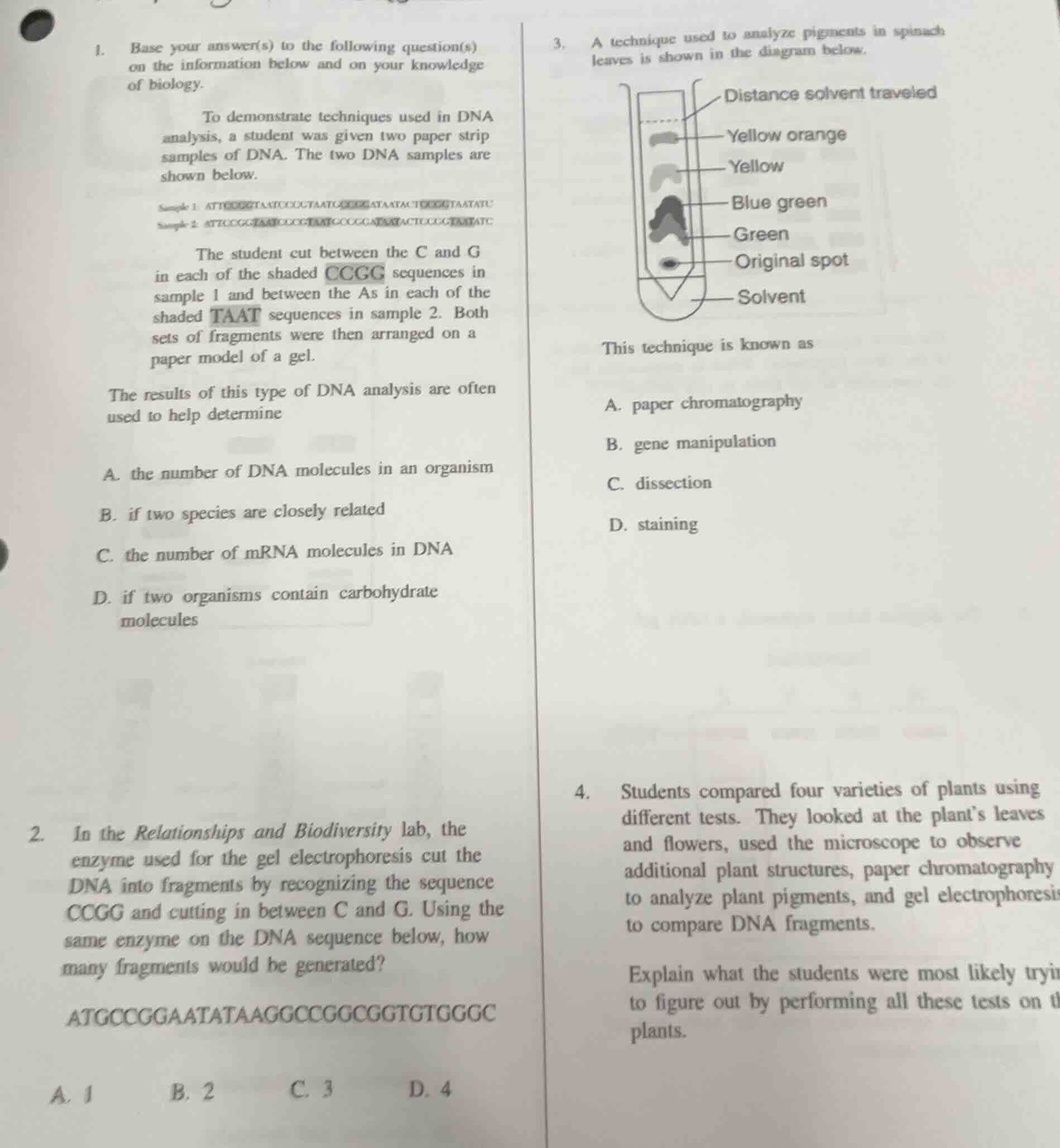
- base your answer(s) to the following question(s) on the information below and on your knowledge of biology. to demonstrate techniques used in dna analysis, a student was given two paper strip samples of dna. the two dna samples are shown below. sample 1: attcggttaatcccgtaatcccgtaatactcccgtaatatc sample 2: attcggttaatcccgtaatcccgtaatactcccgtaatatc the student cut between the c and g in each of the shaded ccgg sequences in sample 1 and between the as in each of the shaded taat sequences in sample 2. both sets of fragments were then arranged on a paper model of a gel. the results of this type of dna analysis are often used to help determine a. the number of dna molecules in an organism b. if two species are closely related c. the number of mrna molecules in dna d. if two organisms contain carbohydrate molecules 2. in the relationships and biodiversity lab, the enzyme used for the gel electrophoresis cut the dna into fragments by recognizing the sequence ccgg and cutting in between c and g. using the same enzyme on the dna sequence below, how many fragments would be generated? atgccggaatataaggccggcggtgtgggca a. 1 b. 2 c. 3 d. 4 3. a technique used to analyze pigments in spinach leaves is shown in the diagram below. this technique is known as a. paper chromatography b. gene manipulation c. dissection d. staining 4. students compared four varieties of plants using different tests. they looked at the plant’s leaves and flowers, used the microscope to observe additional plant structures, paper chromatography to analyze plant pigments, and gel electrophoresis to compare dna fragments. explain what the students were most likely trying to figure out by performing all these tests on the plants.
Question 1
DNA analysis techniques like gel electrophoresis (implied here by cutting DNA into fragments) are used to compare DNA sequences. Closely related species have more similar DNA, so this analysis helps determine evolutionary relationships or relatedness. Option A is incorrect as it's not about counting DNA molecules. Option C is wrong because it's not about mRNA count. Option D is incorrect as DNA analysis doesn't test for carbohydrates.
Step1: Identify the recognition sequence
The enzyme cuts at CCGG, between C and G.
Step2: Locate CCGG in the DNA sequence
The DNA sequence is ATGCCGGAATATAAGGCCGGCGGTGTGGGC. Let's find CCGG:
- First CCGG: positions 3 - 6 (ATGCCGGAATATAAGGCCGGCGGTGTGGGC)
- Second CCGG: positions 13 - 16 (ATGCCGGAATATAAGGCCGGCGGTGTGGGC? Wait, no, let's re - check. Wait, the sequence: ATG CCGG AATATAAGG CCGG CGG TGTGGGC. Wait, let's write the sequence with spaces for CCGG: ATG (CCGG) AATATAAGG (CCGG) (CGG? No, CCGG is 4 bases: C, C, G, G. So first CCGG: ATG C C G G AATATAAGG C C G G C G G TGTGGGC. Wait, the sequence is ATGCCGGAATATAAGGCCGGCGGTGTGGGC. Let's index the bases (1 - n):
1:A, 2:T, 3:G, 4:C, 5:C, 6:G, 7:G, 8:A, 9:A, 10:T, 11:A, 12:T, 13:A, 14:A, 15:G, 16:G, 17:C, 18:C, 19:G, 20:G, 21:C, 22:G, 23:G, 24:T, 25:G, 26:G, 27:G, 28:C.
Wait, no, let's write the sequence as a string: "ATGCCGGAATATAAGGCCGGCGGTGTGGGC"
Looking for "CCGG":
- First "CCGG" starts at index 4: "CCGG" (positions 4 - 7: C, C, G, G)
- Second "CCGG" starts at index 17: "CCGG" (positions 17 - 20: C, C, G, G)
- Wait, wait, the sequence is ATG C C G G A A T A T A A G G C C G G C G G T G T G G G C. Wait, maybe I made a mistake. Wait, the original sequence: ATGCCGGAATATAAGGCCGGCGGTGTGGGC. Let's split into triplets or quadruplets for CCGG (4 - base sequence: CCGG).
First CCGG: positions 3 - 6? No, base 3 is G, base 4 is C, base 5 is C, base 6 is G, base 7 is G. Wait, no: A(1), T(2), G(3), C(4), C(5), G(6), G(7), A(8), A(9), T(10), A(11), T(12), A(13), A(14), G(15), G(16), C(17), C(18), G(19), G(20), C(21), G(22), G(23), T(24), G(25), G(26), G(27), C(28).
Wait, "CCGG" is C - C - G - G. So we need two Cs followed by two Gs. So in the sequence:
- At positions 4 - 7: C(4), C(5), G(6), G(7) → CCGG
- At positions 17 - 20: C(17), C(18), G(19), G(20) → CCGG
- Wait, is there a third? Wait, the sequence after 20 is C(21), G(22), G(23), T(24)... No, C(21), G(22), G(23) is CGG, not CCGG. Wait, maybe the sequence is ATGCCGGAATATAAGGCCGGCGGTGTGGGC. Let's count the number of CCGG:
First CCGG: "CCGG" (from ATGCCGGAATATAAGGCCGGCGGTGTGGGC)
Second CCGG: "CCGG" (from ATGCCGGAATATAAGGCCGGCGGTGTGGGC)
Wait, but when we cut at each CCGG, the number of fragments is (number of cuts + 1). Wait, if there are 2 CCGG sequences, the number of cuts is 2, so fragments = 2 + 1? No, wait, no. Wait, let's take an example: if a sequence is X - CCGG - Y - CCGG - Z, cutting at each CCGG will give X, Y, Z? No, wait, cutting between C and G in CCGG (so the cut is after the second C, before the two Gs? Wait, the problem says "cut between the C and G in each of the shaded CCGG sequences" i.e., CCGG → cut between C and G, so C C | G G. So for a single CCGG, it's split into CC and GG? No, wait, the DNA is a long chain, so when you cut at a restriction site, you get fragments. The number of fragments is (number of restriction sites) + 1.
Wait, the DNA sequence is ATGCCGGAATATAAGGCCGGCGGTGTGGGC. Let's find all CCGG:
- CCGG at positions 4 - 7 (C, C, G, G)
- CCGG at positions 17 - 20 (C, C, G, G)
Wait, but let's check the sequence again. Wait, the sequence is ATG C C G G A A T A T A A G G C C G G C G G T G T G G G C. So the first CCGG is at bases 4 - 7 (C, C, G, G), the second at bases 17 - 20 (C, C, G, G). Wait, but when we cut at each CCGG, the number of fragments is (number of cuts) + 1. If there are 2 CCGG sites, we make 2 cuts, so 3 fragments. Wait, but let's test with a simple example: sequence A - CCGG - B - CCGG - C. Cutting at each CCGG gives A, B, C? No, cutting at first CCGG: A - (cut) - B -…
Paper chromatography is a technique used to separate pigments (like chlorophyll and carotenoids in spinach leaves) based on their solubility in a solvent. The diagram shows a paper with solvent travel, original spot, and separated pigment spots, which matches paper chromatography. Gene manipulation is not a separation technique. Dissection is for cutting tissues, not pigment analysis. Staining is for coloring, not separation.

Snap & solve any problem in the app
Get step-by-step solutions on Sovi AI
Photo-based solutions with guided steps
Explore more problems and detailed explanations
B. if two species are closely related