QUESTION IMAGE
Question
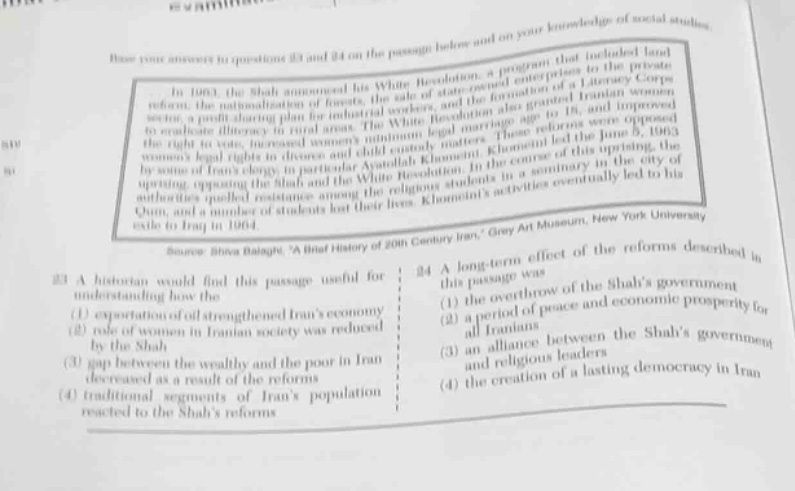
base your answer to questions 23 and 24 on the passage below and on your knowledge of social studies.
in 1963, the shah announced his white revolution, a program that included land reform, the nationalization of forests, the sale of state - owned enterprises to the private sector, a profit - sharing plan for industrial workers, and the formation of a literacy corps to eradicate illiteracy in rural areas. the white revolution also granted iranian women the right to vote, increased womens minimum age to 18, and improved womens legal rights to divorce and child custody matters. these reforms were opposed by some of irans clergy, in particular ayatollah khomeini. khomeini led the uprising of qum, and a number of students lost their lives. on june 5, 1963 authorities quelled resistance among the religious students. in the course of this uprising, the city of qum, and a number of students lost their lives. khomeinis activities eventually led to his exile to iraq in 1964.
source: shiva balaghi, a brief history of 20th century iran, grey art museum, new york university
23 a historian would find this passage useful for understanding how the
(1) exportation of oil strengthened iran’s economy
(2) role of women in iranian society was reduced by the shah
(3) gap between the wealthy and the poor in iran decreased as a result of the reforms
(4) traditional segments of iran’s population reacted to the shah’s reforms
24 a long - term effect of the reforms described in this passage was
(1) the overthrow of the shah’s government
(2) a period of peace and economic prosperity for all iranians
(3) an alliance between the shah’s government and religious leaders
(4) the creation of a lasting democracy in iran
Question 23
To solve this, we analyze each option:
- Option (1): The passage focuses on the White Revolution's social/political impacts, not oil exportation's economic effect. Eliminate.
- Option (2): The passage states the Shah granted women rights (vote, divorce, child custody), so women's role was expanded, not reduced. Eliminate.
- Option (3): The passage doesn't discuss wealth - poor gap from reforms. Eliminate.
- Option (4): The passage mentions opposition from traditional segments (religious leaders, some clergy) to the Shah's reforms (e.g., land reform, women's rights). This matches.
Analyze each option:
- Option (1): The White Revolution's reforms (secular, western - leaning) led to opposition from religious groups, eventually contributing to the 1979 revolution that overthrew the Shah. This is a long - term effect.
- Option (2): The reforms led to unrest, not peace/prosperity. Eliminate.
- Option (3): The reforms caused conflict with religious leaders, not an alliance. Eliminate.
- Option (4): Iran did not become a lasting democracy after the Shah; the revolution led to an Islamic republic. Eliminate.

Snap & solve any problem in the app
Get step-by-step solutions on Sovi AI
Photo-based solutions with guided steps
Explore more problems and detailed explanations
(4) traditional segments of Iran’s population reacted to the Shah’s reforms