QUESTION IMAGE
Question
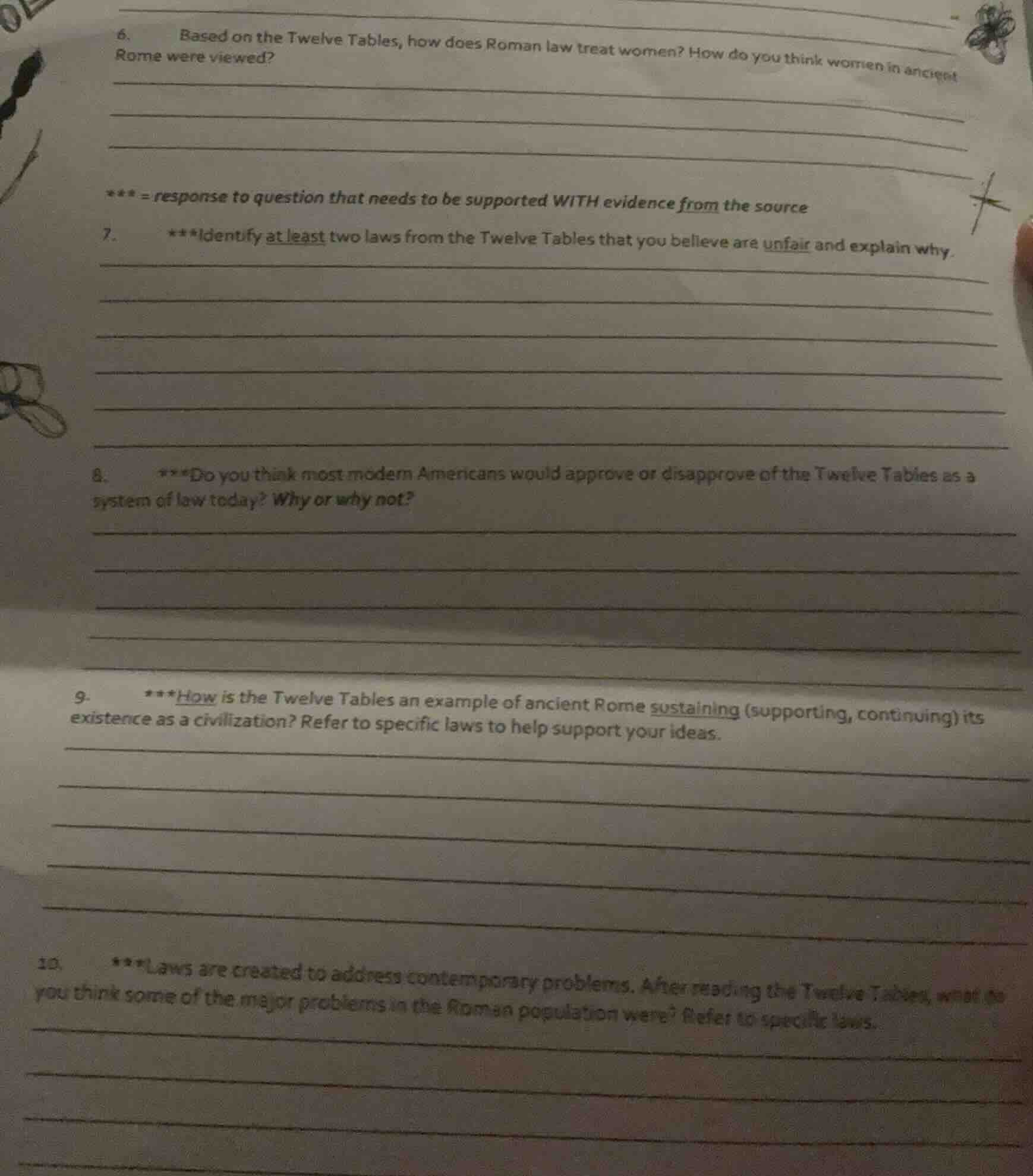
- based on the twelve tables, how does roman law treat women? how do you think women in ancient rome were viewed?
*** = response to question that needs to be supported with evidence from the source
- ***identify at least two laws from the twelve tables that you believe are unfair and explain why.
- ***do you think most modern americans would approve or disapprove of the twelve tables as a system of law today? why or why not?
- ***how is the twelve tables an example of ancient rome sustaining (supporting, continuing) its existence as a civilization? refer to specific laws to help support your ideas.
- ***laws are created to address contemporary problems. after reading the twelve tables, what do you think some of the major problems in the roman population were? refer to specific laws.
Question 6:
Under the Twelve Tables, women were legally under the potestas (absolute authority) of their father or husband (paterfamilias) for life, even after marriage. For example, a woman could not own property, enter contracts, or initiate legal action on her own. This reflects that women in ancient Rome were viewed as dependent, non-autonomous members of society, lacking full legal personhood, and their primary role was seen as domestic and reproductive, tied to the family structure.
Question 7:
- Law on debt bondage (Table 3): This law allowed creditors to imprison, chain, or even kill a debtor who failed to repay debts. It is unfair because it imposed extreme, life-altering punishment for financial hardship, prioritizing creditor rights over human dignity without protections for those facing unavoidable poverty.
- Law on female guardianship (Table 5): This law mandated that all women, regardless of age, remain under the permanent guardianship of a male relative. It is unfair because it stripped women of all legal autonomy, treating them as perpetual minors with no ability to control their own lives, property, or choices, solely based on their gender.
Question 8:
Most modern Americans would strongly disapprove of the Twelve Tables as a legal system today. This is because modern U.S. legal and cultural values center on equality before the law, individual rights, and due process—all of which the Twelve Tables violated. For example, the tables enshrine gender-based discrimination, extreme debt punishment, and unequal treatment of social classes (e.g., harsher penalties for lower-class citizens), which conflict with core American principles like equal protection under the law.
Question 9:
The Twelve Tables sustained Roman civilization by establishing a standardized, written legal code that reduced conflict and stabilized society:
- Property laws (Table 7): These defined clear rules for land ownership, boundaries, and inheritance. This prevented disputes over land, a critical resource in an agrarian society, and ensured orderly transfer of wealth, supporting economic stability.
- Court procedure laws (Table 1): These set formal rules for initiating legal cases, including required notice to defendants. This created a predictable, public system of justice that reduced vigilante violence and gave citizens a structured way to resolve conflicts, maintaining social order.
Question 10:
The Twelve Tables reveal key problems in Roman society:
- Debt and economic inequality: Table 3's strict debt laws show that widespread debt and exploitation of vulnerable debtors was a major issue, as the state felt the need to formalize harsh penalties to enforce repayment.
- Property disputes: Table 7's detailed rules on land boundaries, trespassing, and property damage indicate frequent conflicts over land and resources, likely driven by growing population pressure and unequal land distribution.
- Lack of consistent justice: Before the Twelve Tables, laws were unwritten and controlled by the wealthy patrician class. The creation of a written code (the Twelve Tables) was a demand from the plebeian lower class, showing a major rift between social classes over unequal access to fair legal treatment.

Snap & solve any problem in the app
Get step-by-step solutions on Sovi AI
Photo-based solutions with guided steps
Explore more problems and detailed explanations
Question 6:
Under the Twelve Tables, women were permanently under male guardianship, with no right to own property, sign contracts, or act independently in law. They were viewed as dependent, non-autonomous members of society, whose identity and purpose were tied to their family and male relatives.
Question 7:
- Debt bondage law (Table 3): Unfair because it allowed creditors to imprison or kill debtors for unpaid debts, prioritizing financial claims over human life and dignity.
- Permanent female guardianship law (Table 5): Unfair because it stripped all women of legal autonomy, treating them as perpetual minors regardless of age or competence, solely based on gender.
Question 8:
Most modern Americans would disapprove. The Twelve Tables conflict with core U.S. values like equal protection under the law, individual autonomy, and due process, as it enshrines gender discrimination, extreme class-based penalties, and lack of basic human rights protections.
Question 9:
- Property laws (Table 7) stabilized the agrarian economy by defining clear ownership and inheritance rules, preventing resource conflicts.
- Formal court procedures (Table 1) created a predictable justice system, reducing vigilante violence and resolving disputes to maintain social order, supporting long-term civilization stability.
Question 10:
- Widespread debt and economic exploitation, shown by strict debt punishment laws (Table 3).
- Frequent property and land disputes, addressed by detailed property boundary and trespass laws (Table 7).
- Severe class inequality and unequal access to justice, as the written code was a plebeian demand to counter patrician control of unwritten laws.