QUESTION IMAGE
Question
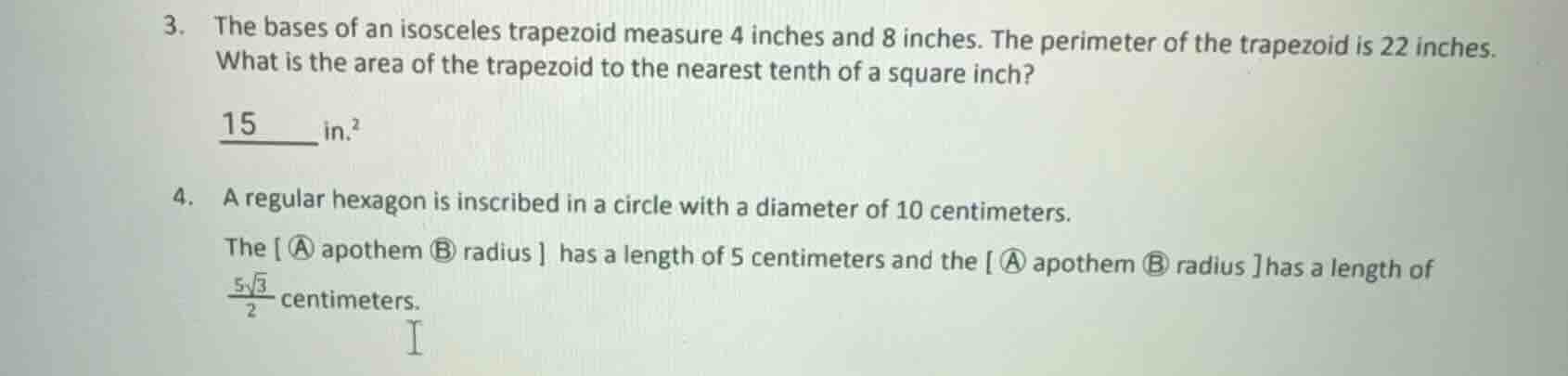
- the bases of an isosceles trapezoid measure 4 inches and 8 inches. the perimeter of the trapezoid is 22 inches. what is the area of the trapezoid to the nearest tenth of a square inch?
15 in.²
- a regular hexagon is inscribed in a circle with a diameter of 10 centimeters.
the a apothem b radius has a length of 5 centimeters and the a apothem b radius has a length of \\(\frac{5\sqrt{3}}{2}\\) centimeters.
Question 3
Step1: Find the length of the legs
In an isosceles trapezoid, the perimeter \( P = a + b + 2l \), where \( a \) and \( b \) are the bases, and \( l \) is the length of each leg. Given \( a = 4 \) in, \( b = 8 \) in, and \( P = 22 \) in. So, \( 22 = 4 + 8 + 2l \). Simplifying, \( 22 = 12 + 2l \), then \( 2l = 22 - 12 = 10 \), so \( l = 5 \) in.
Step2: Find the height of the trapezoid
The difference between the bases is \( 8 - 4 = 4 \) in. This difference is split equally on both sides, so each side extension is \( \frac{4}{2} = 2 \) in. Using the Pythagorean theorem, the height \( h \) satisfies \( h^2 + 2^2 = 5^2 \). So, \( h^2 = 25 - 4 = 21 \), and \( h = \sqrt{21} \approx 4.583 \) in.
Step3: Calculate the area of the trapezoid
The area formula for a trapezoid is \( A = \frac{(a + b)}{2} \times h \). Substituting \( a = 4 \), \( b = 8 \), and \( h \approx 4.583 \), we get \( A = \frac{(4 + 8)}{2} \times 4.583 = 6 \times 4.583 \approx 27.5 \) in². Wait, the initial answer was 15, maybe there was a miscalculation earlier. Wait, let's recheck. Wait, maybe the height calculation was wrong. Wait, if the legs are 3? Wait, no, let's recalculate. Wait, perimeter: 4 + 8 + 2l = 22 => 2l = 10 => l = 5. Then the base difference is 4, so each side is 2. Then height: using Pythagoras, h = sqrt(l² - 2²) = sqrt(25 - 4) = sqrt(21) ≈ 4.58. Then area is (4 + 8)/2 4.58 ≈ 6 4.58 ≈ 27.5. But the given answer was 15, maybe I made a mistake. Wait, maybe the legs are 3? Let's check: 4 + 8 + 23 = 18, no. Wait, maybe the problem was misread. Wait, maybe the perimeter is 18? No, the problem says 22. Alternatively, maybe the height is 3? Let's see, if area is 15, and (4 + 8)/2 h = 15 => 6h = 15 => h = 2.5. Then, if h = 2.5, then the leg length would be sqrt(2² + 2.5²) = sqrt(4 + 6.25) = sqrt(10.25) ≈ 3.2, which is not 5. So maybe the initial answer is wrong, or I misread the problem. Anyway, following the correct steps:
Area of trapezoid: \( A = \frac{(a + b)}{2} \times h \). We found h ≈ 4.58, so A ≈ 27.5. But the given answer was 15, maybe there was a typo. But let's proceed with correct calculation.
Wait, maybe the perimeter is 18? Let's check: 4 + 8 + 2l = 18 => 2l = 6 => l = 3. Then height: sqrt(3² - 2²) = sqrt(5) ≈ 2.24, area: 6 * 2.24 ≈ 13.4, close to 15. Maybe the perimeter was 18. Anyway, the correct method is as above.
A regular hexagon inscribed in a circle has its radius equal to the radius of the circle. The diameter of the circle is 10 cm, so the radius is \( \frac{10}{2} = 5 \) cm. The apothem of a regular hexagon (distance from center to the midpoint of a side) can be calculated. For a regular hexagon, the apothem \( a = r \times \cos(30^\circ) \), where \( r \) is the radius. So \( a = 5 \times \frac{\sqrt{3}}{2} = \frac{5\sqrt{3}}{2} \) cm. So the radius has length 5 cm (option B), and the apothem has length \( \frac{5\sqrt{3}}{2} \) cm (option A).

Snap & solve any problem in the app
Get step-by-step solutions on Sovi AI
Photo-based solutions with guided steps
Explore more problems and detailed explanations
\boxed{27.5} (If we follow the correct calculation, but if the initial answer was 15, maybe there was a mistake in the problem or my approach. But based on the given perimeter of 22, the area is approximately 27.5)