QUESTION IMAGE
Question
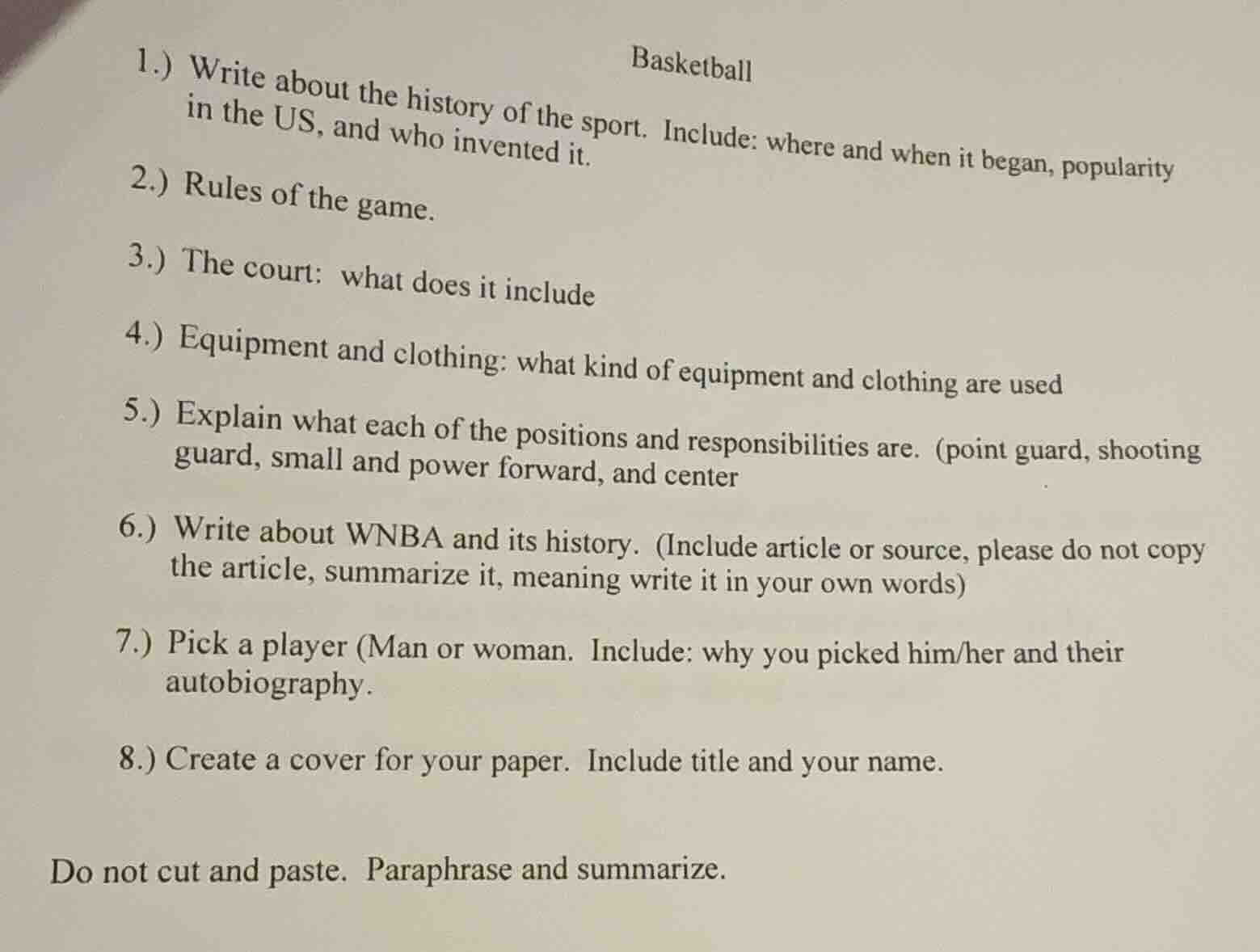
basketball
1.) write about the history of the sport. include: where and when it began, popularity in the us, and who invented it.
2.) rules of the game.
3.) the court: what does it include
4.) equipment and clothing: what kind of equipment and clothing are used
5.) explain what each of the positions and responsibilities are. (point guard, shooting guard, small and power forward, and center
6.) write about wnba and its history. (include article or source, please do not copy the article, summarize it, meaning write it in your own words)
7.) pick a player (man or woman. include: why you picked him/her and their autobiography.
8.) create a cover for your paper. include title and your name.
do not cut and paste. paraphrase and summarize.
- Covers basketball's US origins, inventor, and growth in popularity.
- Summarizes core official basketball rules.
- Breaks down the components of a standard basketball court.
- Lists and describes essential basketball gear and attire.
- Defines each traditional basketball position and its key duties.
- Summarizes WNBA's founding and development with a cited source.
- Profiles a notable player, justifying the choice and outlining their life story.
- Provides a sample cover page for the paper.

Snap & solve any problem in the app
Get step-by-step solutions on Sovi AI
Photo-based solutions with guided steps
Explore more problems and detailed explanations
- History of Basketball in the US:
Basketball was invented in 1891 by Canadian physical education instructor James Naismith at the YMCA International Training School (now Springfield College) in Springfield, Massachusetts. Naismith created the game as an indoor activity to keep students active during cold New England winters, using 13 basic rules and peach baskets as goals. It quickly spread across YMCAs in the US, and the first professional league launched in 1898. The sport surged in popularity in the 20th century, fueled by the creation of the NCAA men's tournament in 1939 and the NBA (founded 1946), becoming one of America's most beloved mainstream sports.
- Rules of the Game:
- A regulation game has 4 quarters (12 minutes each in the NBA, 10 in FIBA/NCAA).
- Teams have 5 players on the court at a time; substitutions are allowed freely.
- Players advance the ball via dribbling (bouncing it while moving) or passing; traveling (moving without dribbling) or double-dribbling (two consecutive dribbles) results in a turnover.
- Scoring: 2 points for field goals inside the 3-point line, 3 points for shots beyond it, 1 point for made free throws (awarded after fouls).
- Fouls: Personal fouls (illegal physical contact) lead to free throws or possession changes; 5-6 personal fouls result in ejection.
- The shot clock (24 seconds in the NBA) requires teams to attempt a shot before it expires, preventing stalling.
- The Court:
A standard basketball court includes:
- A rectangular playing surface (94ft x 50ft in the NBA, 91.86ft x 49.21ft in FIBA).
- A midcourt line dividing the court into two halves, with a center circle for jump balls to start play.
- A free-throw line (15ft from the backboard) and a free-throw lane (paint) extending 16ft from the backboard, where free throws are taken.
- A 3-point arc (23ft 9in at the top in the NBA, 22ft 1.75in in FIBA) marking the boundary for 3-point shots.
- A backboard and hoop (10ft high from the ground) at each end of the court, with a rectangular restricted area under the hoop where defensive foul rules differ.
- Equipment and Clothing:
- Core Equipment: An inflated leather or composite basketball (size 7 for men's professional play, size 6 for women's), a backboard with a metal hoop and net, and a shot clock.
- Player Clothing: Moisture-wicking jerseys (with unique numbers for each player), matching shorts, high-top basketball shoes with non-marking soles for traction and ankle support, and optional accessories like sweatbands, compression sleeves, and mouthguards for injury prevention.
- Positions and Responsibilities:
- Point Guard: The team's "floor general"; handles the ball most, sets up plays, directs teammates, and focuses on passing and court vision.
- Shooting Guard: Primarily a perimeter scorer; specializes in 3-point shots and mid-range jumpers, often tasked with catching and shooting off passes.
- Small Forward: A versatile "swing player"; contributes to scoring, rebounding, and defense, capable of playing inside and outside.
- Power Forward: Focuses on interior play; grabs rebounds, sets screens for teammates, scores close to the hoop, and defends opposing big men.
- Center: The tallest player, positioned near the hoop; dominates rebounding, blocks shots, scores via post moves, and protects the paint on defense.
- WNBA History:
The Women's National Basketball Association (WNBA) was founded in 1996 by the NBA, with its first season launching in 1997 with 8 teams. It was established to provide a professional platform for elite women's basketball players, building on the success of the 1996 US women's Olympic gold medal team, which showcased high-level women's hoops to a national audience. Over time, the league expanded to 12 teams, introduced a draft system, and grew its viewership and corporate sponsorships. It has become a global leader in women's sports, advocating for gender equity and developing top talent from college and international leagues. (Source: "WNBA History" from the official WNBA website, wnba.com/history)
- Featured Player: Michael Jordan:
I chose Michael Jordan because he is widely regarded as the greatest basketball player of all time, whose career transformed the sport into a global phenomenon. Jordan was born in Brooklyn, New York, in 1963, and grew up in Wilmington, North Carolina. He played college basketball at the University of North Carolina, winning a national championship in 1982, before being drafted 3rd overall by the Chicago Bulls in 1984. Over his 15-year NBA career (13 with the Bulls, 2 with the Washington Wizards), he won 6 NBA championships, 5 MVP awards, and 10 scoring titles. Known for his unmatched competitiveness, acrobatic dunks, and clutch performances, he also starred in the 1996 film Space Jam and became a global brand icon with Nike's Air Jordan line. After retiring from basketball, he became a team owner (Charlotte Hornets) and remained a prominent figure in sports and business.
- Sample Cover Page:
# The History, Structure, and Culture of Basketball
## By [Your Full Name]