QUESTION IMAGE
Question
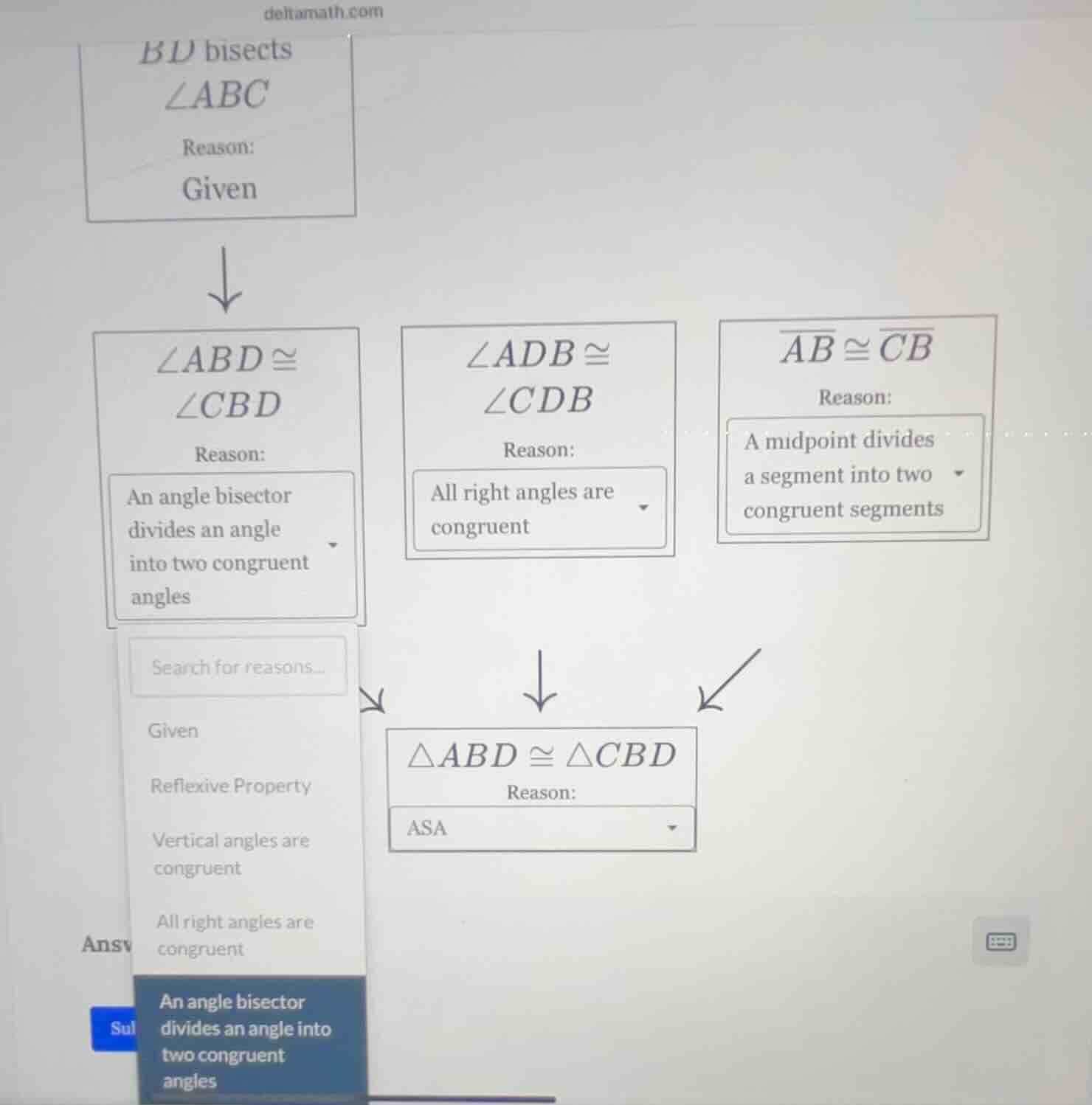
bd bisects ∠abc
reason:
given
∠abd ≅ ∠cbd
reason:
an angle bisector divides an angle into two congruent angles
∠adb ≅ ∠cdb
reason:
all right angles are congruent
\overline{ab} ≅ \overline{cb}
reason:
a midpoint divides a segment into two congruent segments
△abd ≅ △cbd
reason:
asa
Step1: Identify congruent parts
We have \( \angle ABD \cong \angle CBD \) (angle bisector), \( \angle ADB \cong \angle CDB \) (all right angles congruent, or maybe right angles here), and \( \overline{AB} \cong \overline{CB} \) (midpoint divides segment). Also, \( BD \) is common side? Wait, no, the ASA (Angle - Side - Angle) criterion: two angles and the included side. Here, \( \angle ABD \cong \angle CBD \), \( \overline{BD} \cong \overline{BD} \) (reflexive), and \( \angle ADB \cong \angle CDB \)? Wait, no, looking at the given: \( \angle ABD \cong \angle CBD \) (angle bisector), \( \overline{AB} \cong \overline{CB} \) (midpoint), and \( \angle ADB \cong \angle CDB \) (right angles). Wait, actually, for ASA, we need two angles and the included side. Let's check: \( \angle ABD \cong \angle CBD \), \( \overline{BD} \cong \overline{BD} \) (reflexive), and \( \angle ADB \cong \angle CDB \)? No, maybe the included side is \( BD \) between \( \angle ABD \) and \( \angle ADB \), and between \( \angle CBD \) and \( \angle CDB \). So \( \angle ABD \cong \angle CBD \), \( \overline{BD} \cong \overline{BD} \), \( \angle ADB \cong \angle CDB \), so by ASA, \( \triangle ABD \cong \triangle CBD \).
Step2: Confirm the congruence criterion
ASA (Angle - Side - Angle) states that if two angles and the included side of one triangle are congruent to two angles and the included side of another triangle, then the triangles are congruent. Here, \( \angle ABD \cong \angle CBD \), \( \overline{BD} \) is the included side (between \( \angle ABD \) and \( \angle ADB \), and between \( \angle CBD \) and \( \angle CDB \)), and \( \angle ADB \cong \angle CDB \). So the reason for \( \triangle ABD \cong \triangle CBD \) is ASA because we have two angles and the included side congruent.

Snap & solve any problem in the app
Get step-by-step solutions on Sovi AI
Photo-based solutions with guided steps
Explore more problems and detailed explanations
The reason for \( \triangle ABD \cong \triangle CBD \) is ASA (Angle - Side - Angle) congruence criterion, as we have two pairs of congruent angles (\( \angle ABD \cong \angle CBD \), \( \angle ADB \cong \angle CDB \)) and the included side \( \overline{BD} \cong \overline{BD} \) (reflexive property) congruent. So the congruence of \( \triangle ABD \) and \( \triangle CBD \) is by ASA.