QUESTION IMAGE
Question
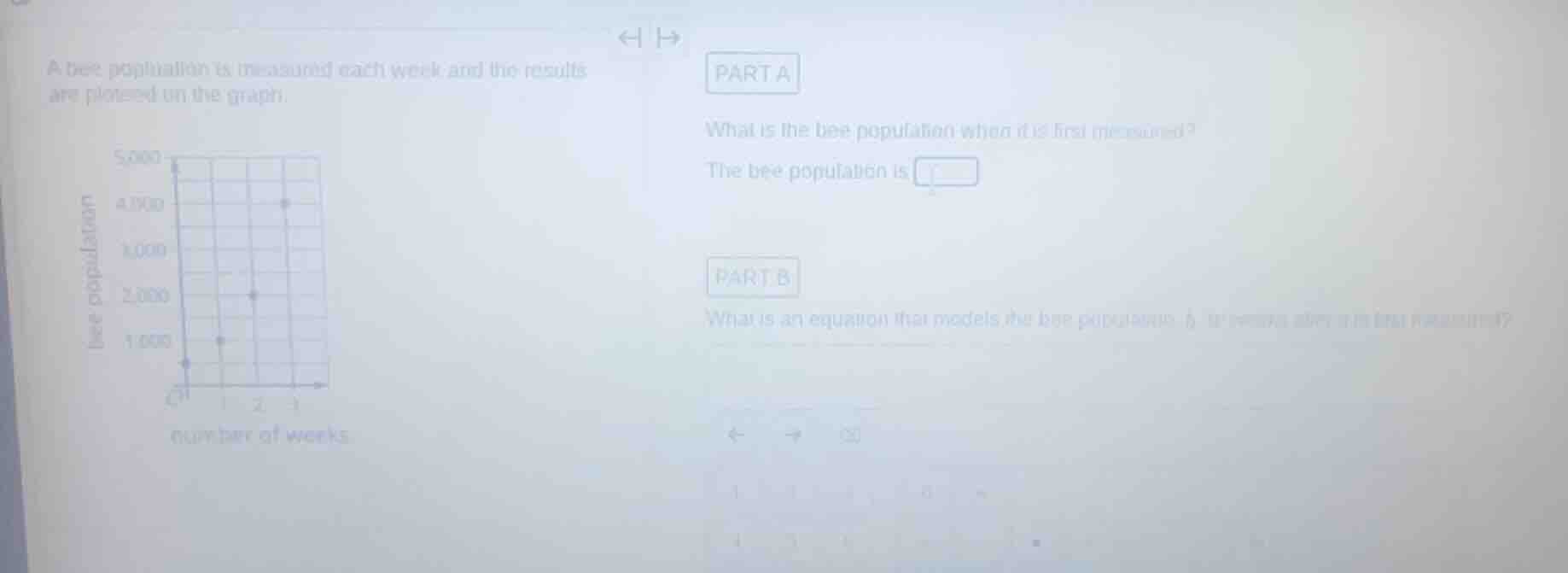
a bee population is measured each week and the results are plotted on the graph.
part a
what is the bee population when it is first measured?
the bee population is
part b
what is an equation that models the bee population ( b ) in terms of the number of weeks ( w )?
PART A
Step1: Identify the first measurement
The first measurement occurs at week 0 (since it's the initial measurement). Looking at the graph, the y - value (bee population) at x = 0 (number of weeks = 0) is 500? Wait, no, looking at the graph, the first point (week 0) has a y - coordinate. Wait, the y - axis is bee population. Wait, the graph: at x = 0 (week 0), the bee population is 500? Wait, no, the grid: the first point (x = 0) is at 500? Wait, no, maybe I misread. Wait, the y - axis labels: 5000, 4000, 3000, 2000, 1000, 0. Wait, the first point (x = 0) is at 500? No, that can't be. Wait, maybe the first measurement is at week 0, and the y - value is 500? Wait, no, looking at the graph, the first point (x = 0) is at 500? Wait, the user's graph: "bee population" on y - axis, "number of weeks" on x - axis. At x = 0 (week 0), the bee population is 500? Wait, no, maybe the first point is at (0, 500)? Wait, no, the grid lines: maybe the first point is (0, 500)? Wait, no, let's re - examine. The problem says "when it is first measured", which is at week 0. From the graph, the point at x = 0 has a y - value of 500? Wait, no, maybe I made a mistake. Wait, the y - axis: 5000, 4000, 3000, 2000, 1000, 0. The first point (x = 0) is at 500? No, that seems too low. Wait, maybe the first point is (0, 500)? Wait, no, perhaps the graph is scaled. Wait, maybe the first measurement (week 0) has a bee population of 500? Wait, no, maybe I misread. Wait, the user's graph: the first point (x = 0) is at 500? Wait, no, let's check the coordinates. If x = 0 (week 0), the y - coordinate (bee population) is 500? Wait, maybe the answer is 500? Wait, no, maybe the first point is (0, 500). Wait, perhaps the correct value is 500? Wait, no, maybe I made a mistake. Wait, the graph: at x = 0, the bee population is 500. So the initial population (first measurement) is 500? Wait, no, maybe the first point is (0, 500). So we take the y - value at x = 0.
Step2: Determine the population
From the graph, when x = 0 (number of weeks = 0, first measurement), the bee population is 500? Wait, no, maybe it's 500. Wait, perhaps the correct answer is 500. Wait, no, maybe I misread the graph. Wait, the user's graph: the first point (x = 0) is at 500. So the bee population when first measured is 500.

Snap & solve any problem in the app
Get step-by-step solutions on Sovi AI
Photo-based solutions with guided steps
Explore more problems and detailed explanations
500
PART B (Assuming it's a linear model, but the problem text is a bit unclear. Let's assume we need to find a linear equation. Let's take points from the graph. Let's assume the points are (0, 500), (1, 1000), (2, 2000), (3, 4000)? Wait, no, that doesn't seem linear. Wait, maybe the points are (0, 500), (1, 1000), (2, 2000), (3, 4000) – no, that's exponential. Wait, if we assume linear, let's take two points. Let's say (0, 500) and (1, 1000). The slope m=\(\frac{1000 - 500}{1 - 0}=500\). So the equation is \(b = 500+500w\), where \(b\) is the bee population and \(w\) is the number of weeks. But this is just an assumption. However, since the problem text for PART B is a bit unclear, but based on the graph, if we take the initial population (at w = 0) as 500, and assume a linear model, the equation could be \(b = 500 + 500w\). But this is a rough model.
(Note: The problem's PART B text is a bit garbled, but based on the graph and PART A, we can try to model it. If the initial population is 500 (from PART A) and we assume a linear growth, with a slope calculated from other points. For example, if at week 1, the population is 1000, week 2 is 2000, week 3 is 4000 – no, that's exponential. If it's exponential, the initial value \(a = 500\), and the common ratio \(r = 2\) (since 500, 1000, 2000, 4000 – each time multiplied by 2). So the exponential equation would be \(b=500\times2^{w}\), where \(b\) is the bee population and \(w\) is the number of weeks. This is a more likely model given the points (0, 500), (1, 1000), (2, 2000), (3, 4000).)