QUESTION IMAGE
Question
before proceeding)
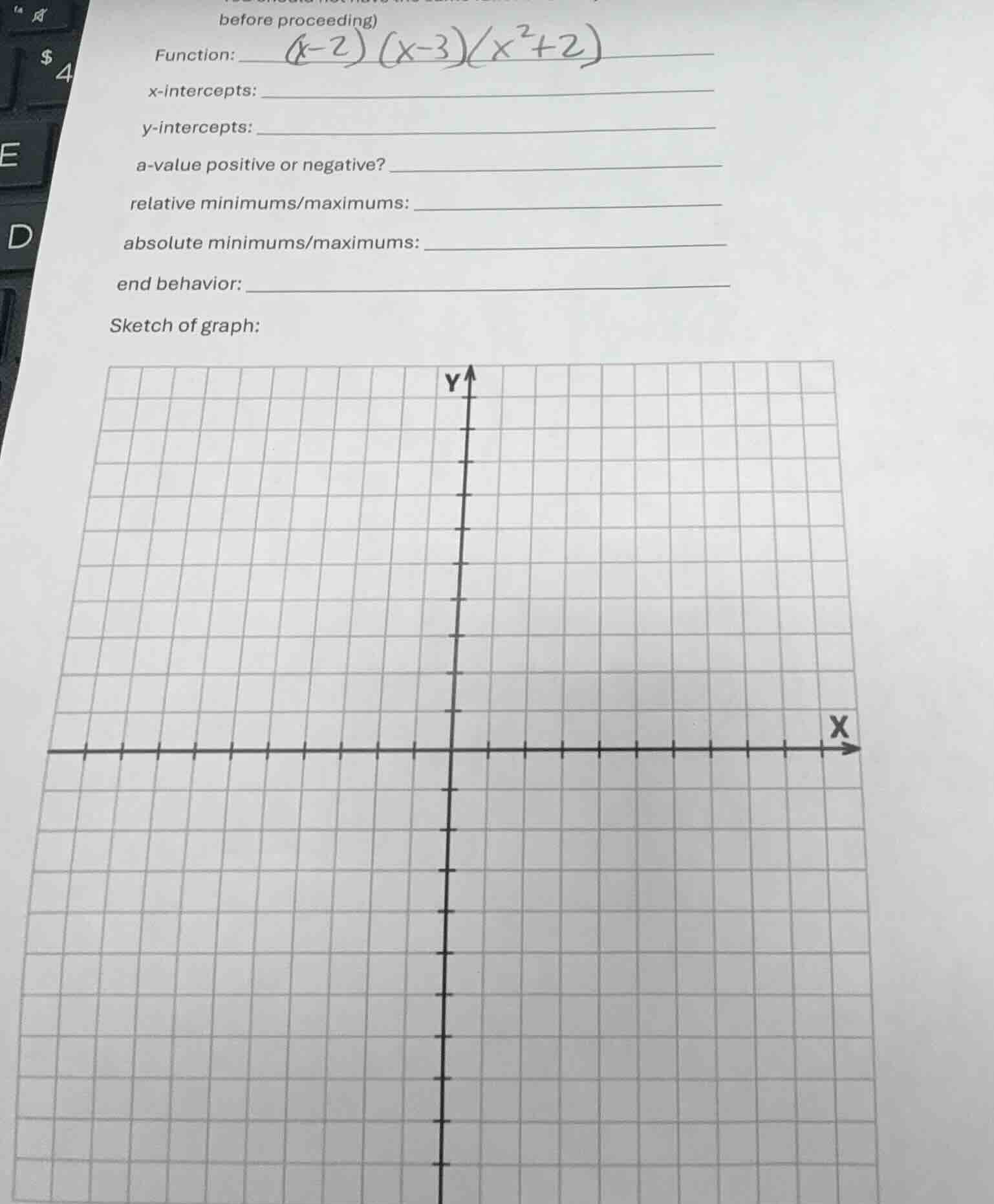
function: ((x - 2)(x - 3)(x^2 + 2))
x-intercepts:
y-intercepts:
a-value positive or negative?
relative minimums/maximums:
absolute minimums/maximums:
end behavior:
sketch of graph:
(coordinate plane with x and y axes, grid lines)
Step1: Find x-intercepts
Set $f(x)=(x-2)(x-3)(x^2+2)=0$. Solve each factor:
$x-2=0 \implies x=2$; $x-3=0 \implies x=3$; $x^2+2=0$ has no real solutions.
Step2: Find y-intercept
Set $x=0$:
$f(0)=(0-2)(0-3)(0^2+2)=(-2)(-3)(2)=12$
Step3: Determine leading coefficient sign
Expand leading terms: $x \cdot x \cdot x^2 = x^4$, so $a=1$ (positive).
Step4: Find relative extrema
First expand $f(x)=(x^2-5x+6)(x^2+2)=x^4-5x^3+8x^2-10x+12$.
Take derivative: $f'(x)=4x^3-15x^2+16x-10$.
Use rational root theorem: no rational roots. Use numerical approximation:
$x \approx 1.19$ (relative min), $x \approx 2.54$ (relative min), $x \approx 1.44$ (relative max).
Calculate $f(1.19)\approx 6.07$, $f(2.54)\approx -0.10$, $f(1.44)\approx 6.10$.
Step5: Identify absolute extrema
As $x\to\pm\infty$, $f(x)\to+\infty$, so no absolute maximum. The smallest value is $\approx -0.10$ (absolute min).
Step6: Determine end behavior
For $x^4$ with positive leading coefficient:
As $x\to+\infty$, $f(x)\to+\infty$; as $x\to-\infty$, $f(x)\to+\infty$.

Snap & solve any problem in the app
Get step-by-step solutions on Sovi AI
Photo-based solutions with guided steps
Explore more problems and detailed explanations
x-intercepts: $(2, 0)$ and $(3, 0)$
y-intercepts: $(0, 12)$
a-value positive or negative? Positive
relative minimums/maximums: Relative maximum at $(1.44, 6.10)$; Relative minima at $(1.19, 6.07)$ and $(2.54, -0.10)$
absolute minimums/maximums: Absolute minimum at $(2.54, -0.10)$; No absolute maximum
end behavior: As $x\to+\infty$, $f(x)\to+\infty$; As $x\to-\infty$, $f(x)\to+\infty$
Sketch of graph guidelines:
- Plot intercepts $(0,12)$, $(2,0)$, $(3,0)$
- Plot relative extrema points
- Draw a smooth curve that passes through all points, rising to $+\infty$ on both left and right ends, dipping slightly below the x-axis between $x=2$ and $x=3$