QUESTION IMAGE
Question
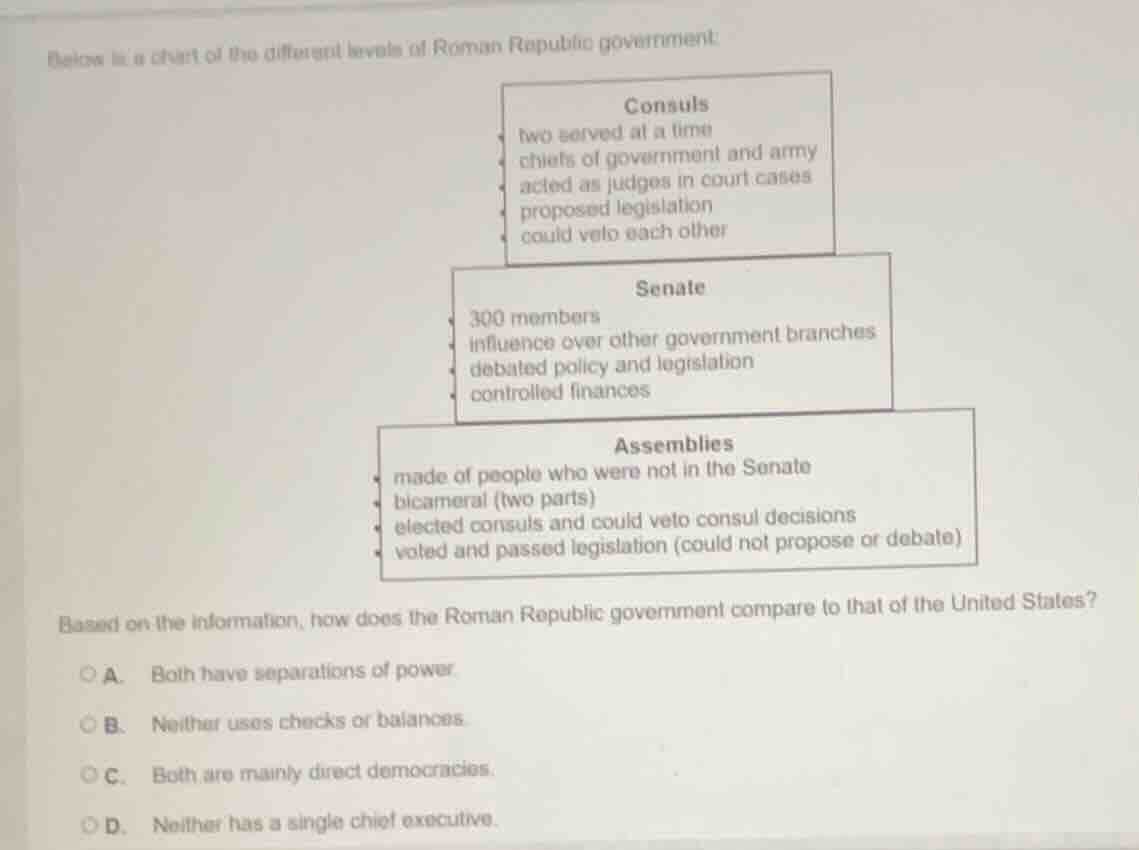
below is a chart of the different levels of roman republic government:consulstwo served at a timechiefs of government and armyacted as judges in court casesproposed legislationcould veto each othersenate300 membersinfluence over other government branchesdebated policy and legislationcontrolled financesassembliesmade of people who were not in the senatebicameral (two parts)elected consuls and could veto consul decisionsvoted and passed legislation (could not propose or debate)based on the information, how does the roman republic government compare to that of the united states?a. both have separations of powerb. neither uses checks or balancesc. both are mainly direct democraciesd. neither has a single chief executive
- Analyze the Roman Republic structure: It has separate branches (Consuls, Senate, Assemblies) with distinct powers, and checks like consuls vetoing each other, Assemblies vetoing consul decisions.
- Analyze the U.S. government structure: It has three separate branches (Executive, Legislative, Judicial) with a system of checks and balances, and clear separation of powers.
- Evaluate options:
- A: Both have separation of power, which matches the analysis.
- B: Both use checks and balances, so this is false.
- C: The U.S. is a representative democracy, not direct; the Roman Republic was also largely representative, so this is false.
- D: The U.S. has a single chief executive (the President), so this is false.

Snap & solve any problem in the app
Get step-by-step solutions on Sovi AI
Photo-based solutions with guided steps
Explore more problems and detailed explanations
A. Both have separations of power.