QUESTION IMAGE
Question
biology b midterm assessment study guide
experimental design
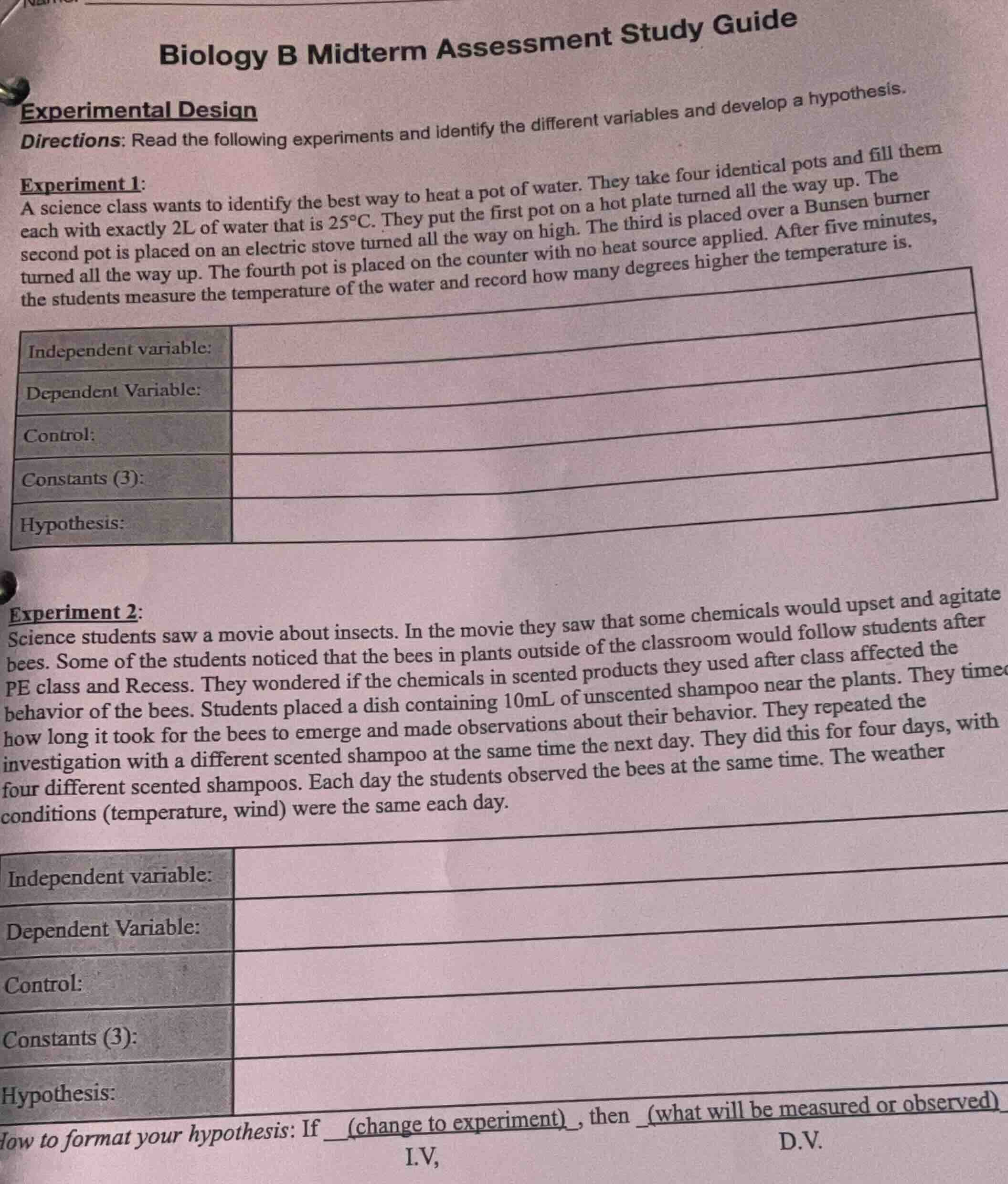
directions: read the following experiments and identify the different variables and develop a hypothesis.
experiment 1:
a science class wants to identify the best way to heat a pot of water. they take four identical pots and fill them each with exactly 2l of water that is 25°c. they put the first pot on a hot plate turned all the way up. the second pot is placed on an electric stove turned all the way on high. the third is placed over a bunsen burner turned all the way up. the fourth pot is placed on the counter with no heat source applied. after five minutes, the students measure the temperature of the water and record how many degrees higher the temperature is.
| independent variable: | |
|---|---|
| control: | |
| constants (3): | |
| hypothesis: |
experiment 2:
science students saw a movie about insects. in the movie they saw that some chemicals would upset and agitate bees. some of the students noticed that the bees in plants outside of the classroom would follow students after pe class and recess. they wondered if the chemicals in scented products they used after class affected the behavior of the bees. students placed a dish containing 10ml of unscented shampoo near the plants. they timed how long it took for the bees to emerge and made observations about their behavior. they repeated the investigation with a different scented shampoo at the same time the next day. they did this for four days, with four different scented shampoos. each day the students observed the bees at the same time. the weather conditions (temperature, wind) were the same each day.
independent variable:
dependent variable:
control:
constants (3):
hypothesis:
how to format your hypothesis: if _(change to experiment)_, then _(what will be measured or observed)_
i.v, d.v.
Experiment 1
- Independent variable: The factor that is changed. Here, it's the heat source (hot plate, electric stove, Bunsen burner, no heat).
- Dependent Variable: The factor that is measured. Here, it's the change in water temperature (how many degrees higher the temperature is).
- Control: The group with no heat source (fourth pot) to compare.
- Constants (3): Identical pots, 2L of water, initial temperature 25°C (these are kept the same).
- Hypothesis: If we use different heat sources (I.V.), then the water temperature will increase by different amounts (D.V.) (e.g., "If a pot of water is heated with a hot plate, electric stove, or Bunsen burner, then the water heated by the Bunsen burner will have the highest temperature increase after five minutes.").
- Independent variable: The factor that is changed. Here, it's the type of shampoo (unscented, different scented shampoos).
- Dependent Variable: The factor that is measured. Here, it's the time for bees to emerge and their behavior.
- Control: The group with unscented shampoo (to compare).
- Constants (3): 10mL of shampoo, same time of observation, same weather conditions (temperature, wind) each day (these are kept the same).
- Hypothesis: If we use different types of shampoo (scented vs. unscented, different scented) (I.V.), then the time for bees to emerge and their behavior will be affected (D.V.) (e.g., "If different scented shampoos are placed near bee plants, then the time for bees to emerge and their behavior will differ compared to using unscented shampoo.").

Snap & solve any problem in the app
Get step-by-step solutions on Sovi AI
Photo-based solutions with guided steps
Explore more problems and detailed explanations
- Independent variable: Type of heat source (hot plate, electric stove, Bunsen burner, no heat)
- Dependent Variable: Change in water temperature (degrees higher)
- Control: The pot with no heat source (fourth pot)
- Constants (3): Identical pots, 2L of water, initial temperature 25°C
- Hypothesis: If a pot of water is heated using different heat sources (hot plate, electric stove, Bunsen burner, no heat), then the temperature increase of the water will differ depending on the heat source.