QUESTION IMAGE
Question
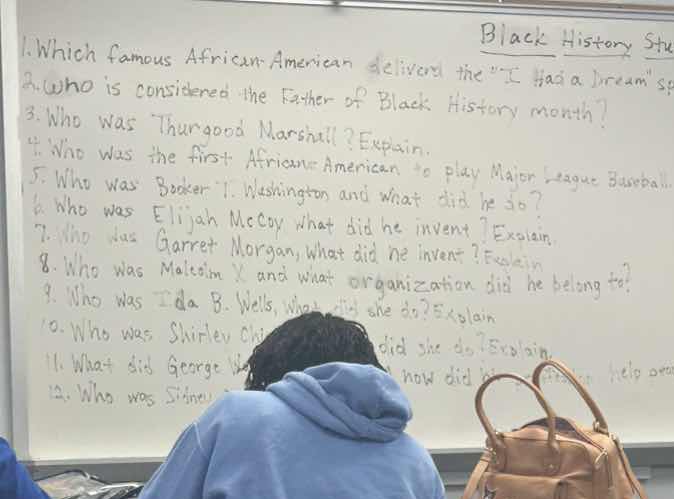
black history stu
- which famous african american delivered the \i have a dream\ spe
- who is considered the father of black history month?
- who was thurgood marshall? explain.
- who was the first african american to play major league baseball.
- who was booker t. washington and what did he do?
- who was elijah mccoy what did he invent? explain.
- who was garret morgan, what did he invent? explain
- who was malcolm x and what organization did he belong to?
- who was ida b. wells, what did she do? explain
- who was shirley chi did she do? explain
- what did george w now did h help peo
- who was sidn
Brief Explanations
- The "I Have a Dream" speech was delivered by Martin Luther King Jr., a pivotal civil rights leader.
- Carter G. Woodson, a historian and author, established the precursor to Black History Month, earning him the title "Father of Black History Month."
- Thurgood Marshall was the first African American Supreme Court Justice; he also won the landmark Brown v. Board of Education case that ended school segregation.
- Jackie Robinson broke Major League Baseball's color barrier in 1947 when he joined the Brooklyn Dodgers.
- Booker T. Washington was a prominent educator and civil rights leader; he founded the Tuskegee Institute to provide vocational training for African Americans and advocated for economic advancement as a path to equality.
- Elijah McCoy was a Canadian-American inventor; he created the automatic lubricator for steam engines, which revolutionized industrial machinery by reducing downtime for manual lubrication.
- Garrett Morgan was an African American inventor; he created the three-position traffic signal (to prevent collisions between changing signals) and a smoke hood (early gas mask) to protect firefighters and workers from toxic fumes.
- Malcolm X was a radical civil rights leader; he was a key figure in the Nation of Islam before leaving the organization, advocating for Black pride, self-defense, and racial equality through unapologetic activism.
- Ida B. Wells was a journalist, activist, and anti-lynching crusader; she documented lynchings in the U.S. through her writing, organized anti-lynching campaigns, and co-founded the NAACP.
- Shirley Chisholm was the first African American woman elected to the U.S. Congress (representing New York in 1968) and the first Black woman to run for a major party's presidential nomination (1972). She advocated for racial and gender equality, poverty reduction, and education reform.
- (Note: The question is incomplete. Assuming it refers to George Washington Carver): George Washington Carver was an agricultural scientist; he developed hundreds of uses for crops like peanuts, sweet potatoes, and soybeans to help Southern Black farmers diversify their crops and improve economic stability, reducing reliance on cotton.
- (Note: The name is cut off. Assuming it refers to Sidney Poitier): Sidney Poitier was the first African American man to win an Academy Award for Best Actor (for Lilies of the Field in 1964). He broke racial barriers in Hollywood, starring in films that challenged racial stereotypes, and later worked as a diplomat and activist.

Snap & solve any problem in the app
Get step-by-step solutions on Sovi AI
Photo-based solutions with guided steps
Explore more problems and detailed explanations
- Martin Luther King Jr.
- Carter G. Woodson
- Thurgood Marshall was the first African American U.S. Supreme Court Justice; he led the legal fight against school segregation, winning Brown v. Board of Education.
- Jackie Robinson
- Booker T. Washington was an educator/civil rights leader; he founded the Tuskegee Institute and promoted economic advancement for African Americans via vocational training.
- Elijah McCoy invented the automatic steam engine lubricator, which automated machinery lubrication to cut downtime.
- Garrett Morgan invented the three-position traffic signal and a smoke hood (early gas mask) to improve public safety.
- Malcolm X was a radical civil rights leader; he was part of the Nation of Islam, advocating Black pride and self-defense.
- Ida B. Wells was an anti-lynching activist and journalist; she documented lynchings, campaigned against them, and co-founded the NAACP.
- Shirley Chisholm was the first Black woman in U.S. Congress and first Black woman to seek a major party's presidential nomination; she fought for racial/gender equality and social reform.
- (Assuming George Washington Carver): He developed hundreds of crop uses (peanuts, sweet potatoes) to help Black Southern farmers diversify and stabilize their livelihoods.
- (Assuming Sidney Poitier): He was the first Black man to win an Oscar for Best Actor, breaking Hollywood racial barriers through his film roles and activism.