QUESTION IMAGE
Question
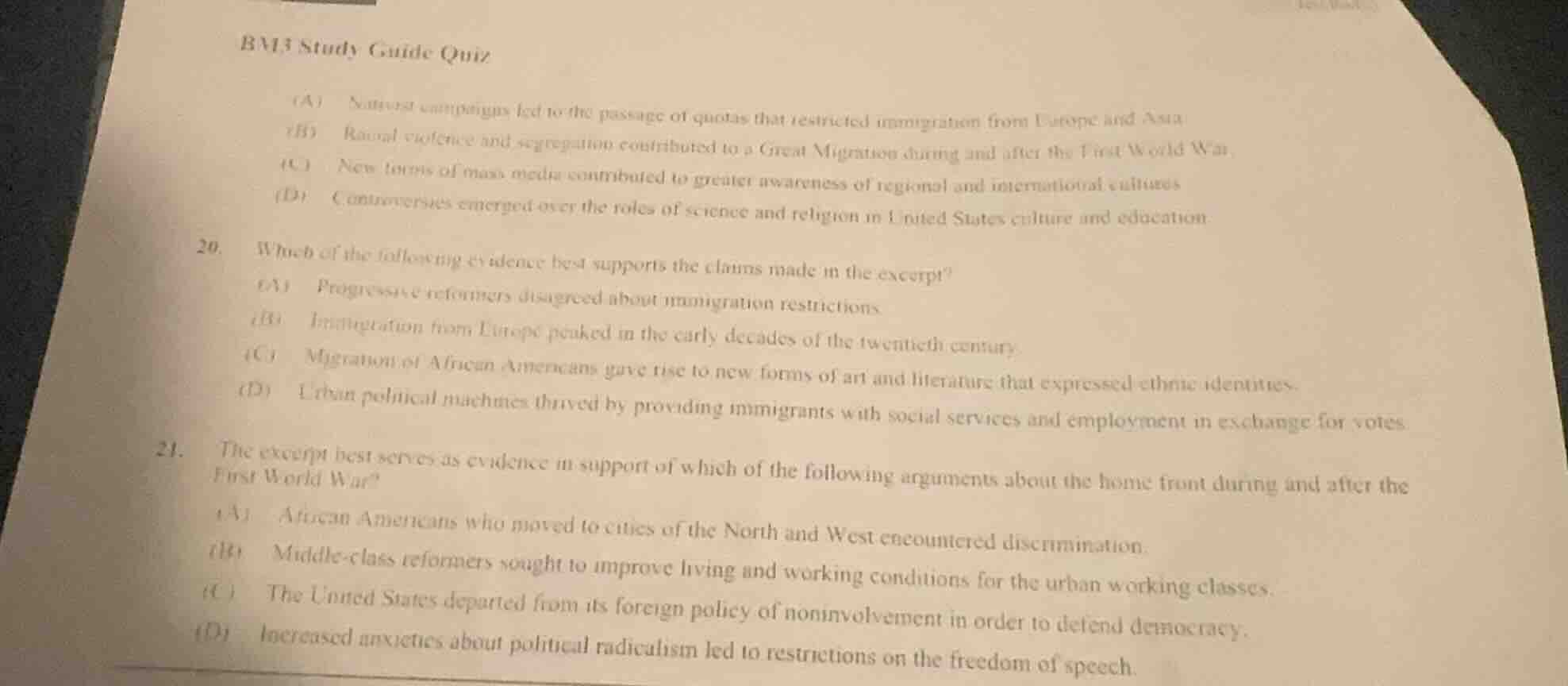
bm13 study guide quiz
(a) nativist campaigns led to the passage of quotas that restricted immigration from europe and asia
(b) racial violence and segregation contributed to a great migration during and after the first world war.
(c) new forms of mass media contributed to greater awareness of regional and international cultures
(d) controversies emerged over the roles of science and religion in united states culture and education
- which of the following evidence best supports the claims made in the excerpt?
(a) progressive reformers disagreed about immigration restrictions
(b) immigration from europe peaked in the early decades of the twentieth century.
(c) migration of african americans gave rise to new forms of art and literature that expressed ethnic identities.
(d) urban political machines thrived by providing immigrants with social services and employment in exchange for votes.
- the excerpt best serves as evidence in support of which of the following arguments about the home front during and after the first world war?
(a) african americans who moved to cities of the north and west encountered discrimination.
(b) middle - class reformers sought to improve living and working conditions for the urban working classes.
(c) the united states departed from its foreign policy of noninvolvement in order to defend democracy.
(d) increased anxieties about political radicalism led to restrictions on the freedom of speech.
Question 19 (assuming the previous question was about the 1920s or related era, but since options are given, let's analyze):
To determine the correct answer, we analyze each option:
- Option A: Nativist campaigns restricting immigration (quota acts like 1924) were part of the era, but need to check context.
- Option B: The Great Migration (African Americans moving North/West) was driven by racial violence (Jim Crow, lynchings) and segregation in the South, especially during/after WWI (jobs in war industries, etc.). This is a key event of the era.
- Option C: Mass media (radio, movies) spreading cultural awareness is true but less tied to the core social issues of the time compared to migration.
- Option D: The Scopes Trial (science vs. religion) was a controversy, but the Great Migration is more about demographic/social change.
If the question is about major social changes in the era (post-WWI), Option B is strong. But since the user's image shows question 20 and 21, let's address question 20 and 21 properly.
Question 20: "Which of the following evidence best supports the claims made in the excerpt?" (Assuming the excerpt relates to the Great Migration or cultural changes)
- Option A: Progressive reformers' disagreement on immigration restrictions – not directly supporting migration or cultural claims.
- Option B: Immigration from Europe peaking – if the excerpt is about internal migration (Great Migration), this is about European immigration, not relevant.
- Option C: Migration of African Americans (Great Migration) led to new art/literature (Harlem Renaissance, expressing ethnic identities). This connects migration to cultural expression, supporting the claim.
- Option D: Urban political machines (Tammany Hall) – about political machines and immigration, not cultural expression from migration.
So Answer for Q20: C. Migration of African Americans gave rise to new forms of art and literature that expressed ethnic identities.
Question 21: "The excerpt best serves as evidence in support of which of the following arguments about the home front during and after the First World War?"
- Option A: African Americans moving North/West faced discrimination – while true, the question is about the home front argument. The home front during WWI included social changes, but let's check others.
- Option B: Middle-class reformers (Progressives) improving urban working conditions – the excerpt (if about migration/cultural change) doesn't relate to reformers' efforts.
- Option C: US departing from noninvolvement (entering WWI) – the question is about home front, not foreign policy.
- Option D: Increased anxieties about political radicalism (Red Scare) led to free speech restrictions – the home front during/after WWI had the Red Scare (fear of radicals, labor unrest), leading to laws like Sedition Act, restricting speech. If the excerpt relates to social tensions, this is a home front argument.
But assuming the excerpt is about the Great Migration or cultural changes, but if the question is about home front arguments, let's re-express:
For Q21, if the excerpt is about social/cultural changes post-WWI:
- Option A: Discrimination against African Americans in North/West – part of home front, but the options' D is about Red Scare (home front issue: civil liberties).
Wait, the home front during WWI included:
- Economic mobilization,
- Social tensions (racial, ethnic, political radicalism),
- Cultural changes.
If the excerpt is about, say, the Red Scare (anxieties about radicals), then D is correct. If about Great Migration, A is correct…
The migration of African Americans (Great Migration) led to cultural expressions like the Harlem Renaissance, where new art/literature expressed ethnic identities. This evidence supports claims about the impact of migration on culture. Option C directly connects migration to cultural output.
During/after WWI, the home front saw the Red Scare (anxieties about political radicalism, e.g., labor unions, socialists). This led to restrictions on free speech (e.g., Sedition Act, Palmer Raids). The excerpt (if related to social tensions) supports the argument about political radicalism and free speech restrictions.

Snap & solve any problem in the app
Get step-by-step solutions on Sovi AI
Photo-based solutions with guided steps
Explore more problems and detailed explanations
C. Migration of African Americans gave rise to new forms of art and literature that expressed ethnic identities.