QUESTION IMAGE
Question
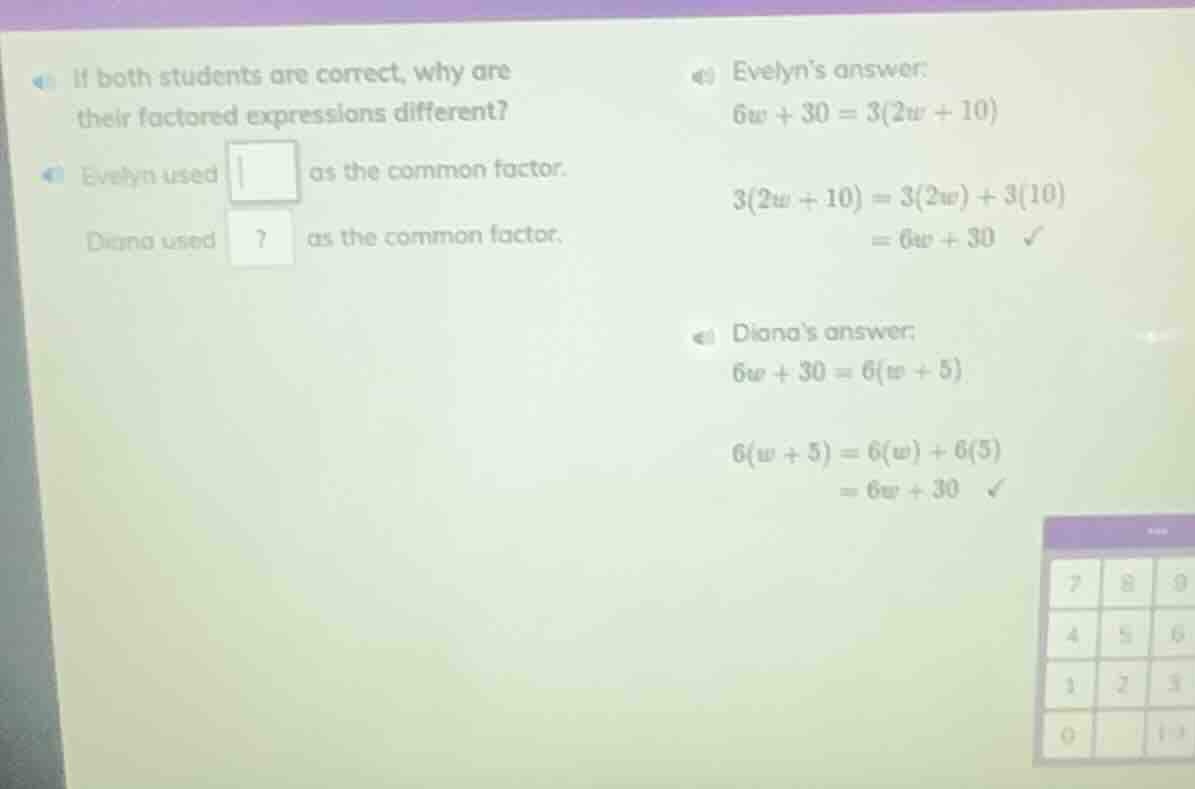
if both students are correct, why are their factored expressions different?
evelyn used \boxed{} as the common factor.
diana used 7 as the common factor.
evelyn’s answer:
$6w + 30 = 3(2w + 10)$
$3(2w + 10) = 3(2w) + 3(10)$
$= 6w + 30$ \checkmark
diana’s answer:
$6w + 30 = 6(w + 5)$
$6(w + 5) = 6(w) + 6(5)$
$= 6w + 30$ \checkmark
Step1: Identify Evelyn's common factor
Look at Evelyn's factored form: $6w + 30 = 3(2w + 10)$. The factor outside the parentheses is 3.
Step2: Identify Diana's common factor
Look at Diana's factored form: $6w + 30 = 6(w + 5)$. The factor outside the parentheses is 6.
Step3: Explain differing expressions
Diana used the greatest common factor (GCF) of 6w and 30, while Evelyn used a smaller common factor. The GCF of 6 and 30 is 6, so Diana's expression is fully factored, but Evelyn's can be factored further.

Snap & solve any problem in the app
Get step-by-step solutions on Sovi AI
Photo-based solutions with guided steps
Explore more problems and detailed explanations
Evelyn used $\boldsymbol{3}$ as the common factor.
Diana used $\boldsymbol{6}$ as the common factor.
Their factored expressions are different because Evelyn used a non-greatest common factor, while Diana used the greatest common factor of the terms $6w$ and $30$.