QUESTION IMAGE
Question
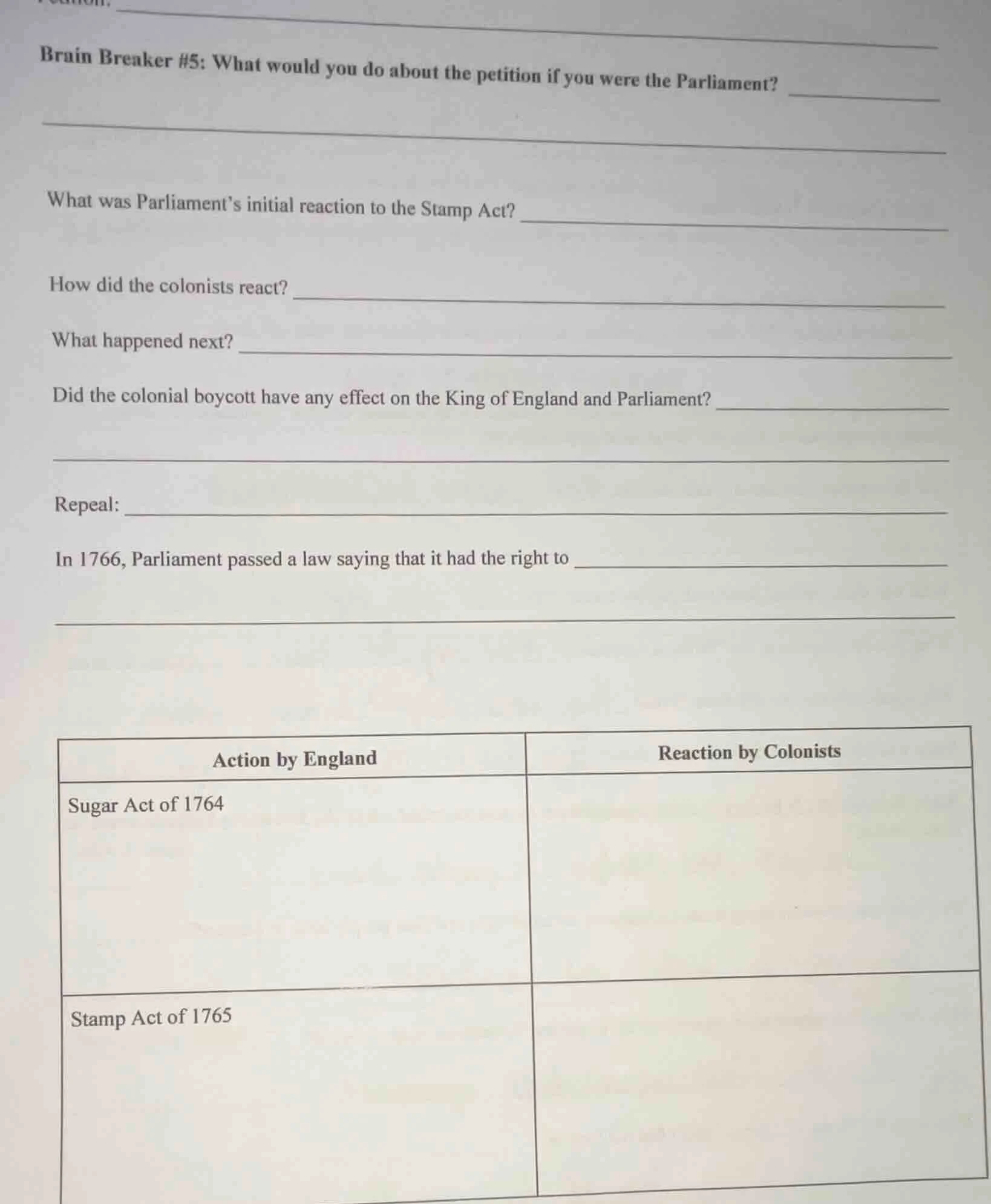
brain breaker #5: what would you do about the petition if you were the parliament?what was parliaments initial reaction to the stamp act?how did the colonists react?what happened next?did the colonial boycott have any effect on the king of england and parliament?repeal:in 1766, parliament passed a law saying that it had the right toaction by england | reaction by colonists--- | ---sugar act of 1764 |stamp act of 1765 |
Brief Explanations
All answers are based on key historical facts of pre-American Revolution British-colonial relations.
- For the hypothetical parliamentary role: Focus on balancing colonial grievances and British authority.
- All other questions reference documented reactions, policies, and impacts of the Sugar Act, Stamp Act, and related events.
- The table summarizes core actions and corresponding colonial responses for the two acts.

Snap & solve any problem in the app
Get step-by-step solutions on Sovi AI
Photo-based solutions with guided steps
Explore more problems and detailed explanations
- Brain Breaker #5: I would first review the colonial petition's grievances thoroughly, then negotiate a compromise that reduces the tax burden on colonists while upholding limited parliamentary authority to avoid further unrest, and hold open hearings with colonial representatives to address concerns.
- What was Parliament's initial reaction to the Stamp Act? Parliament defended the act, arguing it was a necessary measure to raise funds for colonial defense and that colonists, as British subjects, were bound by parliamentary laws.
- How did the colonists react? Colonists organized widespread protests, formed groups like the Sons of Liberty, boycotted British goods, and argued "no taxation without representation," claiming Parliament had no right to tax them without colonial representation.
- What happened next? Colonial assemblies sent formal petitions and protests to Parliament, and the boycotts began to hurt British merchants' profits.
- Did the colonial boycott have any effect on the King of England and Parliament? Yes, British merchants pressured Parliament to repeal the act because their sales and profits dropped significantly due to the colonial boycott.
- Repeal: Parliament repealed the Stamp Act in 1766, responding to the economic pressure from British merchants and colonial unrest.
- In 1766, Parliament passed a law saying that it had the right to legislate for the colonies in all cases whatsoever.
| Action by England | Reaction by Colonists |
|---|---|
| Stamp Act of 1765: Imposed a direct tax on all printed materials in the colonies (legal documents, newspapers, playing cards, etc.) | Colonists launched mass protests, destroyed stamped paper, formed the Sons of Liberty, organized widespread boycotts of British goods, and passed resolutions declaring the act unconstitutional due to "no taxation without representation." |