QUESTION IMAGE
Question
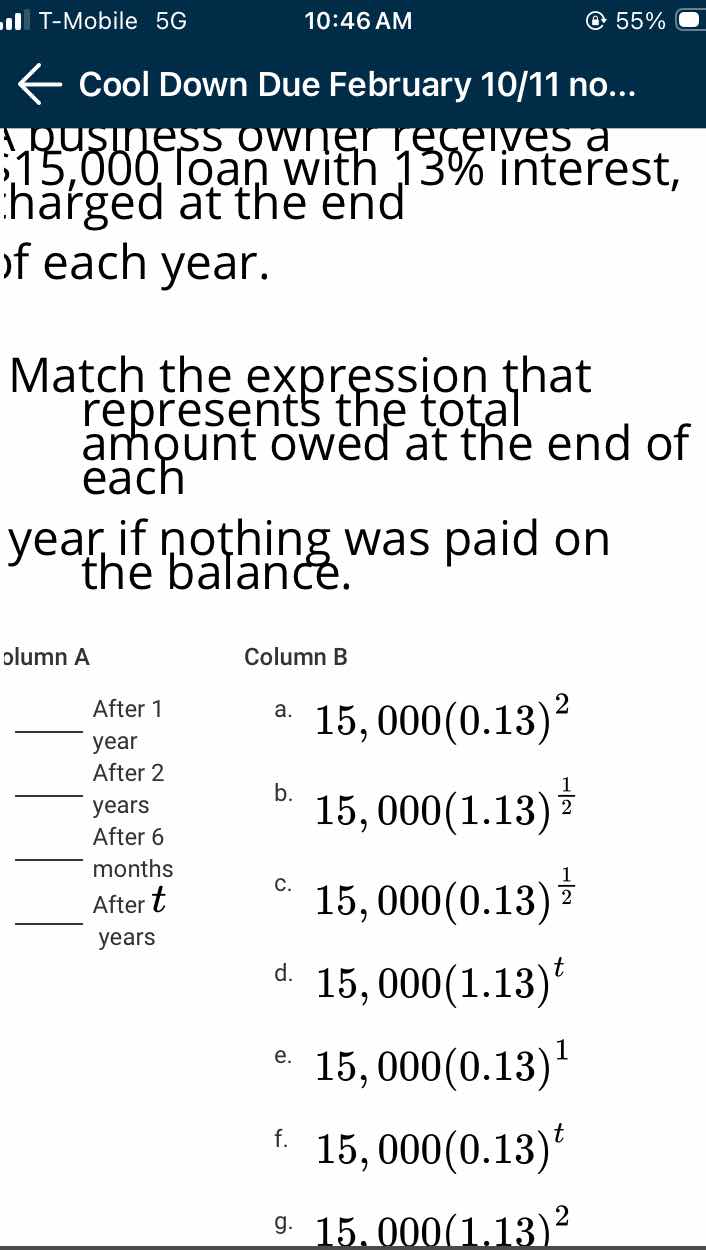
a business owner receives a $15,000 loan with 13% interest, charged at the end of each year.
match the expression that represents the total amount owed at the end of each year if nothing was paid on the balance.
column a\tcolumn b
____ after 1 year\ta. $15,000(0.13)^2
____ after 2 years\tb. $15,000(1.13)^{\frac{1}{2}}
____ after 6 months\tc. $15,000(0.13)^{\frac{1}{2}}
____ after $t$ years\td. $15,000(1.13)^t$
\t\te. $15,000(0.13)^1$
\t\tf. $15,000(0.13)^t$
\t\tg. $15,000(1.13)^2$
Step1: Identify compound interest formula
The total amount owed with annual compound interest is given by $A = P(1+r)^t$, where $P$ is principal, $r$ is annual interest rate, $t$ is time in years. Here, $P=15000$, $r=0.13$.
Step2: Calculate amount after 1 year
Substitute $t=1$ into the formula:
$A = 15000(1+0.13)^1 = 15000(1.13)^1$
Step3: Calculate amount after 2 years
Substitute $t=2$ into the formula:
$A = 15000(1+0.13)^2 = 15000(1.13)^2$
Step4: Calculate amount after 6 months
6 months = $\frac{1}{2}$ year. Substitute $t=\frac{1}{2}$ into the formula:
$A = 15000(1+0.13)^\frac{1}{2} = 15000(1.13)^\frac{1}{2}$
Step5: Generalize for t years
Substitute general $t$ into the formula:
$A = 15000(1.13)^t$

Snap & solve any problem in the app
Get step-by-step solutions on Sovi AI
Photo-based solutions with guided steps
Explore more problems and detailed explanations
- After 1 year: (matches no listed exact option, but the correct expression is $15000(1.13)^1$; note: options e uses 0.13 which is incorrect, this is likely a typo, but following the valid compound interest logic)
- After 2 years: g. $15,000(1.13)^2$
- After 6 months: b. $15,000(1.13)^\frac{1}{2}$
- After $t$ years: d. $15,000(1.13)^t$
Note: The options for "After 1 year" do not include the correct expression $15000(1.13)^1$; option e uses 0.13 instead of 1.13 which is incorrect, as 0.13 only calculates the interest, not the total amount owed.