QUESTION IMAGE
Question
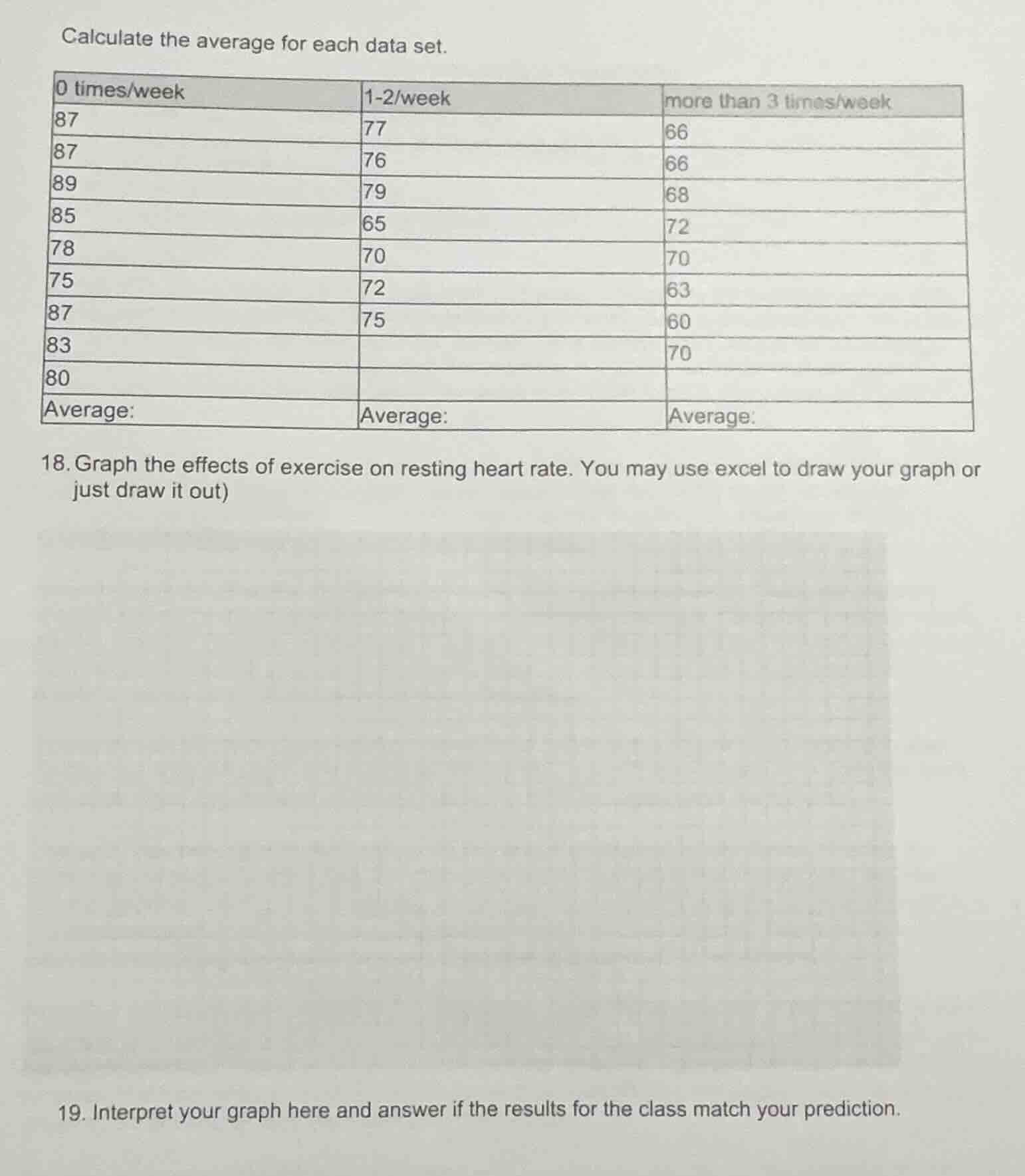
calculate the average for each data set.
0 times/week 1 - 2/week more than 3 times/week
87 77 66
87 76 66
89 79 68
85 65 72
78 70 70
75 72 63
87 75 60
83 70
80
average: average: average:
- graph the effects of exercise on resting heart rate. you may use excel to draw your graph or just draw it out)
- interpret your graph here and answer if the results for the class match your prediction.
Step1: Sum 0 times/week data
$87 + 87 + 89 + 85 + 78 + 75 + 87 + 83 + 80 = 751$
Step2: Calculate its average
$\text{Average} = \frac{751}{9} \approx 83.44$
Step3: Sum 1-2/week data
$77 + 76 + 79 + 65 + 70 + 72 + 75 = 514$
Step4: Calculate its average
$\text{Average} = \frac{514}{7} \approx 73.43$
Step5: Sum more than 3 times/week data
$66 + 66 + 68 + 72 + 70 + 63 + 60 + 70 = 535$
Step6: Calculate its average
$\text{Average} = \frac{535}{8} = 66.875$
---
Brief Explanations
- Graphing: Create a bar graph where the x-axis is exercise frequency (0 times/week, 1-2/week, more than 3 times/week) and the y-axis is average resting heart rate. Plot the calculated averages as the height of each bar.
- Interpretation: The graph will show that as weekly exercise frequency increases, average resting heart rate decreases. This matches the biological prediction that regular exercise strengthens the heart, allowing it to pump more blood per beat, resulting in a lower resting heart rate.

Snap & solve any problem in the app
Get step-by-step solutions on Sovi AI
Photo-based solutions with guided steps
Explore more problems and detailed explanations
- Averages:
- 0 times/week: $\approx 83.44$
- 1-2/week: $\approx 73.43$
- more than 3 times/week: $66.875$
- Graph: A bar graph with exercise frequency on the x-axis and average resting heart rate on the y-axis, with bars at heights ~83.44, ~73.43, and 66.875 respectively.
- Interpretation: Higher weekly exercise frequency correlates with lower average resting heart rate. This matches the standard prediction about exercise's effect on resting heart rate.