QUESTION IMAGE
Question
calculator
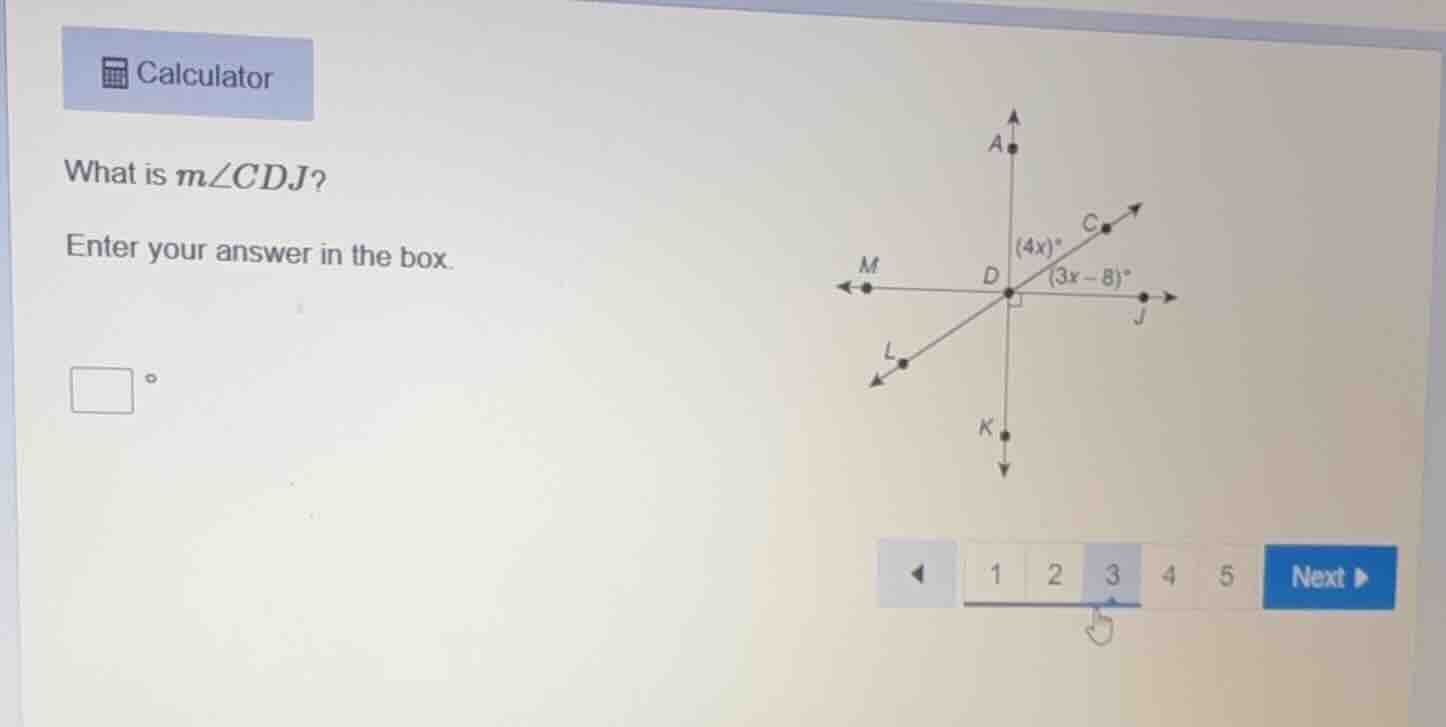
what is ( mangle cdj )?
enter your answer in the box.
\\(\square\\)°
Step1: Identify angle relationship
Angles \( \angle ADJ \) is a right angle? Wait, no, looking at the diagram, \( DJ \) and \( DK \) are perpendicular (right angle), so the sum of \( (4x)^\circ \) and \( (3x - 8)^\circ \) should be \( 90^\circ \) because they are complementary (since \( ADK \) is a right angle? Wait, no, \( A \) and \( K \) are vertical, \( M \) and \( J \) are horizontal, so \( \angle ADJ \) and \( \angle KDJ \) are related. Wait, actually, the angles \( (4x)^\circ \) and \( (3x - 8)^\circ \) are adjacent and form a right angle? Wait, no, the right angle is between \( DJ \) and \( DK \), so \( \angle ADJ \) is \( (4x)^\circ + (3x - 8)^\circ = 90^\circ \)? Wait, no, the right angle is between \( DJ \) and \( DK \), so the angles above \( DJ \) ( \( (4x)^\circ \)) and next to it ( \( (3x - 8)^\circ \)) should add up to \( 90^\circ \) because \( ADK \) is a right angle? Wait, let's re-examine: the diagram shows \( DJ \) is horizontal, \( DK \) is vertical (right angle between them), and \( DC \) is a ray making \( (4x)^\circ \) with \( DA \) and \( (3x - 8)^\circ \) with \( DJ \). So the sum of \( (4x)^\circ \) and \( (3x - 8)^\circ \) should be \( 90^\circ \) because \( DA \) and \( DK \) are vertical, so \( \angle ADK = 90^\circ \), and \( \angle ADC + \angle CDJ = 90^\circ \). So:
\( 4x + (3x - 8) = 90 \)
Step2: Solve for \( x \)
Combine like terms:
\( 7x - 8 = 90 \)
Add 8 to both sides:
\( 7x = 98 \)
Divide by 7:
\( x = 14 \)
Step3: Find \( m\angle CDJ \)
\( \angle CDJ = (3x - 8)^\circ \). Substitute \( x = 14 \):
\( 3(14) - 8 = 42 - 8 = 34 \)? Wait, no, wait: Wait, \( \angle CDJ \) is \( (3x - 8)^\circ \)? Wait, no, wait, maybe I mixed up. Wait, the angle \( \angle CDJ \) is \( (3x - 8)^\circ \)? Wait, no, let's check again. Wait, the equation: \( 4x + (3x - 8) = 90 \), so \( 7x = 98 \), \( x = 14 \). Then \( \angle CDJ = 3x - 8 = 3*14 - 8 = 42 - 8 = 34 \)? Wait, no, wait, maybe \( \angle CDJ \) is \( 4x \)? Wait, no, the diagram: \( DC \) is between \( DA \) and \( DJ \), so \( \angle ADC = 4x \), \( \angle CDJ = 3x - 8 \), and \( \angle ADJ = 90^\circ \) (since \( DA \) is vertical, \( DJ \) is horizontal, right angle). So \( 4x + (3x - 8) = 90 \), so \( x = 14 \), then \( \angle CDJ = 3x - 8 = 3*14 - 8 = 34 \)? Wait, no, wait, that can't be. Wait, maybe I made a mistake. Wait, let's check again. Wait, the right angle is between \( DJ \) and \( DK \), so \( \angle KDJ = 90^\circ \), and \( \angle LDC \) is vertical to \( \angle CDJ \)? No, maybe the sum of \( 4x \) and \( 3x - 8 \) is \( 90 \) because \( DA \) and \( DJ \) are not vertical and horizontal? Wait, no, the diagram shows \( DJ \) is horizontal (to the right), \( DA \) is vertical (up), so \( \angle ADJ = 90^\circ \). Therefore, \( \angle ADC + \angle CDJ = 90^\circ \), so \( 4x + (3x - 8) = 90 \), so \( 7x = 98 \), \( x = 14 \). Then \( \angle CDJ = 3x - 8 = 3*14 - 8 = 34 \)? Wait, but let's check \( 4x = 56 \), 56 + 34 = 90, which is correct. So \( m\angle CDJ = 34^\circ \)? Wait, no, wait, maybe \( \angle CDJ \) is \( 4x \)? Wait, no, the label says \( (3x - 8)^\circ \) next to \( DJ \), so that's \( \angle CDJ \). So yes, \( 3x - 8 = 34 \). Wait, but let's confirm: if \( x = 14 \), then \( 4x = 56 \), \( 3x - 8 = 34 \), 56 + 34 = 90, which is the right angle between \( DA \) and \( DJ \). So that's correct.

Snap & solve any problem in the app
Get step-by-step solutions on Sovi AI
Photo-based solutions with guided steps
Explore more problems and detailed explanations
34