QUESTION IMAGE
Question
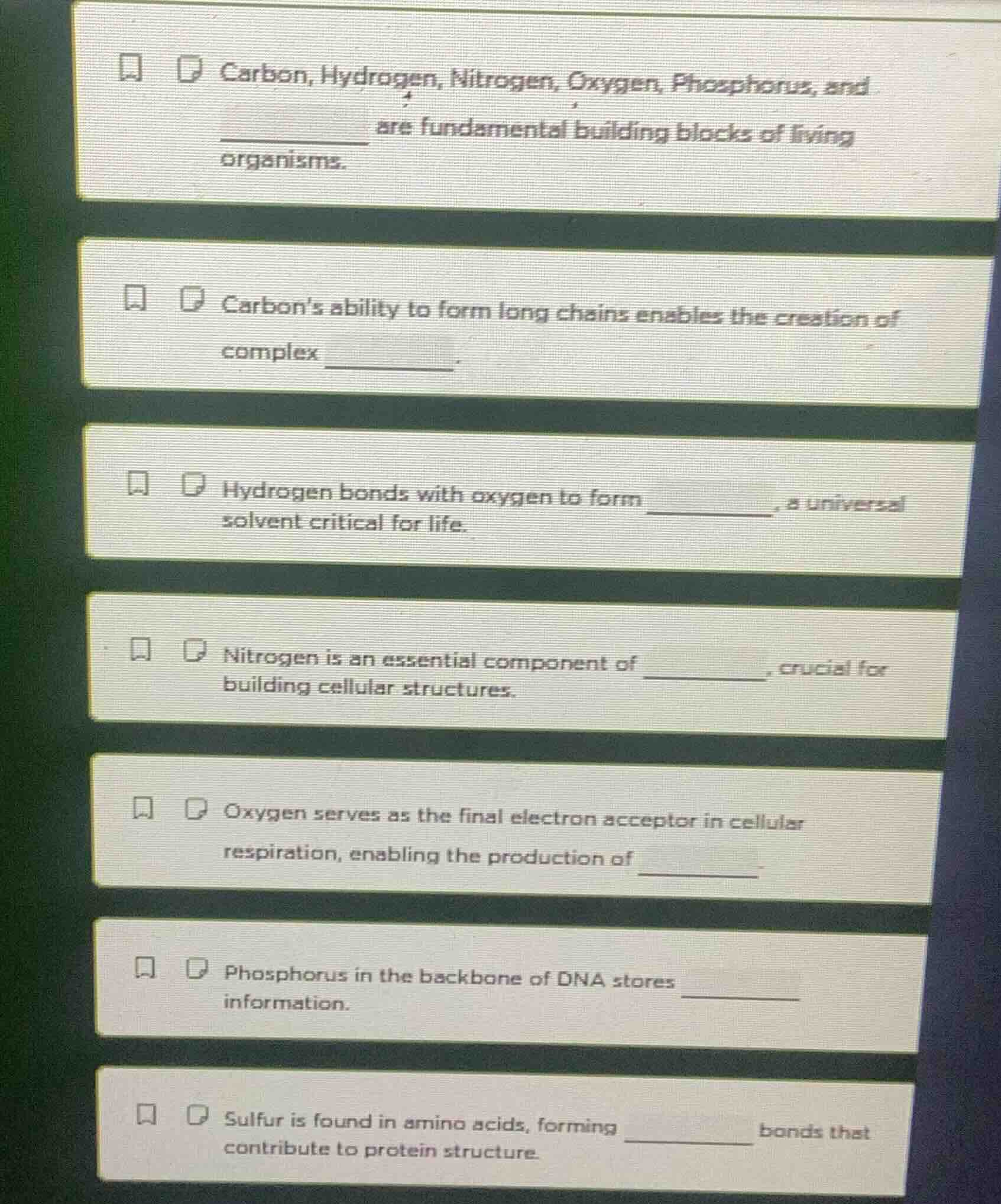
carbon, hydrogen, nitrogen, oxygen, phosphorus, and
__________ are fundamental building blocks of living
organisms.
carbons ability to form long chains enables the creation of
complex __________.
hydrogen bonds with oxygen to form __________, a universal
solvent critical for life.
nitrogen is an essential component of __________, crucial for
building cellular structures.
oxygen serves as the final electron acceptor in cellular
respiration, enabling the production of __________.
phosphorus in the backbone of dna stores __________
information.
sulfur is found in amino acids, forming __________ bonds that
contribute to protein structure.
Question 1:
The essential elements for living organisms include Carbon (C), Hydrogen (H), Nitrogen (N), Oxygen (O), Phosphorus (P), and Sulfur (S). These are known as the CHNOPS elements, fundamental for biomolecules.
Carbon can form long chains (and rings) through covalent bonding, allowing the creation of complex organic molecules like carbohydrates, lipids, proteins, and nucleic acids.
Hydrogen and oxygen combine to form water ($H_2O$), which is a universal solvent, vital for biochemical reactions and transporting substances in organisms.

Snap & solve any problem in the app
Get step-by-step solutions on Sovi AI
Photo-based solutions with guided steps
Explore more problems and detailed explanations
Sulfur