QUESTION IMAGE
Question
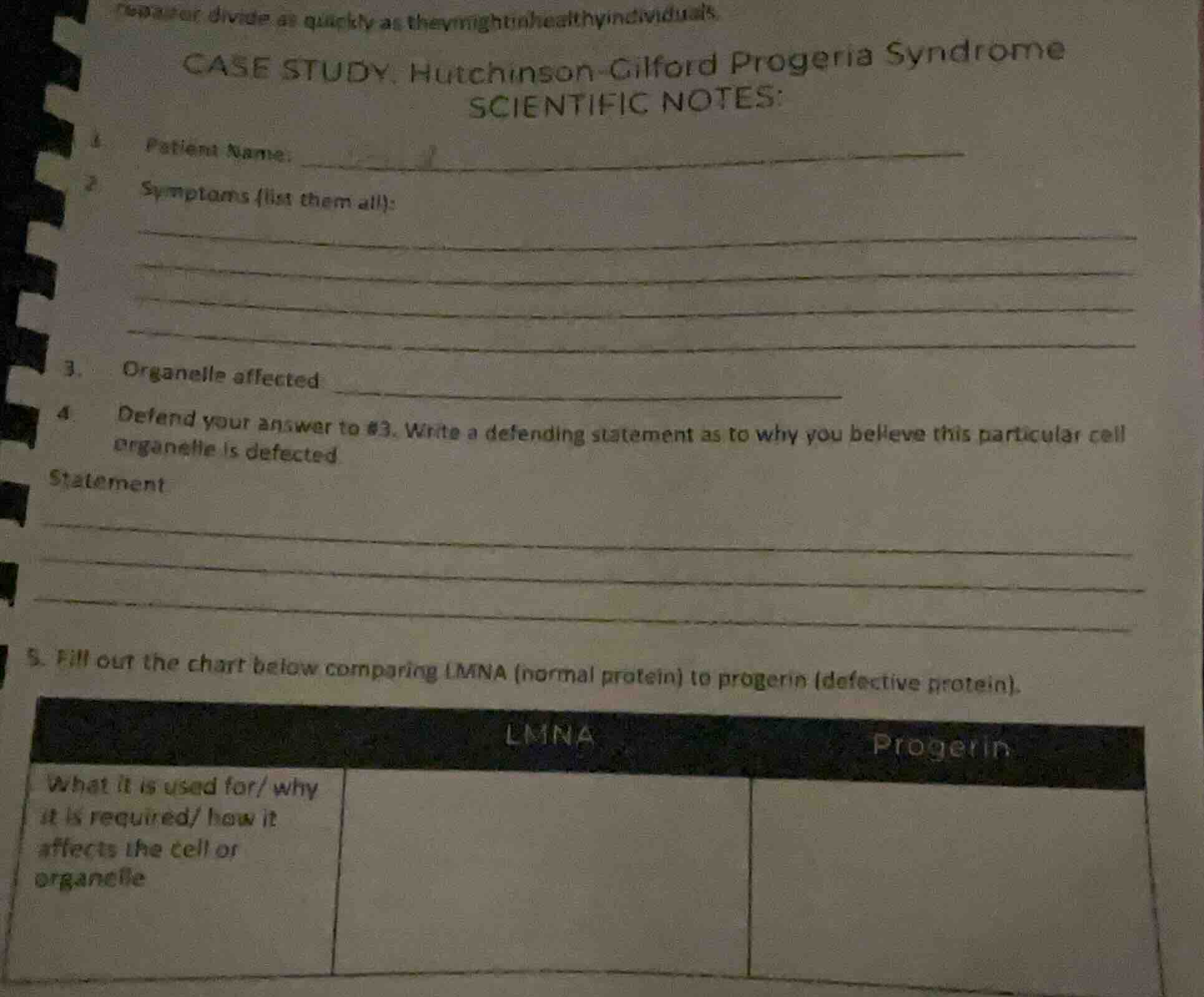
case study: hutchinson-gilford progeria syndrome scientific notes:
- patient name:
- symptoms (list them all):
- organelle affected
- defend your answer to #3. write a defending statement as to why you believe this particular cell organelle is defected.
statement
- fill out the chart below comparing lmna (normal protein) to progerin (defective protein).
| lmna | progerin |
|---|
To solve the case study on Hutchinson - Gilford Progeria Syndrome, we analyze each part:
1. Patient Name
Since this is a case study (often hypothetical or with a sample name in educational materials), a common sample name could be "John Doe" (or any name as it's a fill - in, but for a typical case study, a generic name is used).
2. Symptoms
Hutchinson - Gilford Progeria Syndrome has the following main symptoms:
- Premature aging (appears much older than actual age)
- Short stature
- Hair loss (alopecia)
- Skin that is thin, dry, and wrinkled
- Joint stiffness
- Delayed tooth eruption or abnormal dental development
- Cardiovascular problems (like atherosclerosis at a young age)
3. Organelle affected
The nucleus is the affected organelle.
4. Defending the answer for the affected organelle
The LMNA gene (which codes for lamin A protein, a component of the nuclear lamina) is mutated in Progeria. The nuclear lamina is part of the nucleus. Progerin (the defective protein) disrupts the structure and function of the nuclear lamina. This disruption affects the shape and stability of the nucleus. A normal nucleus has a regular shape which is important for processes like DNA replication, transcription, and cell division. The abnormal nuclear structure due to defective lamin A (progerin) leads to the characteristic symptoms of premature aging as the normal functioning of the cell is disrupted.
5. Comparing LMNA (normal protein) and Progerin (defective protein)
| LMNA | Progerin |
|---|

Snap & solve any problem in the app
Get step-by-step solutions on Sovi AI
Photo-based solutions with guided steps
Explore more problems and detailed explanations
s:
- Patient Name: John Doe (or any appropriate name)
- Symptoms: Premature aging, short stature, hair loss, thin/dry/wrinkled skin, joint stiffness, delayed tooth eruption, cardiovascular problems
- Organelle affected: Nucleus
- Statement: The LMNA gene mutation produces progerin, which disrupts the nuclear lamina (part of the nucleus). The nuclear lamina maintains nuclear structure/function (e.g., DNA processes, cell cycle). Disruption causes cell dysfunction and Progeria symptoms.
- (Filled table as above)