QUESTION IMAGE
Question
- cells of reproducing (organisms) are called ______
- cells with two sets of matching chromosomes is said to be ______
- cells that have a single set of chromosomes are ______
- the process by which the number of chromosomes is cut in half is called ______
- in prophase 1 of meiosis, homologous chromosomes pair up to form a structure called a ______
- when pieces from one chromosome are exchanged with the other, it is called ______
- during metaphase 1, paired chromosomes ______
- during anaphase 1, each pair moves to ______ ends
- at the end of telophase 1, how many cells are there? ______
- at the end of telophase 2, how many cells are there? ______
- in mitosis, each daughter cell receives a complete ______ set of chromosomes
- in meiosis, each daughter cell receives a ______ set of chromosomes
use figure 12 - 18 to answer indicate if the event happens in mitosis (m), meiosis (e), or both (b)
- ______ chromosomes replicate
- ______ chromosomes pairs (tetrads) line up along the equator.
- ______ individual chromatids separate and move to the poles.
- ______ cytokinesis results in four unique daughter cells.
- ______ cells produced are diploid.
- ______ spindle fibers move chromosomes.
- ______ cytokinesis results in two identical daughter cells.
- ______ cells produced are haploid.
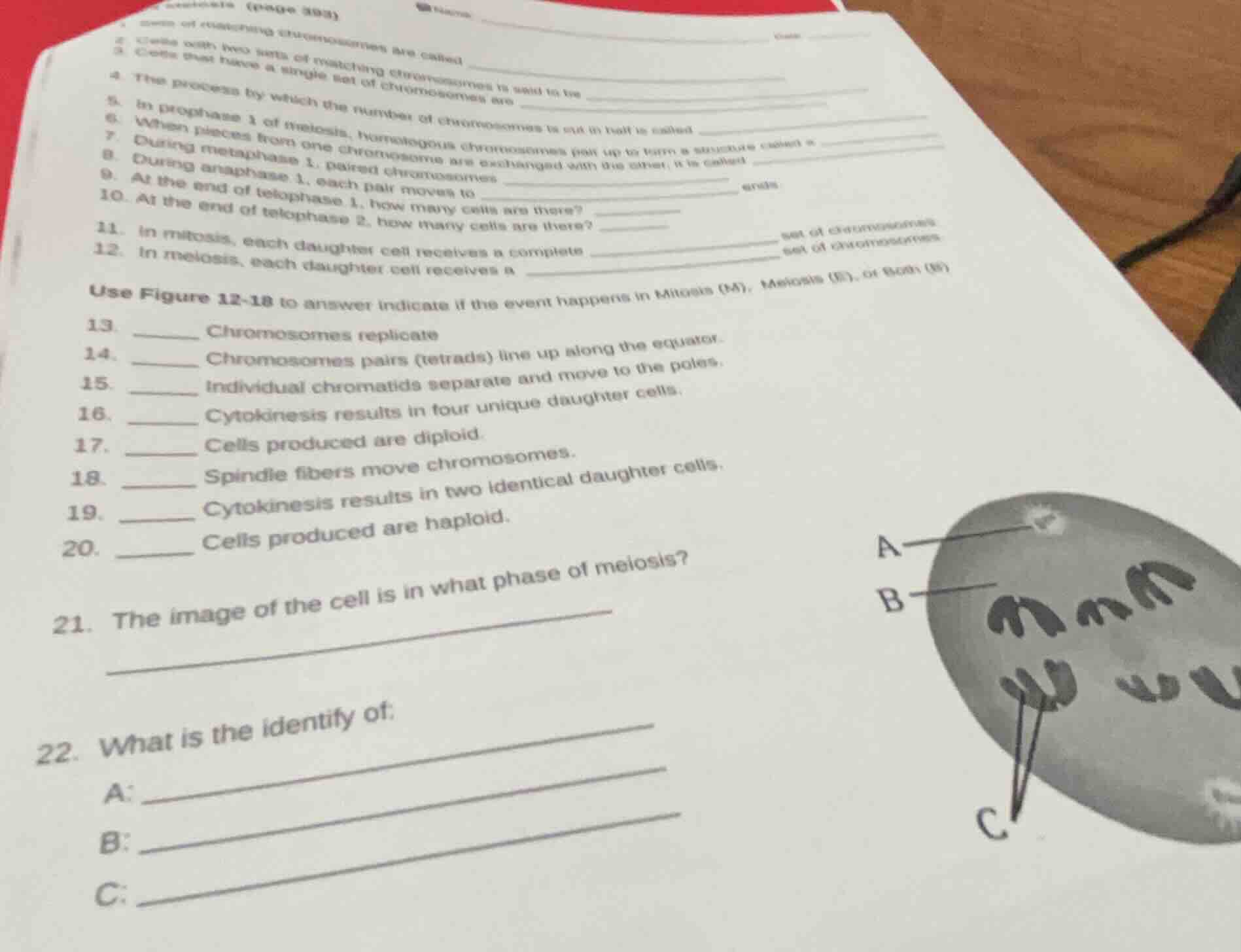
- the image of the cell is in what phase of meiosis?
______
- what is the identify of:
a: ______
b: ______
c: ______
Question 1 (assuming the first fill - in - the - blank question: "Cells with two sets of chromosomes are said to be ______")
In biology, cells with two sets of chromosomes (one from each parent) are defined as diploid. This is a fundamental concept in the study of cell genetics and reproduction, especially in relation to processes like mitosis and meiosis.
In the context of cell biology, cells with a single set of chromosomes (as opposed to two sets in diploid cells) are known as haploid. Haploid cells are important in sexual reproduction, for example, gametes (sperm and egg cells) are haploid.
Meiosis is the cell division process that reduces the chromosome number by half. This is crucial for sexual reproduction as it produces gametes with half the number of chromosomes of the parent cell, so that when gametes fuse during fertilization, the original chromosome number is restored.

Snap & solve any problem in the app
Get step-by-step solutions on Sovi AI
Photo-based solutions with guided steps
Explore more problems and detailed explanations
diploid