QUESTION IMAGE
Question
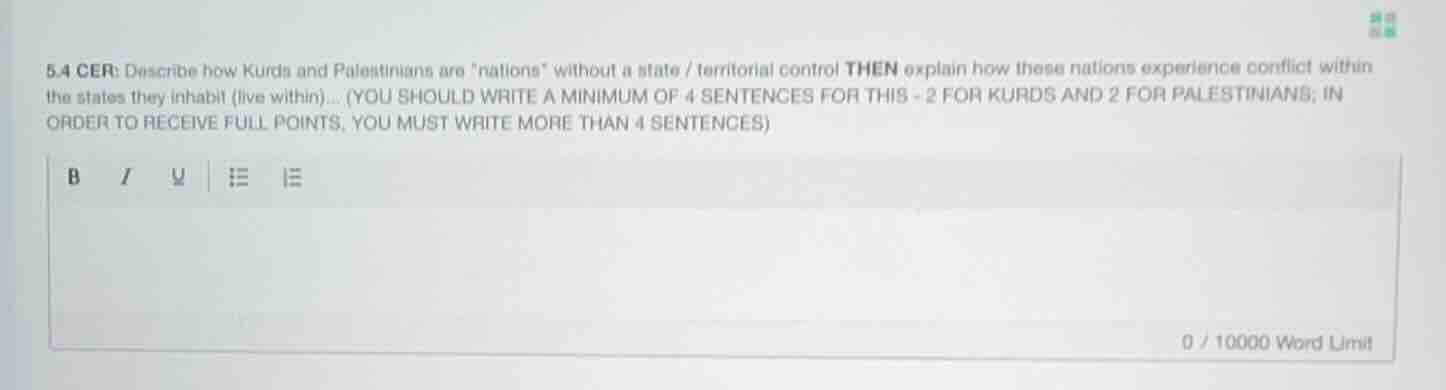
5.4 cer: describe how kurds and palestinians are
ations\ without a state / territorial control then explain how these nations experience conflict within the states they inhabit (live within)... (you should write a minimum of 4 sentences for this - 2 for kurds and 2 for palestinians; in order to receive full points, you must write more than 4 sentences)
Kurds form a distinct cultural, linguistic, and ethnic group concentrated across parts of Turkey, Iraq, Syria, and Iran, with a shared collective identity and historical ties to the region of Kurdistan, yet they lack a sovereign state of their own. Within Turkey, Kurdish communities have faced long-standing restrictions on their language and cultural expression, leading to periodic conflicts with the Turkish government over demands for greater autonomy and recognition. Palestinians are a nation defined by their shared history, cultural heritage, and collective displacement during the 1948 Nakba, with a national identity centered on their connection to historic Palestine, but they do not have full territorial control over a sovereign state. In the West Bank, Palestinians experience conflict with Israeli authorities over issues such as settlement expansion, movement restrictions, and disputes over land and resources, while in Gaza, ongoing blockades and military confrontations have created cycles of violence and humanitarian hardship. Beyond these core points, Kurdish groups in Iraq have secured limited autonomous governance in the Kurdistan Regional Government, but tensions persist with the central Iraqi government over oil revenues and territorial claims to areas like Kirkuk. For Palestinians, internal divisions between political factions like Fatah and Hamas have also fueled internal conflict, complicating efforts to pursue a unified national agenda for statehood and self-determination.

Snap & solve any problem in the app
Get step-by-step solutions on Sovi AI
Photo-based solutions with guided steps
Explore more problems and detailed explanations
Kurds are a distinct ethnic, linguistic, and cultural nation spread across Turkey, Iraq, Syria, and Iran, bound by a shared identity and historical attachment to the Kurdistan region, but they have never established a sovereign, internationally recognized state. In Turkey, decades of state policies restricting Kurdish language education and cultural expression led to armed conflict between Kurdish militant groups like the PKK and Turkish security forces, as Kurds pushed for greater autonomy and cultural rights that were denied by the central government. Palestinians constitute a nation united by their shared history in historic Palestine, collective displacement during the 1948 Nakba, and a common goal of self-determination, yet they lack full territorial control over a sovereign state, with most living in the occupied West Bank, blockaded Gaza Strip, or as refugees across the Middle East. In the occupied West Bank, Palestinians face ongoing conflict with Israeli authorities over expanding Israeli settlements (which are deemed illegal under international law), restrictive movement checkpoints, and disputes over access to land and water resources, while in Gaza, repeated military offensives and a long-standing Israeli-Egyptian blockade have created a cycle of violence and humanitarian crisis that fuels tensions and resistance. Additionally, in Iraq, the semi-autonomous Kurdistan Regional Government has clashed with the central Iraqi government over control of oil-rich territories like Kirkuk, as Kurdish leaders push for greater economic and political independence, highlighting intra-state conflict rooted in competing claims to resources and sovereignty. For Palestinians, internal rifts between the Fatah-led Palestinian Authority in the West Bank and Hamas in Gaza have also created internal conflict, with differing approaches to engaging Israel and governing Palestinian territories hindering unified efforts to advance statehood.