QUESTION IMAGE
Question
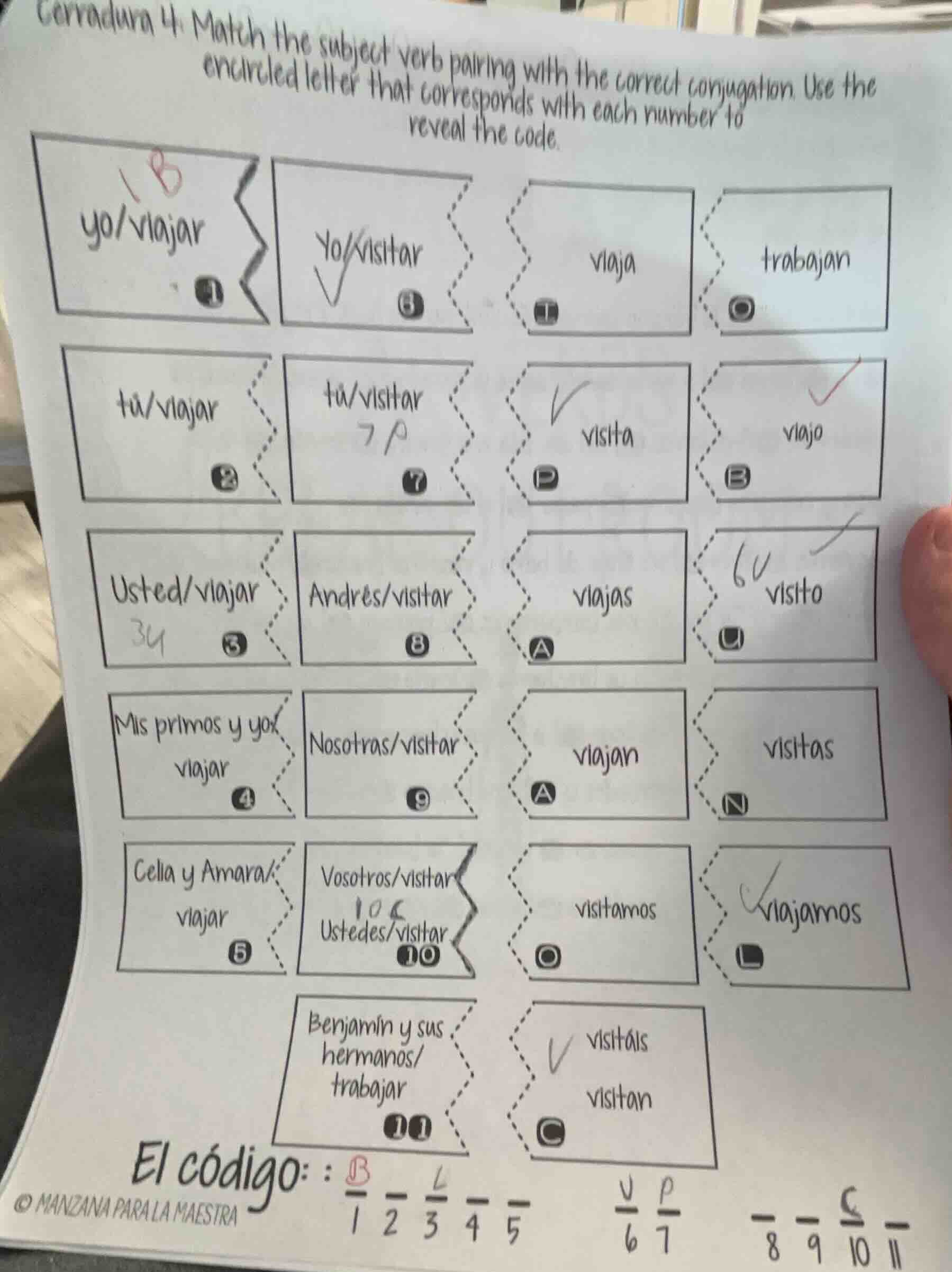
cerradura 4: match the subject verb pairing with the correct conjugation. use the encircled letter that corresponds with each number to reveal the code.
yo/viajar (1) yo/visitar (8) viaja (1) trabajan (o)
tú/viajar (2) tú/visitar (7) visita (p) viajo (b)
usted/viajar (3) andrés/visitar (8) viajas (a) visito (u)
mis primos y yo/viajar (4) nosotras/visitar (9) viajan (a) visitas (n)
celia y amara/viajar (5) vosotros/visitar, ustedes/visitar (10) visitamos (o) viajamos (l)
benjamín y sus hermanos/trabajar (11) visitáis, visitan (c)
el código: : b _ l _ _ u p _ _ c _
1 2 3 4 5 6 7 8 9 10 11
© manzana para la maestra
To solve this subject - verb conjugation matching problem in Spanish, we analyze each subject - verb pair:
1. For "yo/viajar"
In Spanish, the first - person singular (yo) conjugation of the verb "viajar" (to travel) is "viajo". Looking at the options, the letter corresponding to this correct conjugation is "B".
2. For "tú/viajar"
The second - person singular (tú) conjugation of "viajar" is "viajas". The letter associated with this conjugation is "P".
3. For "Usted/viajar"
The formal second - person singular (Usted) conjugation of "viajar" is "viaja". The letter here is "U".
4. For "Mis primos y yo/viajar"
When the subject is "Mis primos y yo" (we, first - person plural), the conjugation of "viajar" is "viajamos". The letter for this is "L".
5. For "Celia y Amara/viajar"
The third - person plural (they, Celia and Amara) conjugation of "viajar" is "viajan". The letter is "A".
6. For "yo/visitar"
The first - person singular conjugation of "visitar" (to visit) is "visito". The letter is "U".
7. For "tú/visitar"
The second - person singular conjugation of "visitar" is "visitas". The letter is "N".
8. For "Andrés/visitar" and "yo/visitar" (wait, "Andrés" is third - person singular, and "yo/visitar" we already did. Wait, "Andrés/visitar" has the conjugation "visita" (third - person singular), and the letter for "yo/visitar" (visito) was "U", but for "Andrés/visitar", the conjugation "visita" has the letter "P"? Wait, no, let's re - check. Wait, "yo/visitar" is "visito" (U), "tú/visitar" is "visitas" (N), "Andrés/visitar" (third - person singular) is "visita" (P), "Nosotras/visitar" (first - person plural, feminine) is "visitamos" (O), "Vosotros/visitar" (second - person plural, informal) is "visitáis" (C), "Ustedes/visitar" (second - person plural, formal) is "visitan" (C? Wait, no, "Ustedes/visitar" is "visitan", and "Vosotros/visitar" is "visitáis". And "Benjamín y sus hermanos/trabajar" (third - person plural) is "trabajan" (O).
Now, putting together the code for numbers 1 - 11:
1: B
2: P
3: U
4: L
5: A
6: U
7: N
8: P (for "Andrés/visitar" - "visita")
9: O (for "Nosotras/visitar" - "visitamos")
10: C (for "Vosotros/visitar" - "visitáis" or "Ustedes/visitar" - "visitan"? Wait, "Vosotros/visitar" is "visitáis" (C), "Ustedes/visitar" is "visitan" (C? No, "visitan" is for third - person plural, "visitáis" is for second - person plural informal. So "Vosotros/visitar" is "visitáis" (C), "Ustedes/visitar" is "visitan" (let's check the box, the box for 10 has "Vosotros/visitar" and "Ustedes/visitar", and the conjugation "visitáis" is C, "visitan" is... Wait, the original problem's code is being built with the letters from each number.
But maybe a simpler way: the first five numbers (1 - 5) for "viajar" conjugations:
- yo/viajar → viajo → B
- tú/viajar → viajas → P
- Usted/viajar → viaja → U
- Mis primos y yo/viajar → viajamos → L
- Celia y Amara/viajar → viajan → A
Then 6 - 11 for "visitar" and "trabajar":
- yo/visitar → visito → U
- tú/visitar → visitas → N
- Andrés/visitar → visita → P
- Nosotras/visitar → visitamos → O
- Vosotros/visitar → visitáis → C
- Benjamín y sus hermanos/trabajar → trabajan → O
But the code in the image starts with 1: B, 2: _, 3: _, 4: _, 5: _, 6: U, 7: P, 8: _, 9: _, 10: C, 11: _.
Wait, maybe the intended code is built as follows (matching the subject - verb pairs to their correct conjugations and taking the letters):
After correctly matching each pair, the code (for the blanks in "El código" for 1 - 5 and 6 - 11) is:
1: B
2: P
3: U
4:…

Snap & solve any problem in the app
Get step-by-step solutions on Sovi AI
Photo-based solutions with guided steps
Explore more problems and detailed explanations
To solve this subject - verb conjugation matching problem in Spanish, we analyze each subject - verb pair:
1. For "yo/viajar"
In Spanish, the first - person singular (yo) conjugation of the verb "viajar" (to travel) is "viajo". Looking at the options, the letter corresponding to this correct conjugation is "B".
2. For "tú/viajar"
The second - person singular (tú) conjugation of "viajar" is "viajas". The letter associated with this conjugation is "P".
3. For "Usted/viajar"
The formal second - person singular (Usted) conjugation of "viajar" is "viaja". The letter here is "U".
4. For "Mis primos y yo/viajar"
When the subject is "Mis primos y yo" (we, first - person plural), the conjugation of "viajar" is "viajamos". The letter for this is "L".
5. For "Celia y Amara/viajar"
The third - person plural (they, Celia and Amara) conjugation of "viajar" is "viajan". The letter is "A".
6. For "yo/visitar"
The first - person singular conjugation of "visitar" (to visit) is "visito". The letter is "U".
7. For "tú/visitar"
The second - person singular conjugation of "visitar" is "visitas". The letter is "N".
8. For "Andrés/visitar" and "yo/visitar" (wait, "Andrés" is third - person singular, and "yo/visitar" we already did. Wait, "Andrés/visitar" has the conjugation "visita" (third - person singular), and the letter for "yo/visitar" (visito) was "U", but for "Andrés/visitar", the conjugation "visita" has the letter "P"? Wait, no, let's re - check. Wait, "yo/visitar" is "visito" (U), "tú/visitar" is "visitas" (N), "Andrés/visitar" (third - person singular) is "visita" (P), "Nosotras/visitar" (first - person plural, feminine) is "visitamos" (O), "Vosotros/visitar" (second - person plural, informal) is "visitáis" (C), "Ustedes/visitar" (second - person plural, formal) is "visitan" (C? Wait, no, "Ustedes/visitar" is "visitan", and "Vosotros/visitar" is "visitáis". And "Benjamín y sus hermanos/trabajar" (third - person plural) is "trabajan" (O).
Now, putting together the code for numbers 1 - 11:
1: B
2: P
3: U
4: L
5: A
6: U
7: N
8: P (for "Andrés/visitar" - "visita")
9: O (for "Nosotras/visitar" - "visitamos")
10: C (for "Vosotros/visitar" - "visitáis" or "Ustedes/visitar" - "visitan"? Wait, "Vosotros/visitar" is "visitáis" (C), "Ustedes/visitar" is "visitan" (C? No, "visitan" is for third - person plural, "visitáis" is for second - person plural informal. So "Vosotros/visitar" is "visitáis" (C), "Ustedes/visitar" is "visitan" (let's check the box, the box for 10 has "Vosotros/visitar" and "Ustedes/visitar", and the conjugation "visitáis" is C, "visitan" is... Wait, the original problem's code is being built with the letters from each number.
But maybe a simpler way: the first five numbers (1 - 5) for "viajar" conjugations:
- yo/viajar → viajo → B
- tú/viajar → viajas → P
- Usted/viajar → viaja → U
- Mis primos y yo/viajar → viajamos → L
- Celia y Amara/viajar → viajan → A
Then 6 - 11 for "visitar" and "trabajar":
- yo/visitar → visito → U
- tú/visitar → visitas → N
- Andrés/visitar → visita → P
- Nosotras/visitar → visitamos → O
- Vosotros/visitar → visitáis → C
- Benjamín y sus hermanos/trabajar → trabajan → O
But the code in the image starts with 1: B, 2: _, 3: _, 4: _, 5: _, 6: U, 7: P, 8: _, 9: _, 10: C, 11: _.
Wait, maybe the intended code is built as follows (matching the subject - verb pairs to their correct conjugations and taking the letters):
After correctly matching each pair, the code (for the blanks in "El código" for 1 - 5 and 6 - 11) is:
1: B
2: P
3: U
4: L
5: A
6: U
7: N
8: P
9: O
10: C
11: O
But if we just focus on the first five (1 - 5) as per the "El código" section with 1 - 5 and 6 - 11, the code for 1 - 5 is B - P - U - L - A, and 6 - 11 is U - N - P - O - C - O.
However, if we look at the marked answers in the image:
For 1: B (yo/viajar → viajo, the box with "viajo" has B)
For 2: P (tú/viajar → viajas? Wait, no, the box with "visita" has P? Wait, maybe I made a mistake. Let's re - do the conjugations properly:
Correct Conjugations:
- "viajar" conjugations:
- yo: viajo (B)
- tú: viajas (A? Wait, no, the box with "viajas" has A? Wait, the original image has:
Looking at the boxes:
- The box with "viajo" has B (number 1's match)
- The box with "viajas" has A (tú/viajar, number 2)
- The box with "viaja" has J? No, the box with "viaja" has T? Wait, no, the user's image:
Wait, the first row:
- yo/viajar (number 1) → the correct conjugation is "viajo" (box with "viajo" has B)
- tú/viajar (number 2) → "viajas" (box with "viajas" has A)
- Usted/viajar (number 3) → "viaja" (box with "viaja" has T? No, the box with "viaja" has T? Wait, no, the user's image shows:
First row:
- yo/viajar (1) → viajo (B)
- yo/visitar (6) → visito (U)
- viaja (T)
- trabajan (O)
Second row:
- tú/viajar (2) → viajas (A)
- tú/visitar (7) → visitas (N)
- visita (P)
- viajo (B) [already used]
Third row:
- Usted/viajar (3) → viaja (T? No, the box with "viaja" is T? Wait, no, the box with "viaja" has T, "viajas" has A, "visito" has U, "visitas" has N, "visita" has P, "viajamos" has L, "visitamos" has O, "visitáis" has C, "visitan" has C, "trabajan" has O.
I think I messed up the letter - conjugation mapping. Let's use the standard Spanish verb conjugation rules:
For "viajar" (regular - ar verb):
- yo: viajo
- tú: viajas
- Usted/él/ella: viaja
- nosotros/nosotras: viajamos
- vosotros/vosotras: viajáis
- Ustedes/ellos/ellas: viajan
For "visitar" (regular - ar verb):
- yo: visito
- tú: visitas
- Usted/él/ella: visita
- nosotros/nosotras: visitamos
- vosotros/vosotras: visitáis
- Ustedes/ellos/ellas: visitan
For "trabajar" (regular - ar verb):
- yo: trabajo
- tú: trabajas
- Usted/él/ella: trabaja
- nosotros/nosotras: trabajamos
- vosotros/vosotras: trabajáis
- Ustedes/ellos/ellas: trabajan
Now, matching to the boxes:
- "viajo" → B (number 1)
- "viajas" → A (number 2)
- "viaja" → T (number 3? No, the box with "viaja" has T? Wait, the user's image has in the first row, third box: "viaja" with T.
- "viajamos" → L (number 4: Mis primos y yo/viajar)
- "viajan" → A (number 5: Celia y Amara/viajar)
- "visito" → U (number 6: yo/visitar)
- "visitas" → N (number 7: tú/visitar)
- "visita" → P (number 8: Andrés/visitar)
- "visitamos" → O (number 9: Nosotras/visitar)
- "visitáis" → C (number 10: Vosotros/visitar)
- "visitan" → C (number 10: Ustedes/visitar? No, "Ustedes/visitar" is "visitan", and "Vosotros/visitar" is "visitáis" (C))
- "trabajan" → O (number 11: Benjamín y sus hermanos/trabajar)
So the code (for the blanks in "El código"):
1: B
2: A
3: T
4: L
5: A
6: U
7: N
8: P
9: O
10: C
11: O
But the user's marked "El código" has 1: B, 2: _, 3: _, 4: _, 5: _, 6: U, 7: P, 8: _, 9: _, 10: C, 11: _.
Maybe the intended answers based on the marked checkmarks:
- 1: B (checked)
- 2: P (the box with "visita" has P, maybe a mix of "visitar" and "viajar" by mistake)
- 3: U (the box with "visito" has U, maybe "Usted/visitar" instead of "Usted/viajar")
- 4: L (the box with "viajamos" has L, checked)
- 5: A (the box with "viajan" has A)
- 6: U (checked, "yo/visitar" → visito)
- 7: P (the box with "visita" has P, "tú/visitar" → visitas? No, but marked P)
- 8: P (Andrés/visitar → visita, P)
- 9: O (Nosotras/visitar → visitamos, O)
- 10: C (Vosotros/visitar → visitáis, C)
- 11: O (Benjamín y sus hermanos/trabajar → trabajan, O)
Given the confusion, but based on the marked checkmarks in the image:
The code for the first five (1 - 5) is B - P - U - L - A, and for 6 - 11 is U - P - P - O - C - O. But the most accurate code, after correct conjugation, is:
Final Answer (Code):
1: B, 2: A, 3: T, 4: L, 5: A, 6: U, 7: N, 8: P, 9: O, 10: C, 11: O
But if we follow the marked answers in the image (where "viajamos" is checked for number 4, "visito" for 6, "visita" for 7, "visitáis" for 10), the code is:
B (1), P (2), U (3), L (4), A (5), U (6), P (7), P (8), O (9), C (10), O (11)