QUESTION IMAGE
Question
certain traits become more __________ in a population through the process of natural selection.
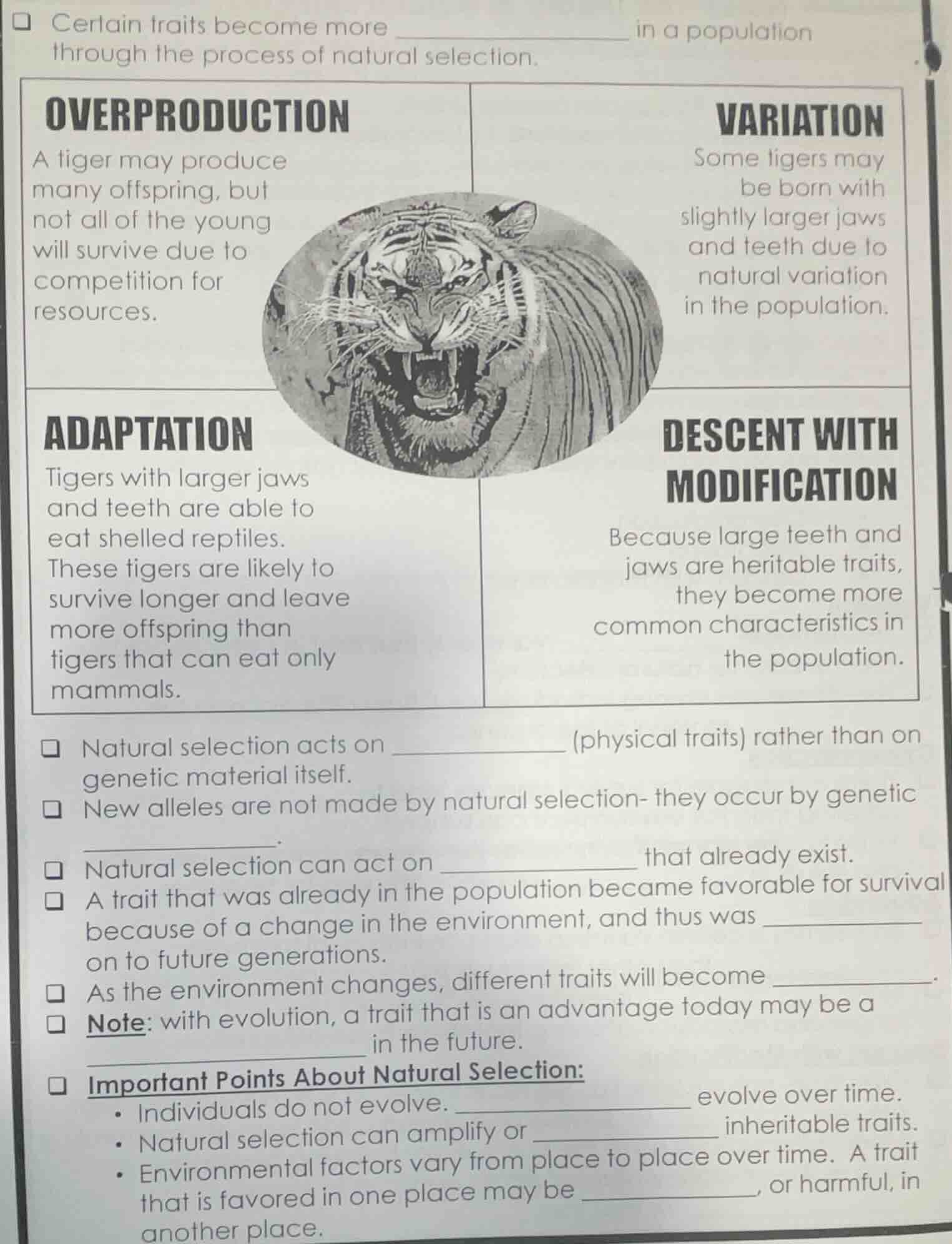
overproduction
a tiger may produce many offspring, but not all of the young will survive due to competition for resources.
variation
some tigers may be born with slightly larger jaws and teeth due to natural variation in the population.
adaptation
tigers with larger jaws and teeth are able to eat shelled reptiles. these tigers are likely to survive longer and leave more offspring than tigers that can eat only mammals.
descent with modification
because large teeth and jaws are heritable traits, they become more common characteristics in the population.
natural selection acts on __________ (physical traits) rather than on genetic material itself.
new alleles are not made by natural selection- they occur by genetic __________.
natural selection can act on __________ that already exist.
a trait that was already in the population became favorable for survival because of a change in the environment, and thus was __________ on to future generations.
as the environment changes, different traits will become __________.
note: with evolution, a trait that is an advantage today may be a __________ in the future.
important points about natural selection:
- individuals do not evolve. __________ evolve over time.
- natural selection can amplify or __________ inheritable traits.
- environmental factors vary from place to place over time. a trait that is favored in one place may be __________, or harmful, in another place.
These fill-in-the-blank questions cover core concepts of natural selection and evolution. Each answer is derived from standard evolutionary biology principles:
- Natural selection increases the frequency of favorable traits in a population.
- Natural selection acts on observable physical traits (phenotypes), not directly on genes.
- New genetic variations come from mutations, not natural selection.
- Natural selection only works on existing heritable traits in a population.
- Favorable traits are passed (selected) to future generations when environments change.
- Changing environments make different traits advantageous over time.
- Trait advantages are not permanent; a beneficial trait can become a disadvantage later.
- Evolution is a population-level process, not something that happens to individual organisms.
- Natural selection can either amplify or reduce the prevalence of inheritable traits.
- Trait fitness is context-dependent; a favorable trait in one environment may be neutral or harmful in another.

Snap & solve any problem in the app
Get step-by-step solutions on Sovi AI
Photo-based solutions with guided steps
Explore more problems and detailed explanations
- Certain traits become more common/favorable in a population through the process of natural selection.
- Natural selection acts on phenotypes (physical traits) rather than on genetic material itself.
- New alleles are not made by natural selection- they occur by genetic mutation.
- Natural selection can act on existing heritable traits that already exist.
- A trait that was already in the population became favorable for survival because of a change in the environment, and thus was passed/selected on to future generations.
- As the environment changes, different traits will become favorable/advantageous.
- Note: with evolution, a trait that is an advantage today may be a disadvantage in the future.
- Important Points About Natural Selection:
- Individuals do not evolve. Populations evolve over time.
- Natural selection can amplify or reduce inheritable traits.
- Environmental factors vary from place to place over time. A trait that is favored in one place may be neutral, or harmful, in another place.