QUESTION IMAGE
Question
ch 17 assignment
14
2.5 points
ebook
print
references
pancreas
thymus
pineal gland
thyroid gland
pituitary gland
hypothalamus
adrenal gland
< prev 14 of 40 next >
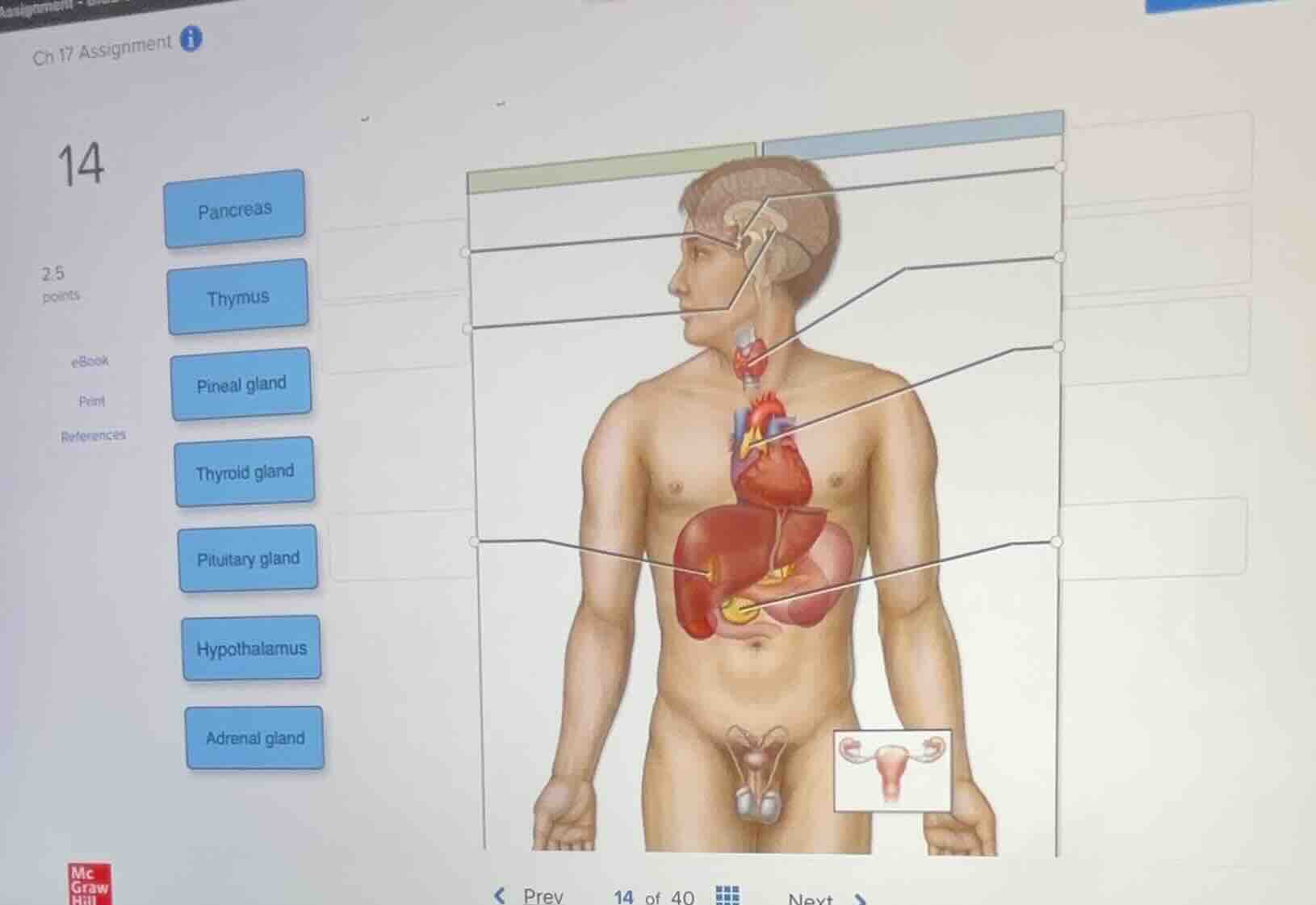
To solve this matching problem (endocrine glands to their anatomical locations), we analyze each gland:
- Hypothalamus: Part of the brain, near the pituitary.
- Pineal gland: In the brain (epithalamus region).
- Pituitary gland: Attached to the hypothalamus, in the brain (sella turcica).
- Thyroid gland: In the neck, anterior to the trachea.
- Thymus: In the mediastinum (chest, between lungs).
- Adrenal gland: On top of each kidney.
- Pancreas: Behind the stomach, in the abdominal cavity (involved in both endocrine/exocrine functions).
Matching (from top to bottom of the diagram, assuming standard endocrine gland positions):
- Top - most brain - related: Hypothalamus (regulatory center), then Pineal gland (brain), then Pituitary gland (brain - attached).
- Neck region: Thyroid gland.
- Chest (mediastinum): Thymus.
- On kidneys: Adrenal gland.
- Abdominal (behind stomach/near kidneys): Pancreas.
If the diagram has lines (from top to bottom) corresponding to:
- Top - most brain area: Hypothalamus
- Next brain area: Pineal gland
- Brain - attached: Pituitary gland
- Neck: Thyroid gland
- Chest: Thymus
- On kidneys: Adrenal gland
- Abdomen: Pancreas
For example, if the first (top) line points to the brain’s hypothalamic region, match to Hypothalamus; the next brain - related to Pineal gland, then Pituitary gland; neck to Thyroid gland; chest to Thymus; kidney - top to Adrenal gland; abdomen to Pancreas.
Final Answer (example matching, adjust to diagram’s line order):
- Top line: Hypothalamus
- Second line: Pineal gland
- Third line: Pituitary gland
- Fourth line: Thyroid gland
- Fifth line: Thymus
- Sixth line: Adrenal gland
- Seventh line: Pancreas
(Note: The exact order depends on the diagram’s labeling. Use anatomical knowledge: Hypothalamus/Pineal/Pituitary (brain), Thyroid (neck), Thymus (chest), Adrenal (kidneys), Pancreas (abdomen).)

Snap & solve any problem in the app
Get step-by-step solutions on Sovi AI
Photo-based solutions with guided steps
Explore more problems and detailed explanations
To solve this matching problem (endocrine glands to their anatomical locations), we analyze each gland:
- Hypothalamus: Part of the brain, near the pituitary.
- Pineal gland: In the brain (epithalamus region).
- Pituitary gland: Attached to the hypothalamus, in the brain (sella turcica).
- Thyroid gland: In the neck, anterior to the trachea.
- Thymus: In the mediastinum (chest, between lungs).
- Adrenal gland: On top of each kidney.
- Pancreas: Behind the stomach, in the abdominal cavity (involved in both endocrine/exocrine functions).
Matching (from top to bottom of the diagram, assuming standard endocrine gland positions):
- Top - most brain - related: Hypothalamus (regulatory center), then Pineal gland (brain), then Pituitary gland (brain - attached).
- Neck region: Thyroid gland.
- Chest (mediastinum): Thymus.
- On kidneys: Adrenal gland.
- Abdominal (behind stomach/near kidneys): Pancreas.
If the diagram has lines (from top to bottom) corresponding to:
- Top - most brain area: Hypothalamus
- Next brain area: Pineal gland
- Brain - attached: Pituitary gland
- Neck: Thyroid gland
- Chest: Thymus
- On kidneys: Adrenal gland
- Abdomen: Pancreas
For example, if the first (top) line points to the brain’s hypothalamic region, match to Hypothalamus; the next brain - related to Pineal gland, then Pituitary gland; neck to Thyroid gland; chest to Thymus; kidney - top to Adrenal gland; abdomen to Pancreas.
Final Answer (example matching, adjust to diagram’s line order):
- Top line: Hypothalamus
- Second line: Pineal gland
- Third line: Pituitary gland
- Fourth line: Thyroid gland
- Fifth line: Thymus
- Sixth line: Adrenal gland
- Seventh line: Pancreas
(Note: The exact order depends on the diagram’s labeling. Use anatomical knowledge: Hypothalamus/Pineal/Pituitary (brain), Thyroid (neck), Thymus (chest), Adrenal (kidneys), Pancreas (abdomen).)