QUESTION IMAGE
Question
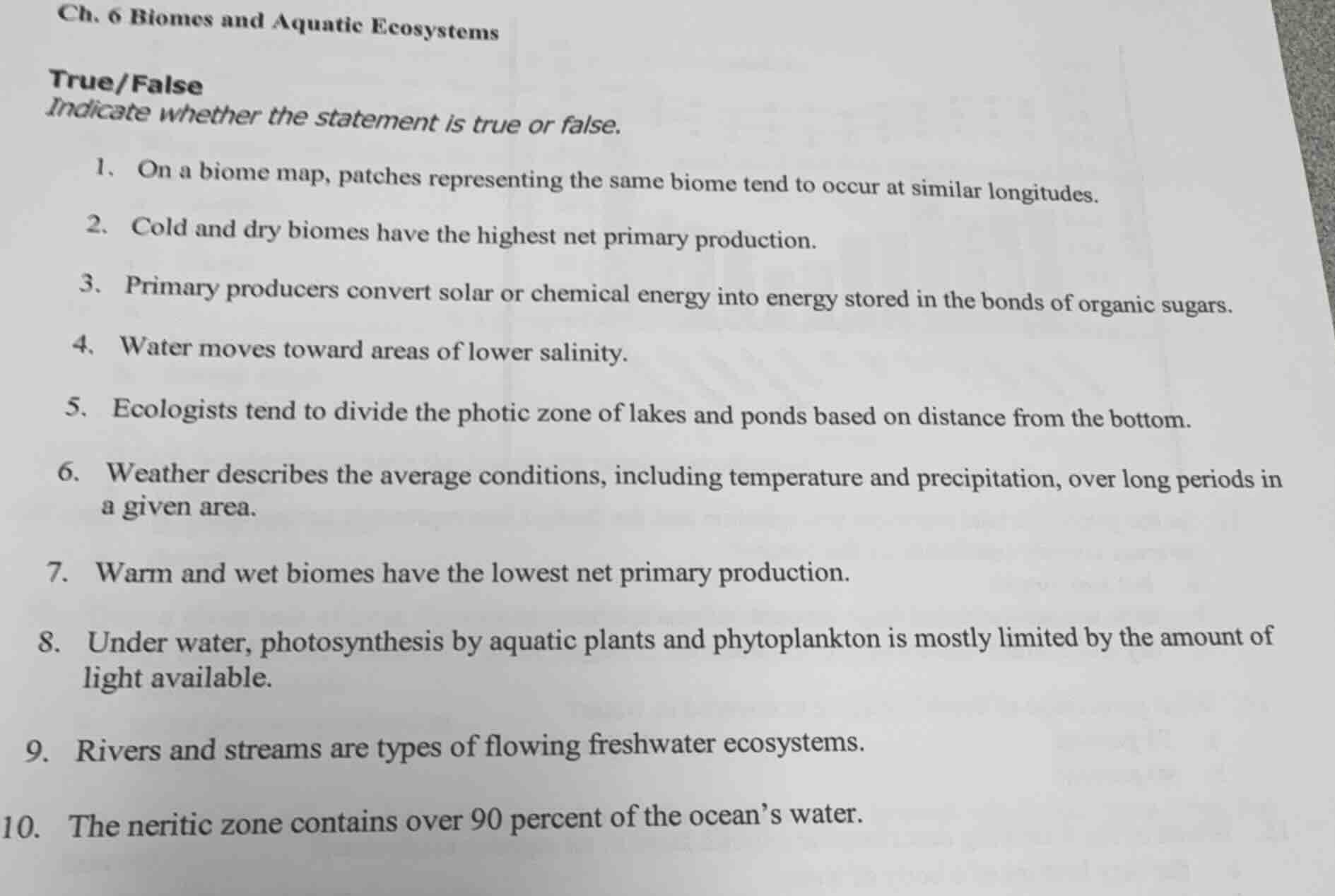
ch. 6 biomes and aquatic ecosystems
true/false
indicate whether the statement is true or false.
- on a biome map, patches representing the same biome tend to occur at similar longitudes.
- cold and dry biomes have the highest net primary production.
- primary producers convert solar or chemical energy into energy stored in the bonds of organic sugars.
- water moves toward areas of lower salinity.
- ecologists tend to divide the photic zone of lakes and ponds based on distance from the bottom.
- weather describes the average conditions, including temperature and precipitation, over long periods in a given area.
- warm and wet biomes have the lowest net primary production.
- under water, photosynthesis by aquatic plants and phytoplankton is mostly limited by the amount of light available.
- rivers and streams are types of flowing freshwater ecosystems.
- the neritic zone contains over 90 percent of the oceans water.
Brief Explanations
- Biomes are determined by climate (temperature/precipitation), which aligns with latitudes, not longitudes.
- Cold/dry biomes (e.g., tundra, desert) have low primary production due to harsh conditions.
- Primary producers (plants, chemosynthetic organisms) convert energy into organic sugars via photosynthesis/chemosynthesis.
- Water moves to areas of higher salinity (osmosis, toward higher solute concentration).
- The photic zone is divided by light availability, not distance from the bottom; benthic zones are based on bottom distance.
- Weather is short-term atmospheric conditions; climate is long-term averages.
- Warm/wet biomes (e.g., rainforests) have the highest net primary production due to ideal growing conditions.
- Light penetrates poorly in water, so it is the main limiting factor for aquatic photosynthesis.
- Rivers and streams are defined by their flowing, freshwater characteristics.
- The oceanic zone contains over 90% of ocean water; the neritic zone is the shallow coastal area.

Snap & solve any problem in the app
Get step-by-step solutions on Sovi AI
Photo-based solutions with guided steps
Explore more problems and detailed explanations
- False
- False
- True
- False
- False
- False
- False
- True
- True
- False