QUESTION IMAGE
Question
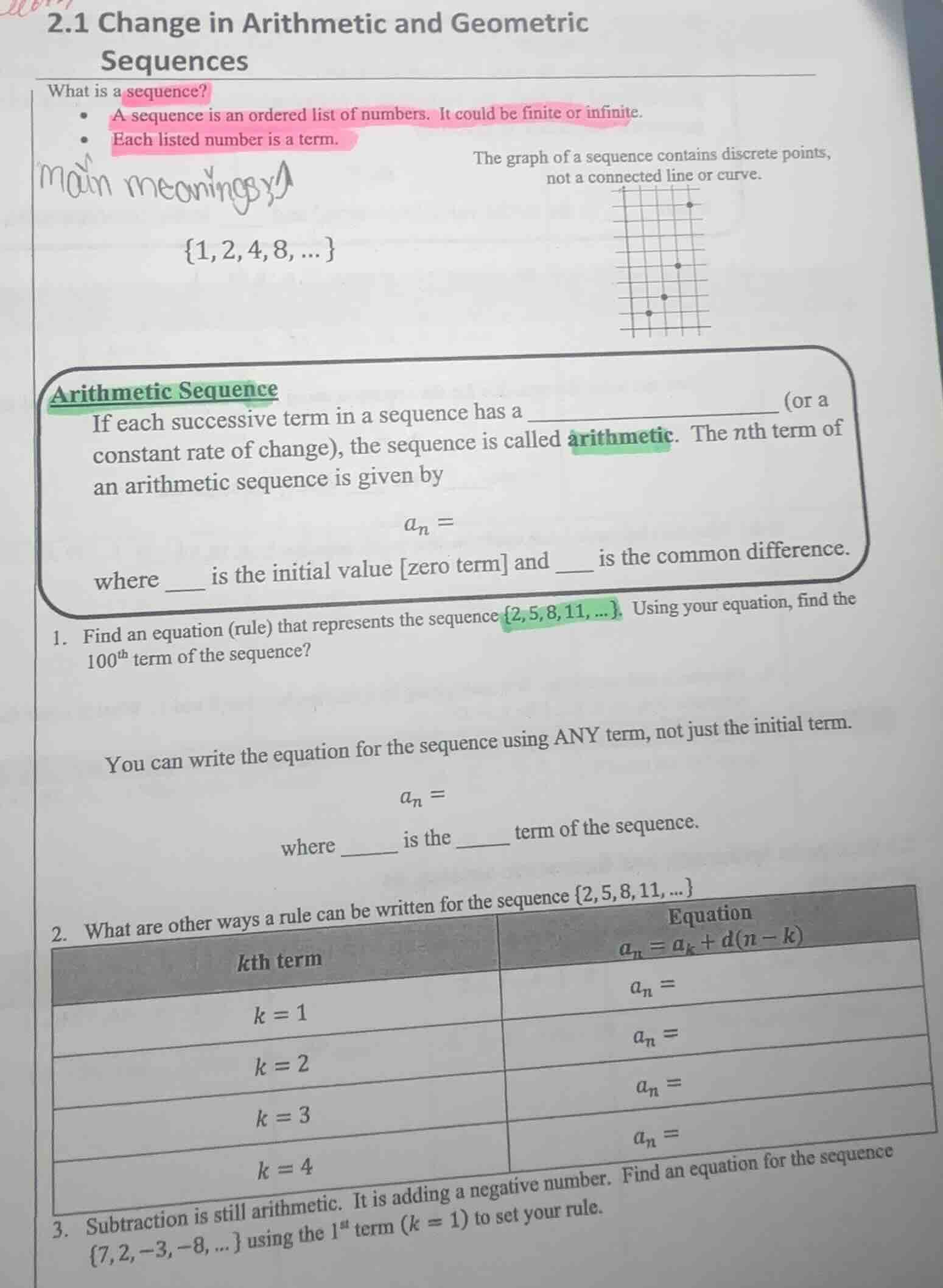
2.1 change in arithmetic and geometric sequences
what is a sequence?
- a sequence is an ordered list of numbers. it could be finite or infinite.
- each listed number is a term.
the graph of a sequence contains discrete points, not a connected line or curve.
{1,2,4,8,...}
arithmetic sequence
if each successive term in a sequence has a _______________ (or a constant rate of change), the sequence is called arithmetic. the nth term of an arithmetic sequence is given by
$a_n = $
where _ is the initial value zero term and _ is the common difference.
- find an equation (rule) that represents the sequence {2,5,8,11,...}. using your equation, find the 100th term of the sequence?
you can write the equation for the sequence using any term, not just the initial term.
$a_n = $
where ___ is the ___ term of the sequence.
- what are other ways a rule can be written for the sequence {2,5,8,11,...}
| kth term | equation |
|---|---|
| $k = 1$ | $a_n = $ |
| $k = 2$ | $a_n = $ |
| $k = 3$ | $a_n = $ |
| $k = 4$ | $a_n = $ |
- subtraction is still arithmetic. it is adding a negative number. find an equation for the sequence {7,2,−3,−8,...} using the 1st term ($k = 1$) to set your rule.
Problem 1:
Step 1: Identify the type of sequence
The sequence \(\{2, 5, 8, 11, \dots\}\) is an arithmetic sequence because the difference between consecutive terms is constant. Let's find the common difference \(d\).
\(d = 5 - 2 = 3\), \(d = 8 - 5 = 3\), \(d = 11 - 8 = 3\), so \(d = 3\).
Step 2: Find the initial term (\(a_0\)) or the first term (\(a_1\))
The first term \(a_1 = 2\). For an arithmetic sequence, the formula for the \(n\)-th term is \(a_n = a_1 + (n - 1)d\) or \(a_n = a_0 + nd\). Let's use \(a_1\) first. If we consider \(n = 1\), \(a_1 = 2 = a_0 + 1\times3\), so \(a_0 = 2 - 3 = -1\). So the formula can also be written as \(a_n = -1 + 3n\) (using \(a_0\)) or \(a_n = 2 + 3(n - 1)\) (using \(a_1\)). Let's simplify \(a_n = 2 + 3(n - 1)\):
\(a_n = 2 + 3n - 3 = 3n - 1\). Let's check for \(n = 1\): \(3(1) - 1 = 2\) (correct), \(n = 2\): \(3(2) - 1 = 5\) (correct), \(n = 3\): \(3(3) - 1 = 8\) (correct), \(n = 4\): \(3(4) - 1 = 11\) (correct). So the formula is \(a_n = 3n - 1\) (or \(a_n = -1 + 3n\) or \(a_n = 2 + 3(n - 1)\)).
Step 3: Find the 100th term
Now, to find the 100th term, substitute \(n = 100\) into the formula \(a_n = 3n - 1\).
\(a_{100} = 3(100) - 1 = 300 - 1 = 299\).
Step 1: Identify the type of sequence
The sequence \(\{7, 2, -3, -8, \dots\}\) is an arithmetic sequence. Let's find the common difference \(d\).
\(d = 2 - 7 = -5\), \(d = -3 - 2 = -5\), \(d = -8 - (-3) = -5\), so \(d = -5\).
Step 2: Use the formula with \(k = 1\)
We use the formula \(a_n = a_k + d(n - k)\) with \(k = 1\), \(a_1 = 7\), and \(d = -5\).
So \(a_n = a_1 + d(n - 1) = 7 + (-5)(n - 1)\).
Step 3: Simplify the formula
Simplify \(7 + (-5)(n - 1)\):
\(a_n = 7 - 5n + 5 = 12 - 5n\). Let's check for \(n = 1\): \(12 - 5(1) = 7\) (correct), \(n = 2\): \(12 - 5(2) = 2\) (correct), \(n = 3\): \(12 - 5(3) = -3\) (correct), \(n = 4\): \(12 - 5(4) = -8\) (correct).

Snap & solve any problem in the app
Get step-by-step solutions on Sovi AI
Photo-based solutions with guided steps
Explore more problems and detailed explanations
The equation (rule) for the sequence \(\{2, 5, 8, 11, \dots\}\) is \(a_n = 3n - 1\) (or equivalent forms like \(a_n = 2 + 3(n - 1)\) or \(a_n = -1 + 3n\)). The 100th term is \(299\).
Problem 2:
For the sequence \(\{2, 5, 8, 11, \dots\}\), we know \(a_k + d(n - k)\) where \(d = 3\). Let's find the equations for different \(k\):
- When \(k = 1\):
\(a_1 = 2\), so \(a_n = a_1 + 3(n - 1) = 2 + 3(n - 1)\) (which simplifies to \(3n - 1\) as before).
- When \(k = 2\):
\(a_2 = 5\), so \(a_n = a_2 + 3(n - 2) = 5 + 3(n - 2) = 5 + 3n - 6 = 3n - 1\) (same as above).
- When \(k = 3\):
\(a_3 = 8\), so \(a_n = a_3 + 3(n - 3) = 8 + 3(n - 3) = 8 + 3n - 9 = 3n - 1\) (same result).
- When \(k = 4\):
\(a_4 = 11\), so \(a_n = a_4 + 3(n - 4) = 11 + 3(n - 4) = 11 + 3n - 12 = 3n - 1\) (same result).