QUESTION IMAGE
Question
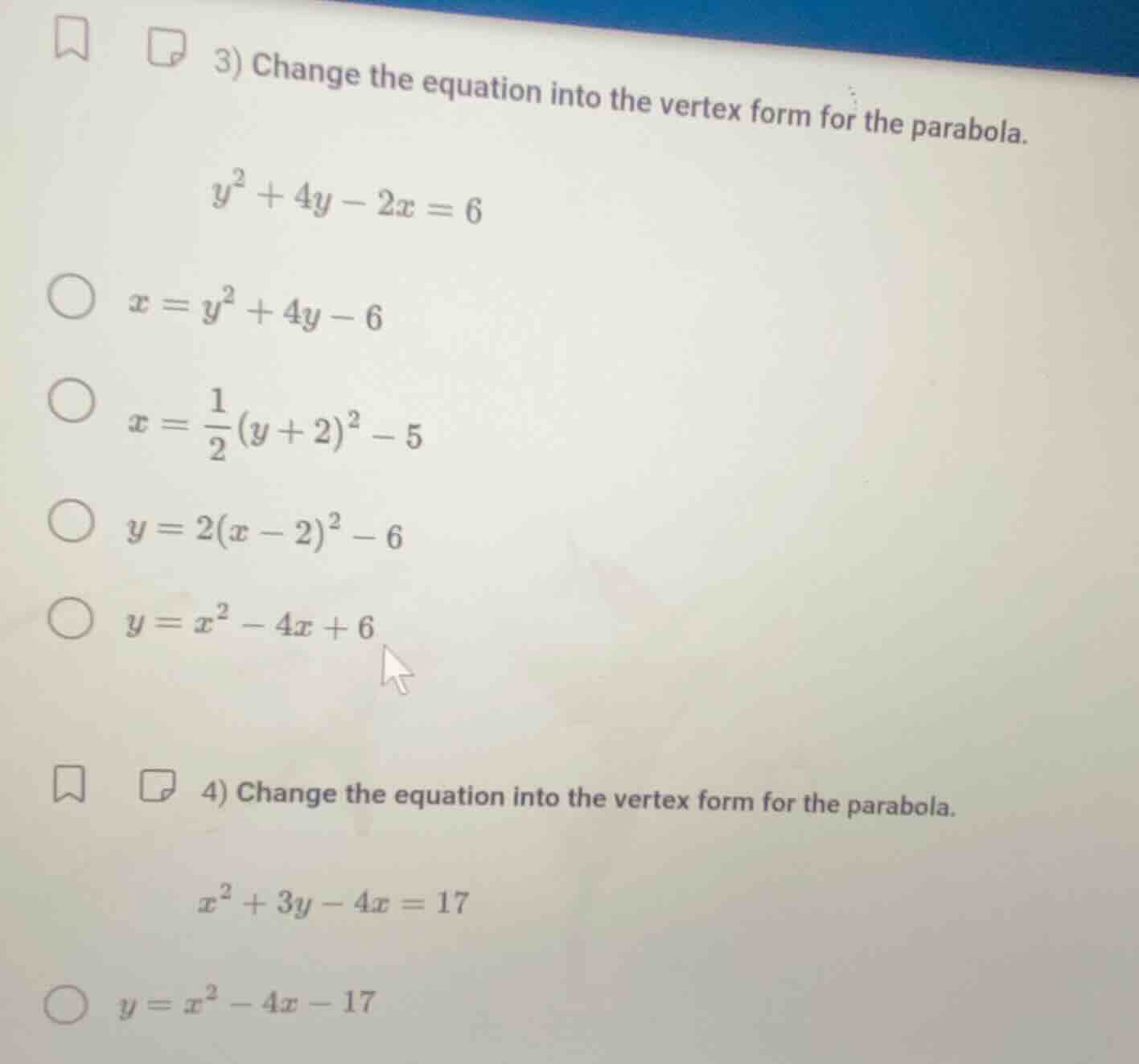
- change the equation into the vertex form for the parabola.
$y^2 + 4y - 2x = 6$
$\bigcirc$ $x = y^2 + 4y - 6$
$\bigcirc$ $x = \frac{1}{2}(y + 2)^2 - 5$
$\bigcirc$ $y = 2(x - 2)^2 - 6$
$\bigcirc$ $y = x^2 - 4x + 6$
- change the equation into the vertex form for the parabola.
$x^2 + 3y - 4x = 17$
$\bigcirc$ $y = x^2 - 4x - 17$
Question 3
Step1: Isolate the y-terms and x
Start with the equation \( y^2 + 4y - 2x = 6 \). Move the \( -2x \) and \( 6 \) to get \( y^2 + 4y = 2x + 6 \).
Step2: Complete the square for y
Take the \( y \)-terms: \( y^2 + 4y \). To complete the square, take half of 4 (which is 2), square it (\( 2^2 = 4 \)), add and subtract it (but since we are dealing with the left side, we add 4 to both sides? Wait, actually, we can factor. Wait, let's rearrange the equation to solve for x first. Wait, the vertex form for a parabola that opens left or right is \( x = a(y - k)^2 + h \), where \((h, k)\) is the vertex. So let's solve for x.
Starting with \( y^2 + 4y - 2x = 6 \).
Add \( 2x \) to both sides: \( y^2 + 4y = 2x + 6 \).
Subtract 6: \( y^2 + 4y - 6 = 2x \).
Now, complete the square for the \( y \)-terms. The \( y \)-terms are \( y^2 + 4y \). The formula for completing the square is \( y^2 + by = (y + \frac{b}{2})^2 - (\frac{b}{2})^2 \). Here, \( b = 4 \), so \( \frac{b}{2} = 2 \), and \( (\frac{b}{2})^2 = 4 \). So:
\( y^2 + 4y = (y + 2)^2 - 4 \).
Substitute back into the equation: \( (y + 2)^2 - 4 - 6 = 2x \).
Simplify: \( (y + 2)^2 - 10 = 2x \).
Divide both sides by 2: \( x = \frac{1}{2}(y + 2)^2 - 5 \).
Step1: Isolate the y-term
Start with \( x^2 + 3y - 4x = 17 \). Move the \( x \)-terms to the right: \( 3y = -x^2 + 4x + 17 \).
Step2: Complete the square for x
First, factor out -1 from the \( x \)-terms: \( 3y = - (x^2 - 4x) + 17 \).
Complete the square inside the parentheses: \( x^2 - 4x \). Take half of -4 (which is -2), square it (4). So \( x^2 - 4x = (x - 2)^2 - 4 \).
Substitute back: \( 3y = - [(x - 2)^2 - 4] + 17 \).
Simplify the right side: \( 3y = - (x - 2)^2 + 4 + 17 \) → \( 3y = - (x - 2)^2 + 21 \).
Divide both sides by 3: \( y = -\frac{1}{3}(x - 2)^2 + 7 \). Wait, but let's check the given options. Wait, the given option is \( y = x^2 - 4x - 17 \)? No, that can't be. Wait, maybe I made a mistake. Wait, the original equation is \( x^2 + 3y - 4x = 17 \). Let's solve for y:
\( 3y = -x^2 + 4x + 17 \) → \( y = -\frac{1}{3}x^2 + \frac{4}{3}x + \frac{17}{3} \). But the given option is \( y = x^2 - 4x - 17 \)? No, that's not matching. Wait, maybe the options are different. Wait, the first option for question 4 is \( y = x^2 - 4x - 17 \), but that's not the vertex form. Wait, maybe I misread the equation. Wait, the equation is \( x^2 + 3y - 4x = 17 \). Let's rearrange:
\( 3y = -x^2 + 4x + 17 \) → \( y = -\frac{1}{3}x^2 + \frac{4}{3}x + \frac{17}{3} \). To write in vertex form, we complete the square for the \( x \)-terms.
Factor out -1/3 from the \( x \)-terms: \( y = -\frac{1}{3}(x^2 - 4x) + \frac{17}{3} \).
Complete the square inside the parentheses: \( x^2 - 4x = (x - 2)^2 - 4 \).
Substitute back: \( y = -\frac{1}{3}[(x - 2)^2 - 4] + \frac{17}{3} \).
Distribute the -1/3: \( y = -\frac{1}{3}(x - 2)^2 + \frac{4}{3} + \frac{17}{3} \).
Simplify: \( y = -\frac{1}{3}(x - 2)^2 + \frac{21}{3} \) → \( y = -\frac{1}{3}(x - 2)^2 + 7 \).
But the given option is \( y = x^2 - 4x - 17 \), which is just solving for y without completing the square (linear term, not vertex form). Wait, maybe the question has a typo, or I misread. Wait, the option is \( y = x^2 - 4x - 17 \)? Let's check:
From \( x^2 + 3y - 4x = 17 \), solve for y:
\( 3y = -x^2 + 4x + 17 \) → \( y = -\frac{1}{3}x^2 + \frac{4}{3}x + \frac{17}{3} \). The option \( y = x^2 - 4x - 17 \) would be if we had \( 3y = 3x^2 - 12x - 51 \), which is not the case. So maybe the option is incorrect, but if we just solve for y without completing the square, we get \( y = -\frac{1}{3}x^2 + \frac{4}{3}x + \frac{17}{3} \), but the given option is \( y = x^2 - 4x - 17 \), which is not correct. Wait, maybe I made a mistake in the equation. Wait, the equation is \( x^2 + 3y - 4x = 17 \). Let's rearrange:
\( 3y = x^2 - 4x + 17 \)? No, that would be if the equation was \( -x^2 + 3y - 4x = 17 \), but it's \( x^2 + 3y - 4x = 17 \). So \( 3y = -x^2 + 4x + 17 \), so y is a quadratic in x with a negative leading coefficient. The given option \( y = x^2 - 4x - 17 \) has a positive leading coefficient, so it's incorrect. But maybe the question has a typo, or I misread. Alternatively, maybe the equation is \( -x^2 + 3y - 4x = 17 \), which would make \( 3y = x^2 + 4x + 17 \), but that's not the case. Wait, perhaps the user made a mistake in the problem statement. But based on the given option, the first option is \( y = x^2 - 4x - 17 \), which is not the vertex form. However, if we just solve for y without completing the square, we get \( y = \frac{1}{3}x^2 - \frac{4}{3}x + \frac{17}{3} \), which is not the same as the given option. So there might be an error in the problem or options. But assuming the question is to write in vertex form, the correct vertex form is \( y = -\frac{1}{3}(x - 2)^…

Snap & solve any problem in the app
Get step-by-step solutions on Sovi AI
Photo-based solutions with guided steps
Explore more problems and detailed explanations
B. \( x = \frac{1}{2}(y + 2)^2 - 5 \) (assuming the options are labeled, but from the given options, the second option is \( x = \frac{1}{2}(y + 2)^2 - 5 \))