QUESTION IMAGE
Question
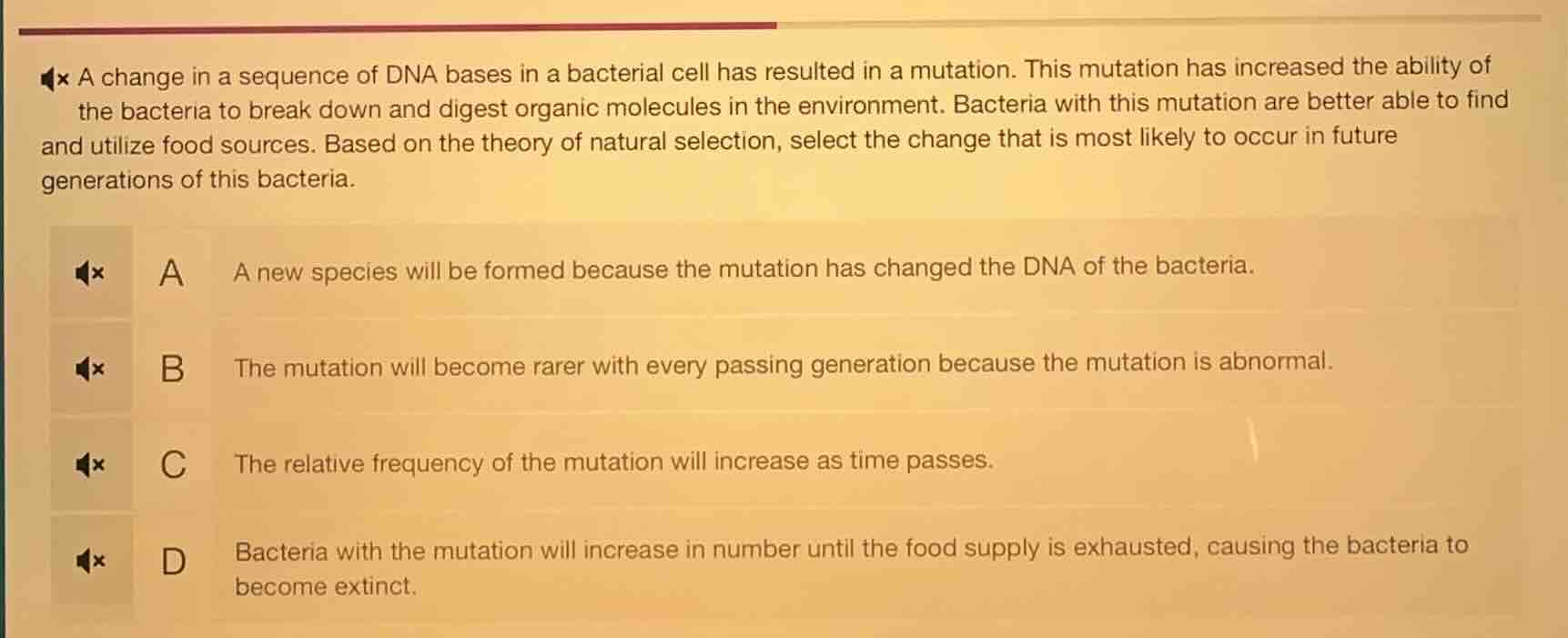
a change in a sequence of dna bases in a bacterial cell has resulted in a mutation. this mutation has increased the ability of the bacteria to break down and digest organic molecules in the environment. bacteria with this mutation are better able to find and utilize food sources. based on the theory of natural selection, select the change that is most likely to occur in future generations of this bacteria. a a new species will be formed because the mutation has changed the dna of the bacteria. b the mutation will become rarer with every passing generation because the mutation is abnormal. c the relative frequency of the mutation will increase as time passes. d bacteria with the mutation will increase in number until the food supply is exhausted, causing the bacteria to become extinct.
- Option A: Forming a new species requires more than just a DNA mutation; it involves significant genetic divergence and reproductive isolation, so this is incorrect.
- Option B: The mutation is beneficial (helps digest food, find food sources), so natural selection would favor it, not make it rarer. Thus, this is wrong.
- Option C: Since the mutation helps bacteria survive and reproduce better (find/utilize food), natural selection will increase the frequency of this beneficial mutation over generations. This aligns with natural selection theory.
- Option D: Bacteria can adapt to changing food sources or the mutation helps them utilize food better, and there's no indication the food supply will be exhausted to the point of extinction. This is an overstatement and incorrect.

Snap & solve any problem in the app
Get step-by-step solutions on Sovi AI
Photo-based solutions with guided steps
Explore more problems and detailed explanations
C. The relative frequency of the mutation will increase as time passes.