QUESTION IMAGE
Question
chapter 02 quiz: the research enterprise in psychology
total points: ~/20 \t\t\t\t\t\t\t\t\t\t\t\t\t\t\t\t\t\t\t\tattempts left: 3
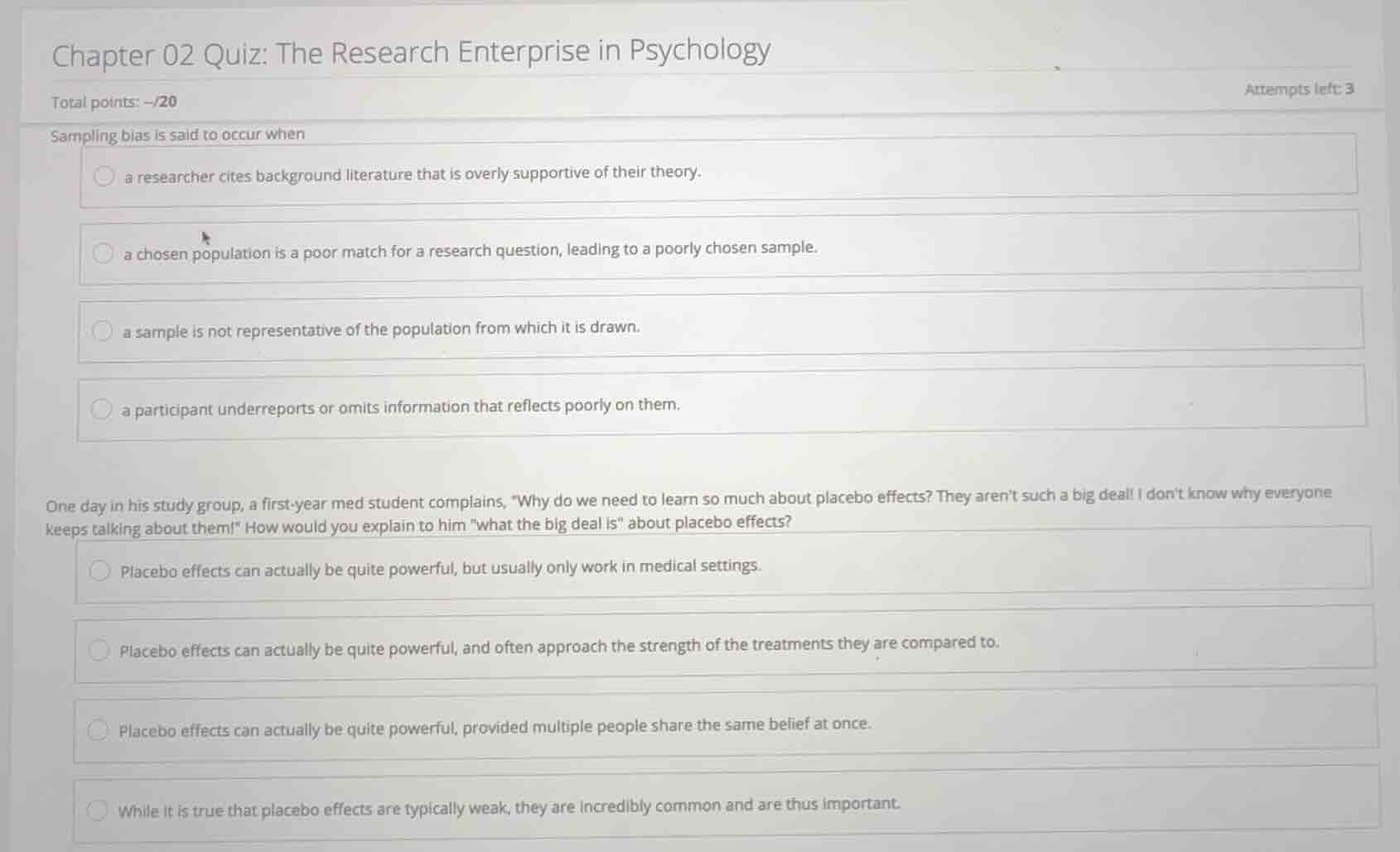
sampling bias is said to occur when
\ta researcher cites background literature that is overly supportive of their theory.
\ta chosen population is a poor match for a research question, leading to a poorly chosen sample.
\ta sample is not representative of the population from which it is drawn.
\ta participant underreports or omits information that reflects poorly on them.
one day in his study group, a first-year med student complains, \why do we need to learn so much about placebo effects? they arent such a big deal! i dont know why everyone keeps talking about them!\ how would you explain to him \what the big deal is\ about placebo effects?
\tplacebo effects can actually be quite powerful, but usually only work in medical settings.
\tplacebo effects can actually be quite powerful, and often approach the strength of the treatments they are compared to.
\tplacebo effects can actually be quite powerful, provided multiple people share the same belief at once.
\twhile it is true that placebo effects are typically weak, they are incredibly common and are thus important.
- For the sampling bias question: Sampling bias is defined as a situation where the sample selected does not accurately reflect the broader population it is meant to represent, leading to skewed results.
- For the placebo effects question: Research consistently shows that placebo effects can be very strong, often having effects that are comparable in magnitude to the active treatments they are tested against, which makes them critically important in medical and psychological research and practice.

Snap & solve any problem in the app
Get step-by-step solutions on Sovi AI
Photo-based solutions with guided steps
Explore more problems and detailed explanations
- a sample is not representative of the population from which it is drawn.
- Placebo effects can actually be quite powerful, and often approach the strength of the treatments they are compared to.