QUESTION IMAGE
Question
chapter 11
section 2
section summary
african americans and the war
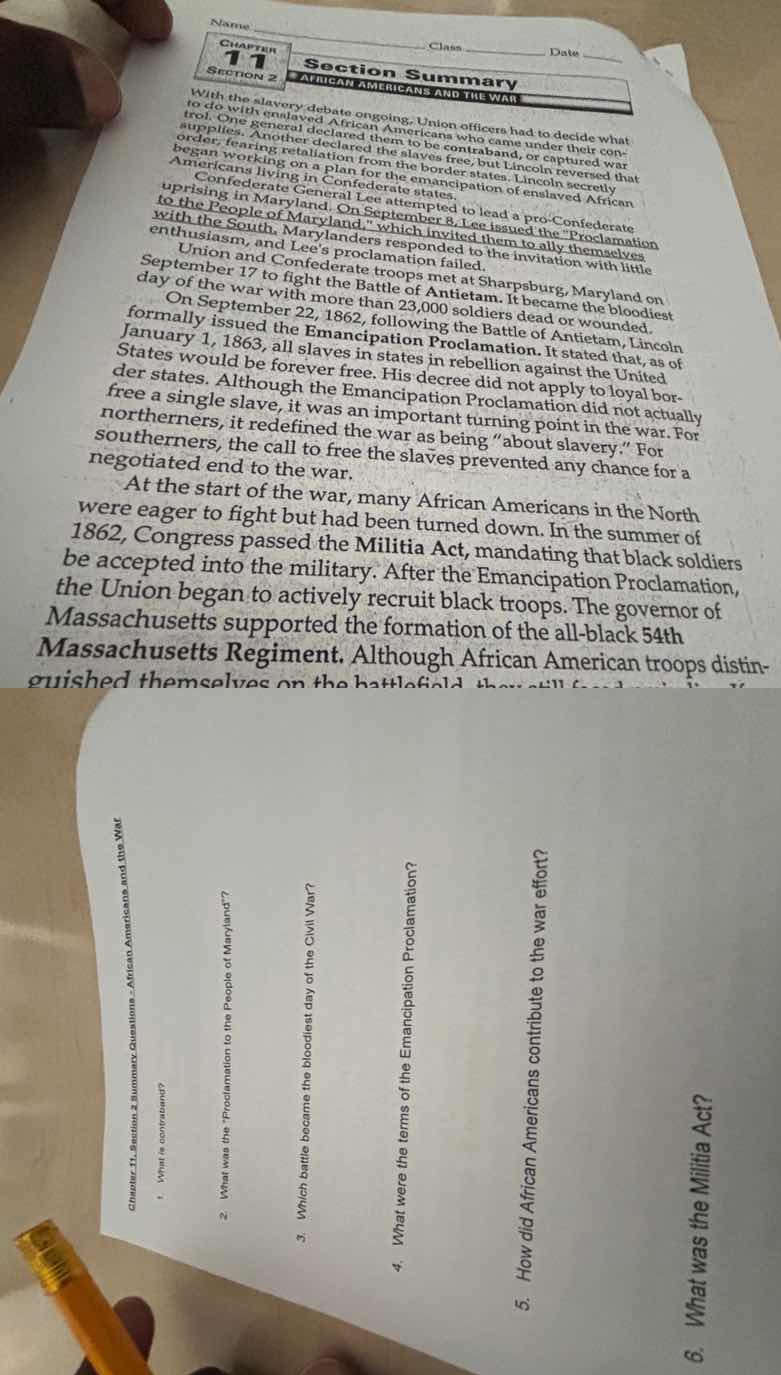
with the slavery debate ongoing, union officers had to decide what to do with enslaved africans americans who were under their con - trol. one general declared them to be contraband, or captured war supplies. another said that the slaves free, but lincoln reversed that order, fearing resistance from the border states. enslaved african americans living in confederate states began working on a plan for the emancipation, or freedom, of slaves. confederate general lee attempted to lead a pro - confederate uprising in maryland. on september 8, lee issued the \proclamation to the people of maryland,\ which invited them to ally themselves with the south. marylanders responded with little enthusiasm, and lees proclamation failed. it became the bloodiest union and confederate troops met at sharpsburg, maryland on september 17 to fight the battle of antietam. it became the bloodiest day of the war with more than 23,000 soldiers dead or wounded.
on september 22, 1862, following the battle of antietam, lincoln formally issued the emancipation proclamation. it stated that, as of january 1, 1863, all slaves in states in rebellion against the united states would be forever free. his decree did not apply to loyal bor - der states. although the emancipation proclamation did not actually free a single slave, it was an important turning point in the war. for northerners, it redefined the war as being \about slavery.\ for southerners, the call to free the slaves prevented any chance for a negotiated end to the war.
at the start of the war, many african americans in the north were eager to fight but had been turned down. in the summer of 1862, congress passed the militia act, mandating that black soldiers be accepted into the military. after the emancipation proclamation, the union began to actively recruit black troops. the governor of massachusetts supported the formation of the all - black 54th massachusetts regiment. although african american troops distin - guished themselves on the battlefield...
chapter 11, section 2 assessment questions - african americans and the war
- what is controversy?
- what was the proclamation to the people of maryland?
- which battle became the bloodiest day of the civil war?
- what were the terms of the emancipation proclamation?
- how did african americans contribute to the war effort?
- what was the militia act?
- A contraband, in this context, was an enslaved person who escaped to or was captured by Union lines during the Civil War; Union generals classified them as "contraband of war" to avoid returning them to enslavers.
- Issued by Confederate General Lee, it was a pro-Confederate proclamation that invited enslaved African Americans in Maryland to ally with the South to resist Union forces, but it received little enthusiasm.
- The Battle of Antietam, fought on September 17, 1862, in Sharpsburg, Maryland, became the bloodiest single day of the Civil War, with over 23,000 soldiers dead or wounded.
- The Emancipation Proclamation stated that as of January 1, 1863, all enslaved people in states in rebellion against the United States would be forever free; it did not apply to enslaved people in loyal border states.
- After being allowed to enlist (following the Militia Act and Emancipation Proclamation), African Americans served in segregated Union regiments, distinguished themselves in battle, and expanded the Union's military force, helping to turn the tide of the war.
- Passed in the summer of 1862, the Militia Act mandated that Black soldiers be accepted into the Union military, opening the door for African American enlistment.

Snap & solve any problem in the app
Get step-by-step solutions on Sovi AI
Photo-based solutions with guided steps
Explore more problems and detailed explanations
- A contraband was an enslaved person who escaped to or was captured by Union lines, classified as "contraband of war" to avoid return to enslavers.
- It was a pro-Confederate proclamation by Lee that invited enslaved Marylanders to ally with the South, which gained little support.
- The Battle of Antietam
- As of January 1, 1863, all enslaved people in rebelling states would be forever free; it excluded loyal border states.
- They served in segregated Union regiments, fought bravely in battles, and increased the Union's military manpower.
- A 1862 congressional act that required the Union military to accept Black soldiers.