QUESTION IMAGE
Question
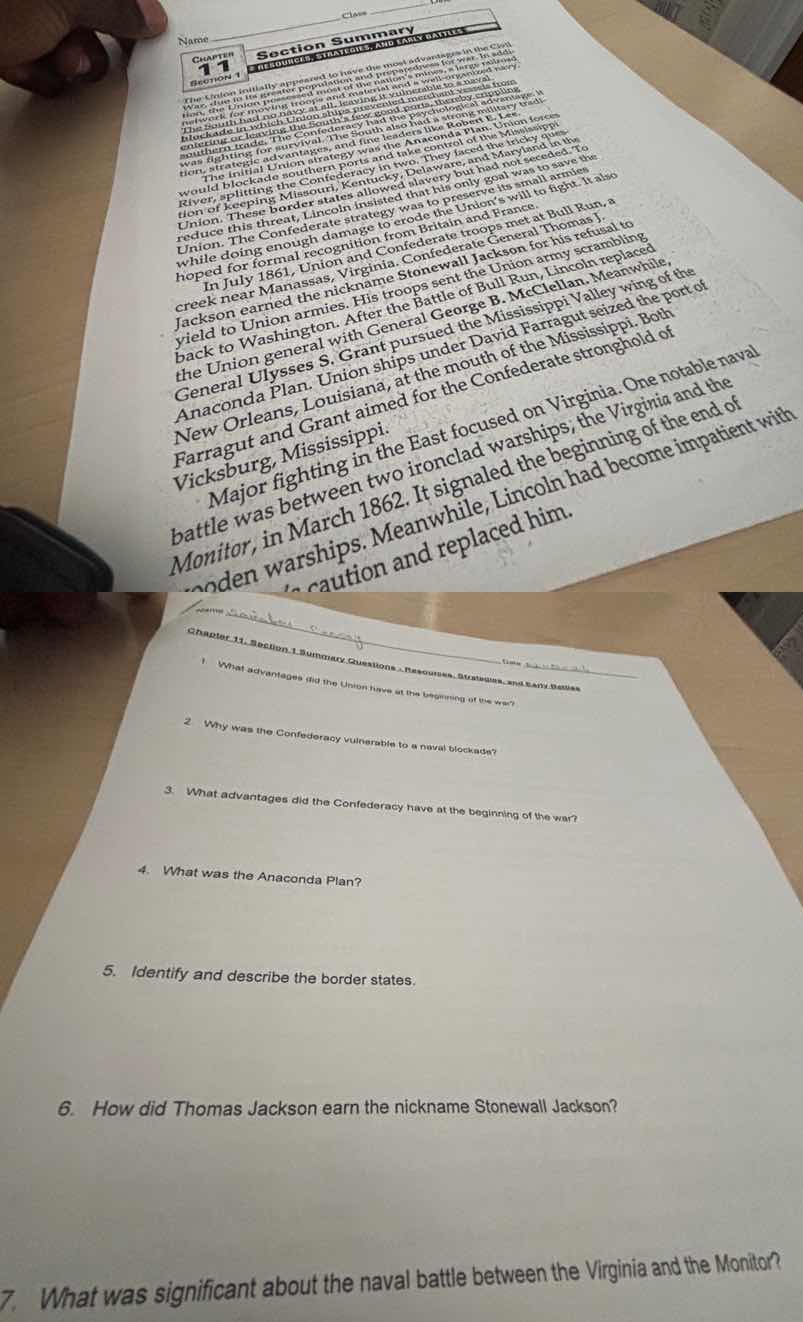
chapter 11, section 1 summary questions - resources, strategies, and early battles
1 what advantages did the union have at the beginning of the war?
2 why was the confederacy vulnerable to a naval blockade?
3 what advantages did the confederacy have at the beginning of the war?
4 what was the anaconda plan?
5 identify and describe the border states.
6 how did thomas jackson earn the nickname stonewall jackson?
7 what was significant about the naval battle between the virginia and the monitor?
Brief Explanations
- The Union had a larger population for troops, more industrial capacity to produce weapons/supplies, a more extensive railroad network for transportation, and control over most of the nation's financial resources.
- The Confederacy relied heavily on exporting cotton to Europe for revenue and importing manufactured goods/weapons. Its major ports were key to this trade, and a naval blockade cut off these critical supply and income lines; it also lacked the industrial capacity to build a large navy to counter the blockade.
- The Confederacy fought a defensive war on familiar territory, had military leaders with strong tactical experience, and possessed high morale from fighting to protect their home region.
- The Anaconda Plan was a Union military strategy to defeat the Confederacy by: 1) Blockading all Confederate ports to cut off trade, and 2) Gaining control of the Mississippi River to split the Confederacy into two isolated parts, slowly squeezing the Confederacy like an anaconda constricts its prey.
- Border states were slave states that did not secede from the Union: Delaware, Kentucky, Maryland, Missouri, and West Virginia (formed later in the war). They were strategically critical because they bordered both the Union and Confederacy; their loyalty gave the Union access to more troops and resources, and prevented the Confederacy from gaining a larger territory and population.
- At the First Battle of Bull Run in July 1861, Thomas Jackson's brigade held firm against a Union advance, refusing to retreat. A fellow general shouted, "There is Jackson standing like a stone wall!" This moment earned him the nickname "Stonewall Jackson".
- The battle between the Virginia (Confederate) and Monitor (Union) in March 1862 was the first naval battle between ironclad warships. It signaled the end of wooden warships as the dominant naval vessels, revolutionizing naval warfare technology globally.

Snap & solve any problem in the app
Get step-by-step solutions on Sovi AI
Photo-based solutions with guided steps
Explore more problems and detailed explanations
- Larger population, more industry, railroads, finances.
- Relied on port trade; no large navy to resist.
- Defensive home terrain, skilled generals, high morale.
- Union strategy: blockade Confederate ports, split Confederacy via Mississippi River.
- Delaware, Kentucky, Maryland, Missouri, West Virginia; slave states that stayed in the Union, critical for Union resources/strategy.
- Held firm at First Bull Run, called a "stone wall" by a general.
- First ironclad naval battle; ended wooden warship dominance, revolutionized naval warfare.