QUESTION IMAGE
Question
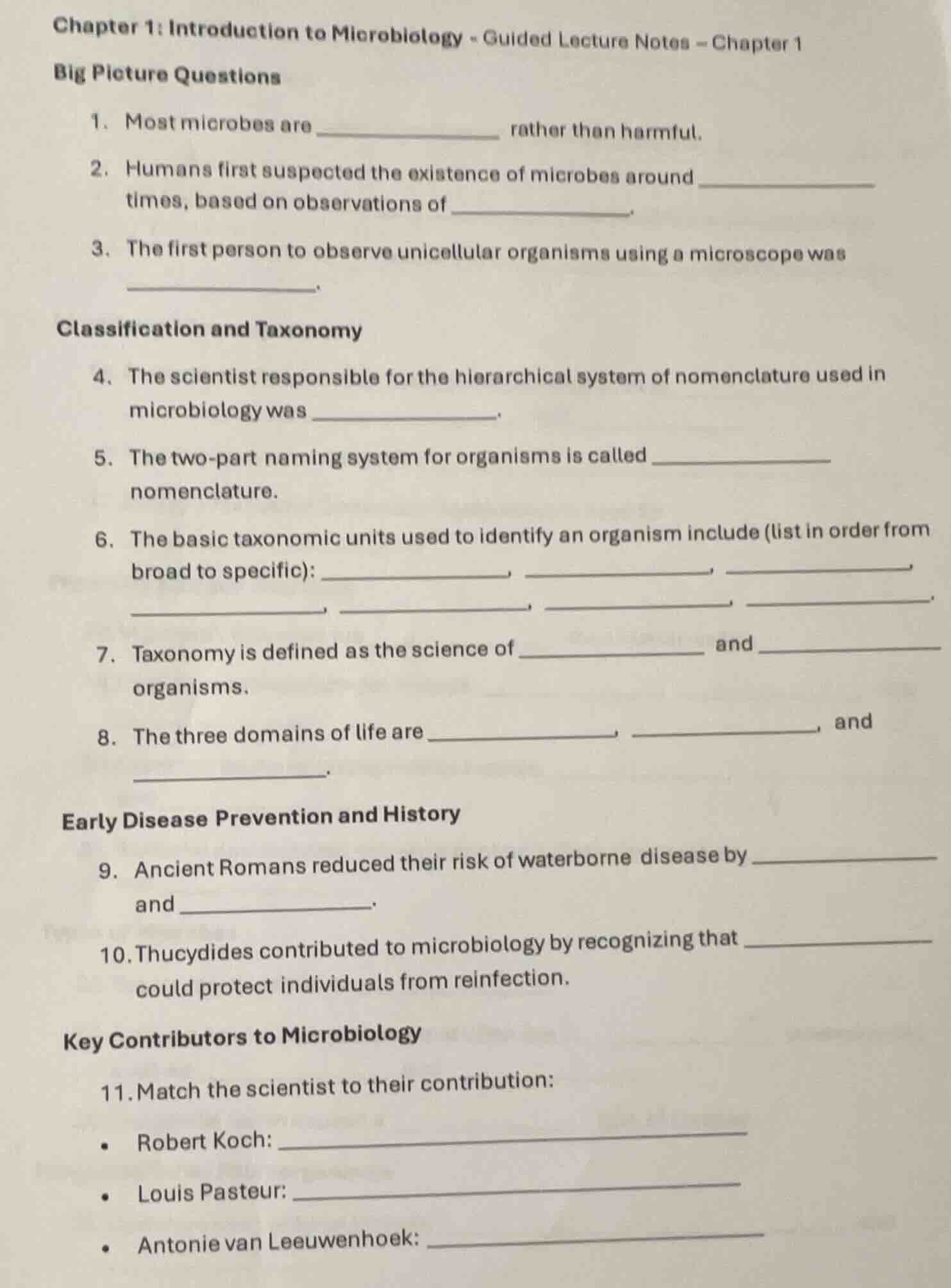
chapter 1: introduction to microbiology - guided lecture notes - chapter 1
big picture questions
- most microbes are ______________ rather than harmful.
- humans first suspected the existence of microbes around ____________ times, based on observations of ____________.
- the first person to observe unicellular organisms using a microscope was ______________.
classification and taxonomy
- the scientist responsible for the hierarchical system of nomenclature used in microbiology was ______________.
- the two - part naming system for organisms is called ______________ nomenclature.
- the basic taxonomic units used to identify an organism include (list in order from broad to specific): ____________, __________, __________, __________, __________, __________, ____________.
- taxonomy is defined as the science of ____________ and ____________ organisms.
- the three domains of life are ____________, __________, and ____________.
early disease prevention and history
- ancient romans reduced their risk of waterborne disease by ____________ and ____________.
- thucydides contributed to microbiology by recognizing that ______________ could protect individuals from reinfection.
key contributors to microbiology
- match the scientist to their contribution:
- robert koch: ______________
- louis pasteur: ______________
- antonie van leeuwenhoek: ______________
Brief Explanations
- Most microbes play beneficial roles like nutrient cycling or aiding digestion.
- Ancient scholars noticed spoilage/fermentation, hinting at unseen organisms.
- This scientist built simple microscopes to view "animalcules".
- This scientist established the standardized naming hierarchy for organisms.
- This two-part system uses genus and species names.
- Taxonomic ranks progress from the broadest group to the most specific individual organism.
- Taxonomy encompasses organizing and naming living things consistently.
- These three domains represent the highest level of biological classification, separating cellular life by key traits.
- Roman engineering focused on clean water access and waste removal.
- This early observation laid groundwork for the concept of immunity.
- Each scientist made a foundational, distinct contribution to microbiology: one proved germ theory, one disproved spontaneous generation, one was the first to observe microbes.

Snap & solve any problem in the app
Get step-by-step solutions on Sovi AI
Photo-based solutions with guided steps
Explore more problems and detailed explanations
- beneficial
- 500 BCE; spoilage/fermentation
- Antonie van Leeuwenhoek
- Carolus Linnaeus
- binomial
- Kingdom, Phylum, Class, Order, Family, Genus, Species
- classifying; naming
- Bacteria, Archaea, Eukarya
- building aqueducts; constructing sewage systems
- surviving a disease
11.
- Robert Koch: Developed postulates to prove germ theory of disease
- Louis Pasteur: Disproved spontaneous generation and created pasteurization
- Antonie van Leeuwenhoek: First to observe and document live microscopic organisms (animalcules)