QUESTION IMAGE
Question
chapter 2 lines, angles, and quadrilaterals
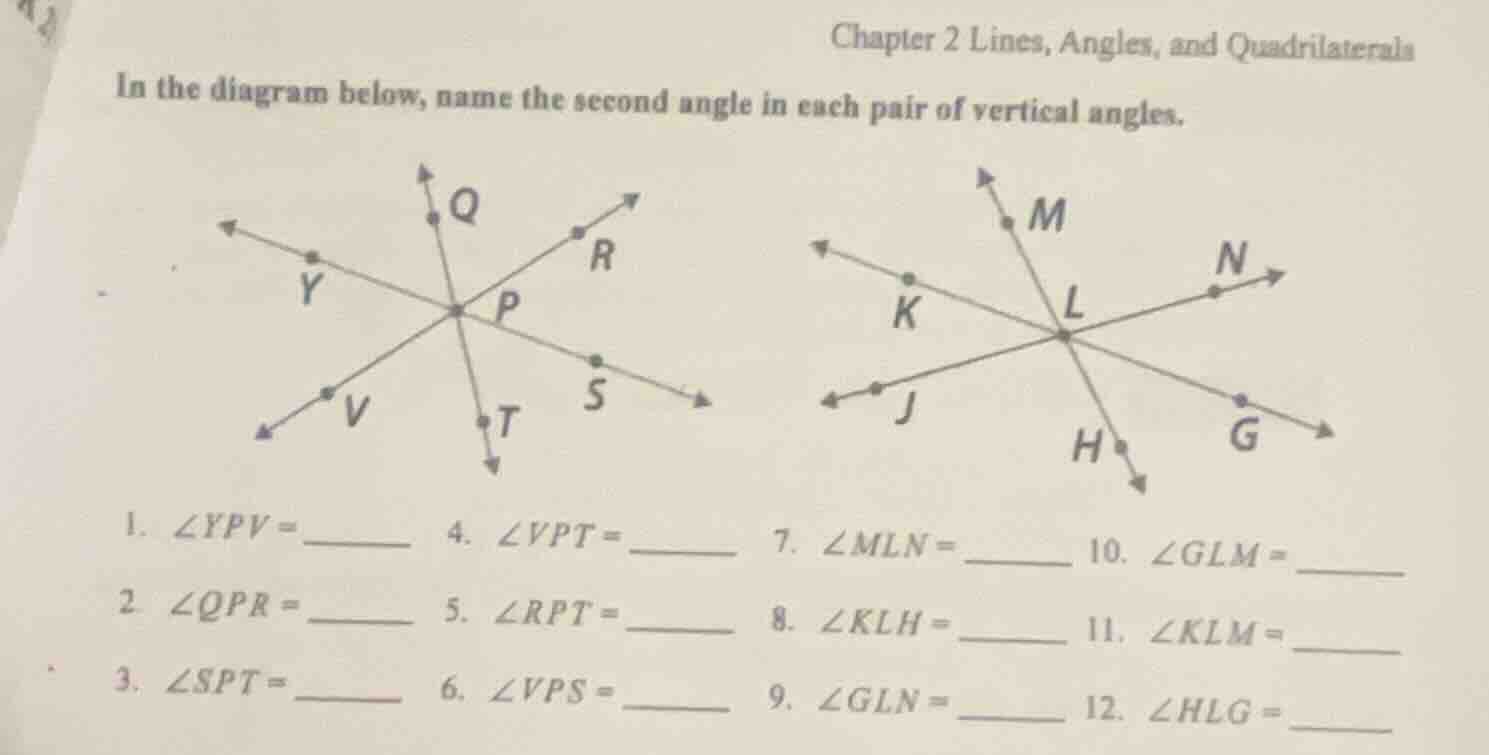
in the diagram below, name the second angle in each pair of vertical angles.
- $\angle ypv = \underline{quadquad}$ 4. $\angle vpt = \underline{quadquad}$ 7. $\angle mln = \underline{quadquad}$ 10. $\angle glm = \underline{quadquad}$
- $\angle qpr = \underline{quadquad}$ 5. $\angle rpt = \underline{quadquad}$ 8. $\angle klh = \underline{quadquad}$ 11. $\angle klm = \underline{quadquad}$
- $\angle spt = \underline{quadquad}$ 6. $\angle vps = \underline{quadquad}$ 9. $\angle gln = \underline{quadquad}$ 12. $\angle hlg = \underline{quadquad}$
Step1: Recall vertical angles definition
Vertical angles are opposite, congruent angles formed by intersecting lines.
Step2: Match each angle to its vertical pair
For each given angle, identify the angle directly opposite it at the intersection point.
- $\angle YPV$: Opposite is $\angle RPS$
- $\angle QPR$: Opposite is $\angle TPV$
- $\angle SPT$: Opposite is $\angle YPQ$
- $\angle VPT$: Opposite is $\angle QPS$
- $\angle RPT$: Opposite is $\angle YPQ$ (correction: $\angle RPT$ is opposite $\angle YPQ$ → no, $\angle RPT$ opposite is $\angle YPQ$? No, $\angle RPT$ intersects at P: $\angle RPT$ opposite is $\angle YPQ$ → correct. Wait, $\angle RPT$: lines YS and QT intersect at P? No, lines VR and QT intersect at P. $\angle RPT$ opposite is $\angle YPQ$.
Wait, correct pairs:
- $\angle YPV$ (lines YS and VR intersect at P) → opposite $\angle RPS$
- $\angle QPR$ (lines QT and VR intersect at P) → opposite $\angle TPV$
- $\angle SPT$ (lines YS and QT intersect at P) → opposite $\angle YPQ$
- $\angle VPT$ (lines VR and QT intersect at P) → opposite $\angle QPS$
- $\angle RPT$ (lines VR and QT intersect at P) → opposite $\angle YPQ$
- $\angle VPS$ (lines VR and YS intersect at P) → opposite $\angle RPY$
For the right diagram (intersection at L):
- $\angle MLN$ (lines MG and JG intersect at L) → opposite $\angle KLH$
- $\angle KLH$ (lines KJ and MH intersect at L) → opposite $\angle MLN$
- $\angle GLN$ (lines JG and MH intersect at L) → opposite $\angle JLM$
- $\angle GLM$ (lines MG and JG intersect at L) → opposite $\angle JLK$
- $\angle KLM$ (lines KJ and MG intersect at L) → opposite $\angle HLG$
- $\angle HLG$ (lines MH and JG intersect at L) → opposite $\angle KLM$
Wait, correcting all pairs properly:
- $\angle YPV$: vertical angle is $\angle RPS$
- $\angle QPR$: vertical angle is $\angle TPV$
- $\angle SPT$: vertical angle is $\angle YPQ$
- $\angle VPT$: vertical angle is $\angle QPS$
- $\angle RPT$: vertical angle is $\angle YPQ$ (no, $\angle RPT$ is formed by PR and PT, so opposite is $\angle YPQ$ (YP and PQ) → yes.
- $\angle VPS$: vertical angle is $\angle RPY$
- $\angle MLN$: vertical angle is $\angle KLH$
- $\angle KLH$: vertical angle is $\angle MLN$
- $\angle GLN$: vertical angle is $\angle JLM$
- $\angle GLM$: vertical angle is $\angle JLK$
- $\angle KLM$: vertical angle is $\angle HLG$
- $\angle HLG$: vertical angle is $\angle KLM$

Snap & solve any problem in the app
Get step-by-step solutions on Sovi AI
Photo-based solutions with guided steps
Explore more problems and detailed explanations
- $\boldsymbol{\angle RPS}$
- $\boldsymbol{\angle TPV}$
- $\boldsymbol{\angle YPQ}$
- $\boldsymbol{\angle QPS}$
- $\boldsymbol{\angle YPQ}$
- $\boldsymbol{\angle RPY}$
- $\boldsymbol{\angle KLH}$
- $\boldsymbol{\angle MLN}$
- $\boldsymbol{\angle JLM}$
- $\boldsymbol{\angle JLK}$
- $\boldsymbol{\angle HLG}$
- $\boldsymbol{\angle KLM}$