QUESTION IMAGE
Question
chapter 3: polynomials and polynomial functions
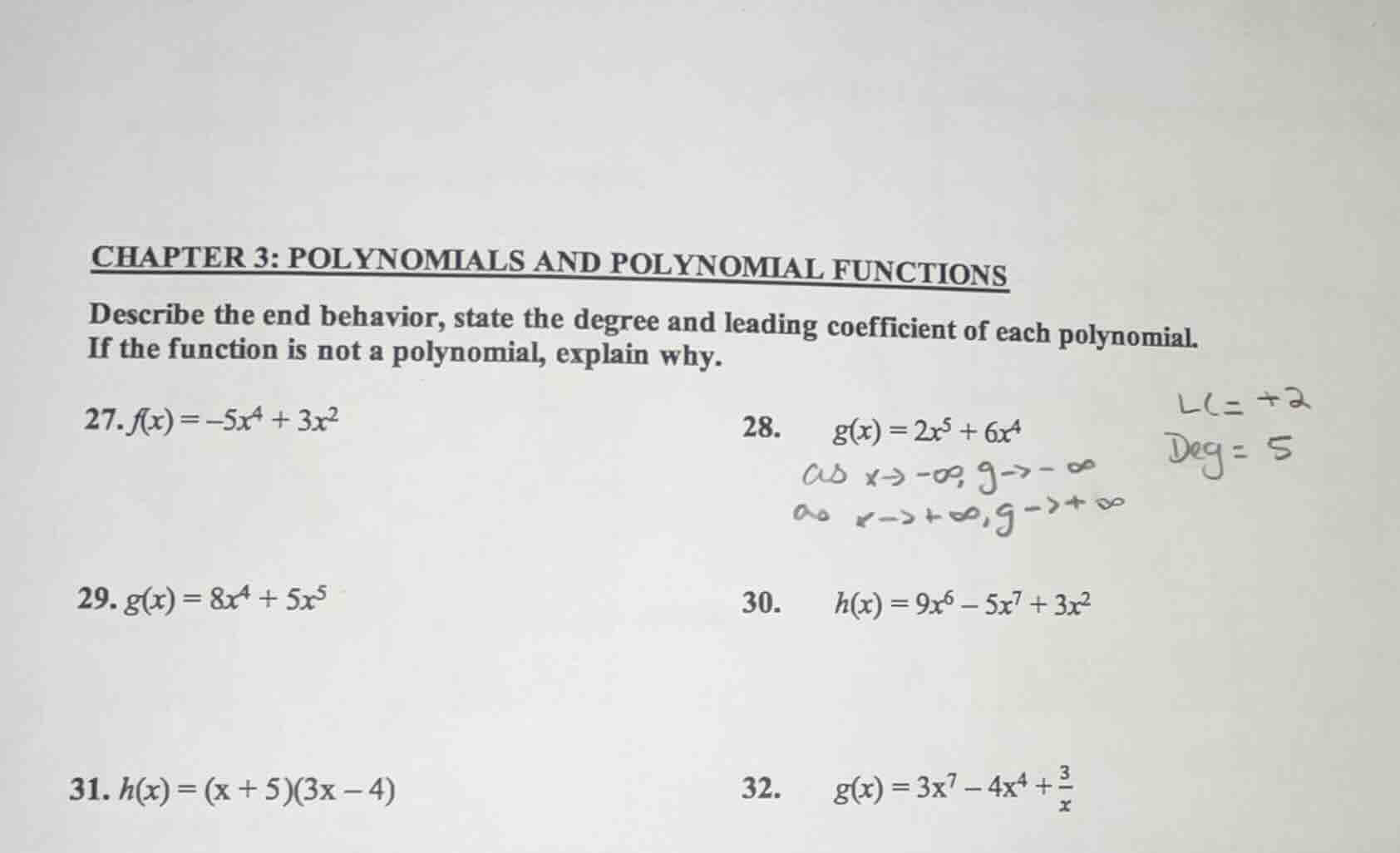
describe the end behavior, state the degree and leading coefficient of each polynomial.
if the function is not a polynomial, explain why.
- $f(x) = -5x^4 + 3x^2$
- $g(x) = 2x^5 + 6x^4$
- $g(x) = 8x^4 + 5x^5$
- $h(x) = 9x^6 - 5x^7 + 3x^2$
- $h(x) = (x + 5)(3x - 4)$
- $g(x) = 3x^7 - 4x^4 + \frac{3}{x}$
Let's solve problem 27: \( f(x) = -5x^4 + 3x^2 \)
Step 1: Identify the degree
The degree of a polynomial is the highest power of \( x \) with a non - zero coefficient. In \( f(x)=-5x^4 + 3x^2 \), the term \( -5x^4 \) has the highest power of \( x \) (power of 4) among the terms \( -5x^4 \) and \( 3x^2 \). So the degree of the polynomial is 4.
Step 2: Identify the leading coefficient
The leading coefficient is the coefficient of the term with the highest degree. For the term \( -5x^4 \), the coefficient is - 5. So the leading coefficient is - 5.
Step 3: Determine the end - behavior
For a polynomial \( f(x)=a_nx^n + a_{n - 1}x^{n - 1}+\cdots+a_1x + a_0 \), the end - behavior is determined by the degree \( n \) (even or odd) and the leading coefficient \( a_n \).
- If the degree \( n \) is even:
- If \( a_n>0 \), as \( x
ightarrow\infty \), \( f(x)
ightarrow\infty \) and as \( x
ightarrow-\infty \), \( f(x)
ightarrow\infty \).
- If \( a_n<0 \), as \( x
ightarrow\infty \), \( f(x)
ightarrow-\infty \) and as \( x
ightarrow-\infty \), \( f(x)
ightarrow-\infty \).
In our polynomial \( f(x)=-5x^4 + 3x^2 \), the degree \( n = 4 \) (even) and the leading coefficient \( a_n=-5<0 \). So as \( x
ightarrow\infty \), \( f(x)
ightarrow-\infty \) and as \( x
ightarrow-\infty \), \( f(x)
ightarrow-\infty \).
Step 1: Identify the degree
The degree of a polynomial is the highest power of \( x \) with a non - zero coefficient. In \( g(x) = 2x^5+6x^4 \), the term \( 2x^5 \) has the highest power of \( x \) (power of 5) among the terms \( 2x^5 \) and \( 6x^4 \). So the degree of the polynomial is 5.
Step 2: Identify the leading coefficient
The leading coefficient is the coefficient of the term with the highest degree. For the term \( 2x^5 \), the coefficient is 2. So the leading coefficient is 2.
Step 3: Determine the end - behavior
For a polynomial \( f(x)=a_nx^n + a_{n - 1}x^{n - 1}+\cdots+a_1x + a_0 \), the end - behavior is determined by the degree \( n \) (even or odd) and the leading coefficient \( a_n \).
- If the degree \( n \) is odd:
- If \( a_n>0 \), as \( x
ightarrow\infty \), \( f(x)
ightarrow\infty \) and as \( x
ightarrow-\infty \), \( f(x)
ightarrow-\infty \).
- If \( a_n<0 \), as \( x
ightarrow\infty \), \( f(x)
ightarrow-\infty \) and as \( x
ightarrow-\infty \), \( f(x)
ightarrow\infty \).
In our polynomial \( g(x)=2x^5 + 6x^4 \), the degree \( n = 5 \) (odd) and the leading coefficient \( a_n = 2>0 \). So as \( x
ightarrow\infty \), \( g(x)
ightarrow\infty \) and as \( x
ightarrow-\infty \), \( g(x)
ightarrow-\infty \).
Step 1: Identify the degree
The degree of a polynomial is the highest power of \( x \) with a non - zero coefficient. In \( g(x)=8x^4 + 5x^5 \), the term \( 5x^5 \) has the highest power of \( x \) (power of 5) among the terms \( 8x^4 \) and \( 5x^5 \). So the degree of the polynomial is 5.
Step 2: Identify the leading coefficient
The leading coefficient is the coefficient of the term with the highest degree. For the term \( 5x^5 \), the coefficient is 5. So the leading coefficient is 5.
Step 3: Determine the end - behavior
For a polynomial \( f(x)=a_nx^n + a_{n - 1}x^{n - 1}+\cdots+a_1x + a_0 \), the end - behavior is determined by the degree \( n \) (even or odd) and the leading coefficient \( a_n \).
- If the degree \( n \) is odd:
- If \( a_n>0 \), as \( x
ightarrow\infty \), \( f(x)
ightarrow\infty \) and as \( x
ightarrow-\infty \), \( f(x)
ightarrow-\infty \).
- If \( a_n<0 \), as \( x
ightarrow\infty \), \( f(x)
ightarrow-\infty \) and as \( x
ightarrow-\infty \), \( f(x)
ightarrow\infty \).
In our polynomial \( g(x)=8x^4 + 5x^5 \), the degree \( n = 5 \) (odd) and the leading coefficient \( a_n = 5>0 \). So as \( x
ightarrow\infty \), \( g(x)
ightarrow\infty \) and as \( x
ightarrow-\infty \), \( g(x)
ightarrow-\infty \).

Snap & solve any problem in the app
Get step-by-step solutions on Sovi AI
Photo-based solutions with guided steps
Explore more problems and detailed explanations
- Degree: 4
- Leading Coefficient: - 5
- End - behavior: As \( x
ightarrow\infty \), \( f(x)
ightarrow-\infty \); as \( x
ightarrow-\infty \), \( f(x)
ightarrow-\infty \)
Let's solve problem 28: \( g(x)=2x^5+6x^4 \)