QUESTION IMAGE
Question
chapter 1 quiz (1.1,1.2, 1.4, 1.5, 1.7)
14 points possible answered: 10/14
question 11
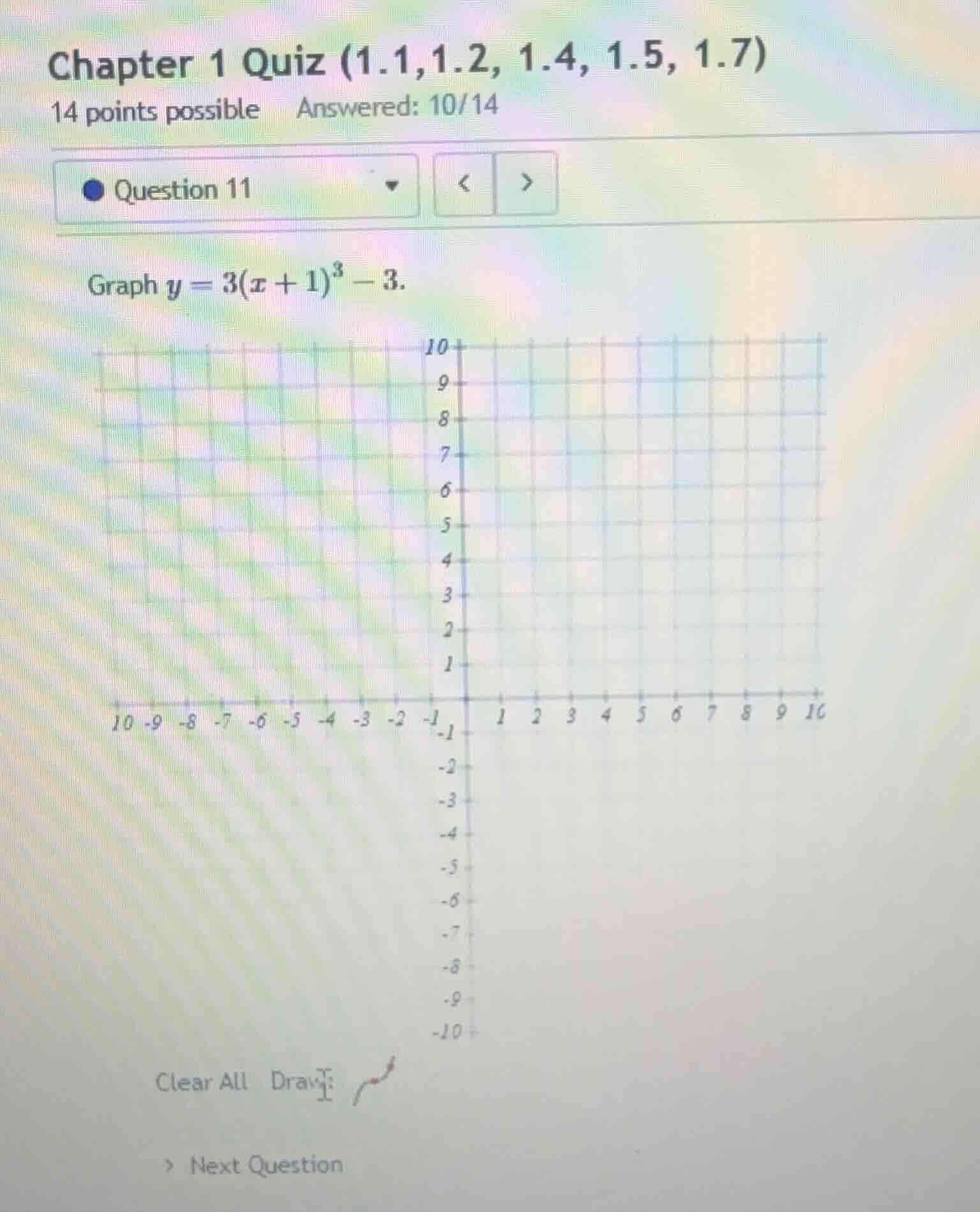
graph $y = 3(x + 1)^3 - 3$.
clear all draw
next question
Step1: Identify the parent function
The parent function of a cubic function is \( y = x^3 \). Its graph passes through the origin \((0,0)\), has a point of inflection at the origin, and increases from left to right.
Step2: Analyze the transformations
- Horizontal shift: The term \((x + 1)\) indicates a horizontal shift. The formula for horizontal shift is \( y = f(x - h) \), where \( h \) is the shift. Here, \( h=- 1 \), so the graph of \( y=x^{3}\) is shifted 1 unit to the left.
- Vertical stretch: The coefficient 3 in front of \((x + 1)^{3}\) is a vertical stretch. A vertical stretch by a factor of \( a>1\) makes the graph narrower. So the graph of \( y=(x + 1)^{3}\) is stretched vertically by a factor of 3.
- Vertical shift: The term \(-3\) at the end indicates a vertical shift. The formula for vertical shift is \( y=f(x)+k \), where \( k \) is the shift. Here, \( k =-3\), so the graph is shifted 3 units down.
Step3: Find key points
- For the parent function \( y = x^{3}\), when \( x = 0,y = 0\); when \( x=1,y = 1\); when \( x=- 1,y=-1\)
- After horizontal shift 1 unit left (\(x\to x + 1\)):
- When \(x+1=0\) (i.e., \(x=-1\)), \(y = 0\)
- When \(x + 1=1\) (i.e., \(x = 0\)), \(y=1\)
- When \(x + 1=-1\) (i.e., \(x=-2\)), \(y=-1\)
- After vertical stretch by factor 3 (\(y\to3y\)):
- When \(x=-1\), \(y=3\times0 = 0\)
- When \(x = 0\), \(y=3\times1=3\)
- When \(x=-2\), \(y=3\times(- 1)=-3\)
- After vertical shift 3 units down (\(y\to y-3\)):
- When \(x=-1\), \(y=0 - 3=-3\)
- When \(x = 0\), \(y=3-3 = 0\)
- When \(x=-2\), \(y=-3-3=-6\)
- Also, when \(x = 1\), \(x + 1=2\), \(y=3\times(2)^{3}-3=3\times8 - 3=24 - 3=21\)
- When \(x=-3\), \(x + 1=-2\), \(y=3\times(-2)^{3}-3=3\times(-8)-3=-24 - 3=-27\)
Step4: Plot the points and draw the graph
- Plot the points \((-3,-27)\), \((-2,-6)\), \((-1,-3)\), \((0,0)\), \((1,21)\)
- The graph should have a point of inflection at \((-1,-3)\), be increasing from left to right (since the leading coefficient of the cubic function \(y = 3(x + 1)^{3}-3=3x^{3}+9x^{2}+9x + 3-3=3x^{3}+9x^{2}+9x\) has a positive leading coefficient \(3>0\)), and show the effect of the vertical stretch (narrower than the parent function) and the horizontal and vertical shifts.
(Note: Since this is a text - based explanation, to actually draw the graph on the given grid, you would mark the key points we found and draw a smooth cubic curve passing through them, showing the left shift, vertical stretch, and down shift from the parent cubic function.)

Snap & solve any problem in the app
Get step-by-step solutions on Sovi AI
Photo-based solutions with guided steps
Explore more problems and detailed explanations
To graph \(y = 3(x + 1)^{3}-3\):
- Start with the parent cubic function \(y=x^{3}\), shift its graph 1 unit to the left, then stretch it vertically by a factor of 3, and then shift it 3 units down.
- Key points to plot: \((-3,-27)\), \((-2,-6)\), \((-1,-3)\), \((0,0)\), \((1,21)\) (and other appropriate points) and draw a smooth, increasing cubic curve through these points, with a point of inflection at \((-1,-3)\).